Brief Report - (2025) Volume 14, Issue 3
Received: 01-May-2025, Manuscript No. jtsm-26-179519;
Editor assigned: 05-May-2025, Pre QC No. P-179519;
Reviewed: 19-May-2025, QC No. Q-179519;
Revised: 22-May-2025, Manuscript No. R-179519;
Published:
29-May-2025
, DOI: 10.37421/2167-0919.2025.14.498
Citation: Romero, Isabel. ”Managing IoT Networks: Challenges and Advanced Solutions.” J Telecommun Syst Manage 14 (2025):498.
Copyright: © 2025 Romero I. This is an open-access article distributed under the terms of the Creative Commons Attribution License, which permits unrestricted use, distribution and reproduction in any medium, provided the original author and source are credited.
Managing the intricate Internet of Things (IoT) networks within telecommunications is paramount for ensuring efficient data flow, resource allocation, and service quality. This involves addressing challenges like device heterogeneity, massive scalability, security vulnerabilities, and real-time data processing. Effective management strategies focus on intelligent network slicing, advanced analytics for predictive maintenance, and robust security frameworks to safeguard sensitive data and prevent unauthorized access. The evolution towards 5G and future networks further amplifies the complexity, demanding dynamic and adaptive management approaches [1].
Security in IoT networks is a critical concern, especially in telecommunications where vast amounts of data are transmitted. This work highlights the need for multi-layered security approaches, including device-level authentication, secure communication protocols, and network-level intrusion detection systems. It emphasizes the importance of proactive security measures to counter emerging threats and ensure the integrity and confidentiality of IoT data within telecom infrastructure [2].
The integration of Artificial Intelligence (AI) and Machine Learning (ML) is transforming the management of IoT networks in telecommunications. This paper explores how AI/ML can be used for anomaly detection, predictive maintenance, resource optimization, and intelligent traffic management. The ability of these technologies to learn from network behavior and adapt in real-time is crucial for handling the dynamic nature of IoT traffic and ensuring high performance [3].
Edge computing plays a significant role in efficient IoT network management by bringing computation and data storage closer to the source of data generation. This reduces latency, conserves bandwidth, and enhances the responsiveness of IoT applications within telecom networks. The paper discusses architectural models and challenges associated with deploying edge intelligence for IoT services [4].
Scalability is a fundamental challenge in managing the ever-growing number of IoT devices in telecommunications. This research examines various architectural approaches and technologies, such as distributed ledgers and lightweight communication protocols, that can support massive IoT deployments. It highlights the importance of scalable infrastructure to handle the influx of data and connections [5].
Quality of Service (QoS) for IoT applications in telecommunications is critical. This paper discusses mechanisms for guaranteeing QoS in heterogeneous IoT environments, focusing on resource management, traffic prioritization, and network slicing. It addresses how to ensure that critical IoT services receive the necessary resources and performance levels [6].
The management of massive IoT devices presents significant challenges in terms of device discovery, connectivity, and data aggregation within telecommunications. This study proposes and evaluates new approaches for efficient device management in large-scale IoT deployments, focusing on distributed architectures and intelligent orchestration [7].
Ensuring energy efficiency in IoT networks is vital, especially for battery-powered devices and large-scale deployments in telecommunications. This paper reviews existing strategies and proposes novel approaches for energy-aware resource management, communication protocols, and data processing techniques to prolong the operational lifetime of IoT devices [8].
Network Function Virtualization (NFV) and Software-Defined Networking (SDN) are key enablers for the flexible and efficient management of future telecommunications networks, including IoT infrastructure. This research explores how NFV and SDN can be applied to create dynamic, programmable, and agile IoT network management systems, optimizing resource utilization and service delivery [9].
The challenges of managing diverse and dynamic IoT traffic within telecommunications necessitate advanced data analytics and processing capabilities. This paper investigates distributed and real-time data processing frameworks for IoT, focusing on techniques that can handle high-volume, high-velocity data streams for effective decision-making and network control [10].
The management of complex Internet of Things (IoT) networks in telecommunications is essential for optimizing data flow, resource distribution, and overall service quality. Key challenges include handling diverse device types, accommodating massive scalability, mitigating security threats, and processing real-time data streams. To address these, intelligent network slicing, predictive maintenance through advanced analytics, and robust security measures are crucial for protecting sensitive information and preventing unauthorized access. The advancement towards 5G and beyond further intensifies these complexities, requiring dynamic and adaptable management paradigms [1].
In the telecommunications sector, the security of IoT networks is a paramount concern due to the immense volume of data being transmitted. Implementing multi-layered security is imperative, encompassing device authentication, secure communication protocols, and network intrusion detection systems. Proactive security strategies are vital to combat evolving threats and maintain the confidentiality and integrity of IoT data within the telecommunications infrastructure [2].
Artificial Intelligence (AI) and Machine Learning (ML) are revolutionizing IoT network management in telecommunications. These technologies enable anomaly detection, predictive maintenance, resource optimization, and intelligent traffic handling. Their capacity for real-time learning and adaptation is critical for managing the dynamic nature of IoT traffic and ensuring high network performance [3].
Edge computing significantly enhances IoT network management in telecommunications by decentralizing computation and data storage closer to data sources. This approach reduces latency, conserves bandwidth, and improves the responsiveness of IoT applications. Architectural models and deployment challenges for edge intelligence in IoT services are discussed [4].
A fundamental hurdle in telecommunications IoT management is scalability, driven by the exponential growth in connected devices. This research surveys architectural solutions and technologies, such as distributed ledgers and efficient communication protocols, designed to support massive IoT deployments. The necessity of scalable infrastructure for managing data and connections is emphasized [5].
Ensuring Quality of Service (QoS) for IoT applications within telecommunications is a critical requirement. This paper examines methods for guaranteeing QoS in heterogeneous IoT environments, focusing on resource allocation, traffic prioritization, and network slicing to ensure that vital IoT services receive adequate resources and performance [6].
Managing vast numbers of IoT devices, including their discovery, connectivity, and data aggregation, poses substantial challenges in telecommunications. This study evaluates novel approaches for efficient device management in large-scale IoT deployments, emphasizing distributed architectures and intelligent orchestration techniques [7].
Energy efficiency is a vital consideration for IoT networks, particularly for battery-operated devices and extensive deployments in telecommunications. This paper reviews current strategies and proposes new methods for energy-aware resource management, communication protocols, and data processing to extend the operational lifespan of IoT devices [8].
Network Function Virtualization (NFV) and Software-Defined Networking (SDN) are instrumental in achieving flexible and efficient management of telecommunications networks, including IoT infrastructure. This research investigates how NFV and SDN can facilitate dynamic, programmable, and agile IoT network management systems for optimized resource utilization and service delivery [9].
The dynamic and diverse nature of IoT traffic in telecommunications demands sophisticated data analytics and processing. This paper explores distributed and real-time data processing frameworks designed for IoT, focusing on techniques capable of managing high-volume, high-velocity data streams to support effective decision-making and network control [10].
Managing Internet of Things (IoT) networks in telecommunications presents significant challenges related to device heterogeneity, scalability, security, and real-time data processing. Solutions involve intelligent network slicing, advanced analytics, and robust security frameworks. Technologies like AI/ML and edge computing are transforming management capabilities, while scalability, Quality of Service (QoS), and energy efficiency remain critical considerations. Network Function Virtualization (NFV) and Software-Defined Networking (SDN) offer flexible management approaches, and advanced data analytics are essential for handling the high volume and velocity of IoT data.
None
None
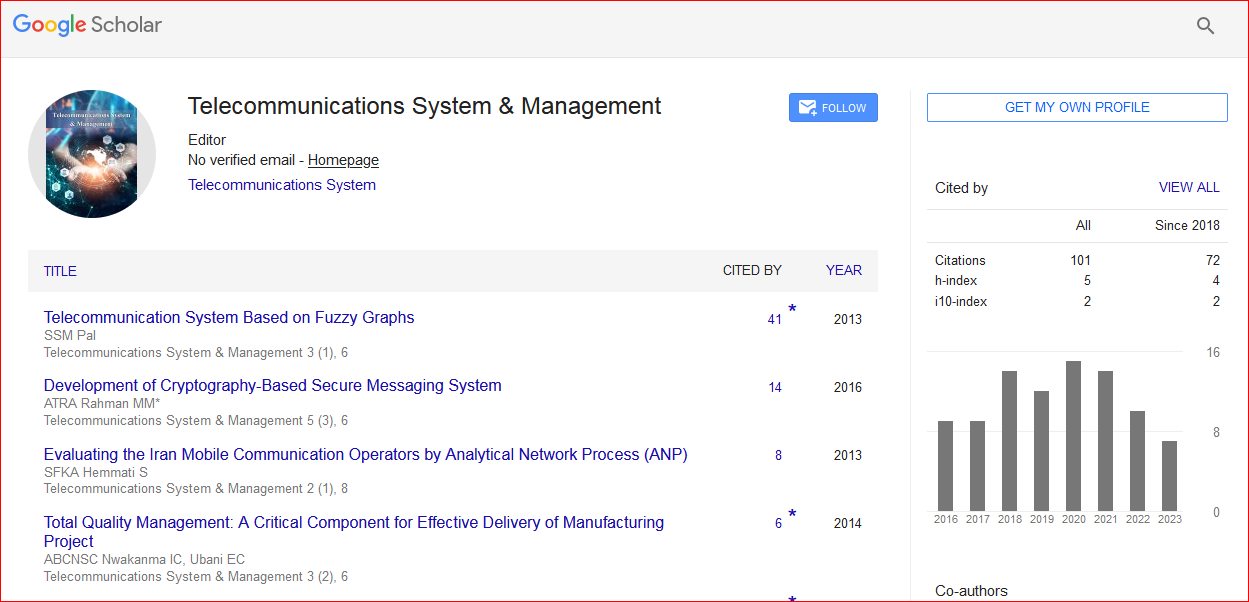
Telecommunications System & Management received 109 citations as per Google Scholar report