Brief Report - (2025) Volume 11, Issue 4
Received: 01-Jul-2025, Manuscript No. ohcr-25-174290;
Editor assigned: 03-Jul-2025, Pre QC No. P-174290;
Reviewed: 17-Jul-2025, QC No. Q-174290;
Revised: 22-Jul-2025, Manuscript No. R-174290;
Published:
29-Jul-2025
, DOI: 10.37421/2471-8726.2025.11.203
Citation: Simmons, Rebecca. ”Managing Complications Across Dental Specialties.” Oral Health Case Rep 11 (2025):203.
Copyright: © 2025 Simmons R. This is an open-access article distributed under the terms of the Creative Commons Attribution License, which permits unrestricted use, distribution and reproduction in any medium, provided the original author and source are credited.
The ongoing evolution of dental practice necessitates a keen understanding of potential complications across various disciplines. For example, recent studies offer critical insights into the common complications observed following tooth extraction within a primary care setting. This research thoroughly details the prevalence and specific characteristics of these issues, which fundamentally helps dental professionals better anticipate and manage post-operative patient experiences. What this really means is that a deeper understanding of these prevalent issues becomes crucial for consistently enhancing patient care and significantly improving recovery outcomes, thereby fostering greater patient satisfaction and long-term oral health [1].
Likewise, a comprehensive review systematically outlines the diverse complications associated with modern dental implants. These range from significant biological challenges, such as the inflammatory condition known as peri-implantitis, to various mechanical failures that can compromise implant integrity. The findings from this review profoundly underscore the vital role of thorough pre-operative assessment and the application of meticulous surgical and prosthetic techniques. These steps are essential for minimizing potential risks during and after implant placement and are key to ensuring the long-term longevity and success of the implants for patients [2].
Endodontic treatments, commonly known as root canal therapies, also present their own set of frequently encountered challenges. A scoping review meticulously delves into these complications, highlighting common procedural errors, the unfortunate event of instrument separation within the root canal, and often the persistent concern of post-operative pain. The review provides a clear overview of practical strategies for both preventing these issues from arising and effectively managing them when they do occur. Ultimately, the goal here is to substantially improve the success rates of root canal therapies, leading to more predictable outcomes and significantly enhancing patient comfort throughout their treatment journey [3].
Orthodontic treatment, while aimed at correcting dental misalignments and improving oral function and aesthetics, can regrettably give rise to various complications. A comprehensive review thoroughly explores these potential issues, which include concerning problems like root resorption, the detrimental enamel demineralization, and instances of soft tissue irritation. The review carefully examines the underlying risk factors involved in these complications and, importantly, outlines a range of effective preventive measures that can be adopted. The overall aim is to ensure both safe and effective orthodontic outcomes, thereby protecting patients' long-term dental health while they undergo treatment [4].
Shifting focus to a particularly vulnerable population, dental trauma in children presents specific and often complex challenges. An important article meticulously details the common types of injuries observed, their immediate consequences, and critically, the potential long-term complications that can affect a childâ??s developing dentition. It also outlines essential management strategies for these incidents. The piece emphatically stresses that early and appropriate intervention is absolutely critical for minimizing adverse outcomes and plays a pivotal role in preserving a child's dental health and ensuring their proper oral development into adulthood [5].
Beyond localized dental issues, the systemic implications of oral health conditions are increasingly recognized as profoundly significant. A review sheds crucial light on the systemic implications of periodontitis, a common gum disease, establishing clear and compelling links between chronic oral inflammation and a variety of serious systemic health conditions. These conditions notably include cardiovascular diseases, diabetes, and adverse pregnancy outcomes. This truly underscores the critical importance of maintaining good periodontal health not just for oral well-being but as a fundamental and integrated component of overall systemic health [6].
Even routine procedures such as the administration of local anesthesia in dental practice carry their own set of potential complications. A meticulous review details a wide range of issues that can arise, from acute systemic reactions and various localized side effects at the injection site to the more severe possibility of nerve injuries. This article emphasizes the crucial role of employing proper administration techniques and conducting thorough patient assessment prior to any procedure. Such diligent practices are paramount in minimizing these potential risks and, above all, ensuring the utmost patient safety during dental treatments [7].
Oral and maxillofacial surgery, a specialized area of dentistry, also encounters its own unique spectrum of common complications. These frequently include concerns like post-operative infection, unexpected hemorrhage, and potential nerve damage, which can have significant patient impact. A comprehensive review in this field provides invaluable practical insights into their effective management. It strongly emphasizes the absolute necessity of careful pre-operative planning and precise surgical execution as foundational elements to achieve optimal patient outcomes and minimize risks in complex surgical procedures [8].
Fixed prosthodontics, a cornerstone of restorative dentistry, is not immune to challenges. A narrative review discusses the various complications associated with these dental restorations, covering issues such as porcelain fracture, the detachment of restorations (debonding), and the development of secondary caries around the margins of the restoration. This review sheds important light on the multitude of factors that contribute to these failures and, critically, offers strategic approaches for improving the longevity and overall success of dental restorations. This aspect is profoundly important for ensuring long-term patient care and satisfaction [9].
Lastly, comprehensive dental care must extend to managing patients with complex medical histories. One review specifically addresses the essential dental considerations necessary for patients undergoing anticoagulant therapy, focusing on their heightened risk of bleeding complications during various dental procedures. It provides clear, actionable guidance on safely managing these patients, crucially emphasizing the critical role of interprofessional collaboration between dental practitioners and other healthcare providers. This collaboration is key to achieving the best possible health outcomes for this patient group, minimizing risks, and ensuring continuity of care [10].
Dental practice, while focused on enhancing oral health, frequently encounters a spectrum of complications arising from various treatments and conditions. For instance, common complications after tooth extraction in primary care settings, including their prevalence and characteristics, are crucial for effective post-operative management and improved patient recovery [C001]. Similarly, the field of oral and maxillofacial surgery faces its own set of challenges, often dealing with concerns such as infection, hemorrhage, and nerve damage. Careful pre-operative planning and precise surgical execution are emphasized as vital for managing these issues and achieving optimal patient outcomes [C008].
In restorative dentistry, the longevity and success of interventions like dental implants and fixed prosthodontics are paramount, yet they are susceptible to diverse complications. Dental implants can suffer from biological issues like peri-implantitis or mechanical failures, highlighting the necessity for thorough pre-operative assessment and meticulous surgical and prosthetic techniques to minimize risks [C002]. Fixed prosthodontics, including crowns and bridges, frequently encounter problems such as porcelain fracture, debonding, and secondary caries. Understanding the factors contributing to these failures is key to developing strategic approaches for improving the overall success and durability of restorations, essential for long-term patient care [C009].
Specialized dental treatments like endodontics and orthodontics also present their unique sets of complications. Endodontic treatment, primarily root canal therapy, often involves procedural errors, instrument separation, and post-operative pain. Effective strategies for prevention and management are vital for enhancing treatment success rates and patient comfort [C003]. Orthodontic treatment, aimed at correcting dental alignments, can lead to issues such as root resorption, enamel demineralization, and soft tissue irritation. Identifying associated risk factors and implementing preventive measures are important steps to ensure safe and effective outcomes for patients [C004].
Specific patient groups or broader health contexts introduce additional layers of complexity. Dental trauma in children, for instance, requires particular attention, detailing common injury types, their immediate and long-term complications, and critical management strategies. Prompt and appropriate intervention is stressed as crucial for minimizing adverse outcomes and preserving a child's dental health [C005]. Furthermore, the systemic implications of oral conditions are gaining increasing recognition. Periodontitis, an inflammatory gum disease, has established links to systemic health conditions like cardiovascular diseases, diabetes, and adverse pregnancy outcomes, emphasizing the fundamental role of good periodontal health in overall well-being [C006].
Even foundational aspects of dental care, such as local anesthesia, carry potential risks. Complications can range from systemic reactions and localized side effects to nerve injuries, underscoring the necessity of proper administration techniques and thorough patient assessment to minimize risks and ensure safety [C007]. For medically complex patients, specifically those on anticoagulant therapy, dental considerations are heightened due to an increased risk of bleeding complications during procedures. Clear guidance on safe management and strong interprofessional collaboration are critical to achieving optimal health outcomes for these patients [C010]. These collective insights across dental specialties reinforce the constant need for vigilance, advanced planning, and ongoing professional development to navigate the intricate challenges of modern dental care.
Across various dental specialties, understanding and managing complications is central to effective patient care. Research highlights common issues after tooth extraction, detailing their prevalence and characteristics to improve post-operative management and recovery. Similarly, dental implants face complications like peri-implantitis and mechanical failures, emphasizing the need for meticulous assessment and technique for longevity. Endodontic treatments encounter procedural errors, instrument separation, and post-operative pain, requiring robust prevention and management strategies to enhance success. Orthodontic care can lead to root resorption and enamel demineralization, necessitating a focus on risk factors and preventive measures for safe outcomes. Dental trauma in children, with its immediate and long-term complications, demands early intervention to preserve dental health. The systemic impact of periodontitis links oral inflammation to conditions like cardiovascular disease and diabetes, underscoring the importance of periodontal health. Local anesthesia, while routine, can cause systemic reactions or nerve injuries, highlighting the need for proper administration and patient assessment. Oral and maxillofacial surgery involves risks like infection, hemorrhage, and nerve damage, stressing careful pre-operative planning. Fixed prosthodontics face porcelain fracture and secondary caries, requiring strategies to improve restoration longevity. Finally, managing patients on anticoagulant therapy requires specific dental considerations to mitigate bleeding risks through interprofessional collaboration. These insights collectively inform best practices for minimizing adverse events and optimizing patient well-being across all dental disciplines.
None
None
1. Yousef S, Hajar A, Huda A. "Prevalence of post-extraction complications in primary care dental practice: A retrospective study".J Clin Exp Dent 15 (2023):e190-e196.
Indexed at, Google Scholar, Crossref
2. Majed A, Yazeed Q, Majed A. "Complications of Dental Implants: A Comprehensive Review".Cureus 16 (2024):e55294.
Indexed at, Google Scholar, Crossref
3. Vikram S, Arshdeep PS, Navjot S. "Common Complications in Endodontic Treatment: A Scoping Review".J Contemp Dent Pract 24 (2023):206-211.
Indexed at, Google Scholar, Crossref
4. Abdullah AA, Mohammed A, Sarah A. "Common Complications of Orthodontic Treatment: A Comprehensive Review".Cureus 16 (2024):e53180.
Indexed at, Google Scholar, Crossref
5. Abdullah A, Abdulaziz A, Badr A. "Dental trauma in children: Management and complications".J Family Community Med 30 (2023):238-245.
Indexed at, Google Scholar, Crossref
6. Farida K, Mariam A, Ali A. "Systemic implications of periodontitis: A review".Cureus 15 (2023):e49174.
Indexed at, Google Scholar, Crossref
7. Saad A, Khaleed A, Meshal A. "Complications Associated with Local Anesthesia in Dentistry: A Review".Cureus 15 (2023):e48906.
Indexed at, Google Scholar, Crossref
8. Abdulrahman A, Abdulaziz A, Mohammed A. "Common Complications of Oral and Maxillofacial Surgery: A Comprehensive Review".Cureus 16 (2024):e52097.
Indexed at, Google Scholar, Crossref
9. Zainab A, Rawan A, Huda A. "Complications of Fixed Prosthodontics: A Narrative Review".J Clin Exp Dent 15 (2023):e202-e209.
Indexed at, Google Scholar, Crossref
10. Omar A, Reem A, Reem A. "Dental Considerations for Patients on Anticoagulants: A Review".Cureus 15 (2023):e50529.
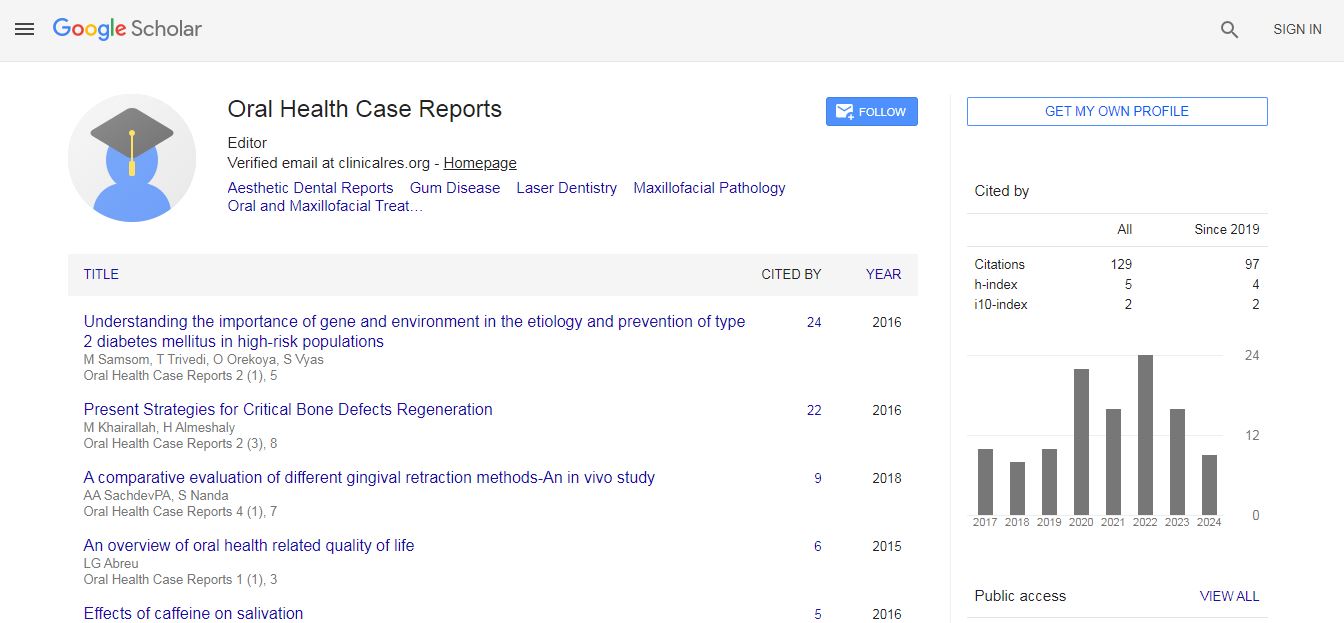
Oral Health Case Reports received 120 citations as per Google Scholar report