Commentary - (2025) Volume 14, Issue 4
Received: 01-Jul-2025, Manuscript No. mcce-26-190181;
Editor assigned: 03-Jul-2025, Pre QC No. P-190181;
Reviewed: 17-Jul-2025, QC No. Q-190181;
Revised: 22-Jul-2025, Manuscript No. R-190181;
Published:
29-Jul-2025
, DOI: 10.37421/2470-6965.2025.14.415
Citation: Dubois, Marie. ”Malaria Vaccines: A New Hope For Elimination.” Malar Contr Elimination 14 (2025):415.
Copyright: © 2025 Dubois M. This is an open-access article distributed under the terms of the Creative Commons Attribution License, which permits unrestricted use, distribution and reproduction in any medium, provided the original author and source are credited.
The development of malaria vaccines represents a monumental step forward in the global fight against this persistent and devastating disease. For decades, malaria control has relied on a combination of vector control, chemoprevention, and prompt diagnosis and treatment, but the introduction of effective vaccines offers a powerful new tool to augment these efforts and potentially accelerate progress towards elimination [1].
The landscape of malaria vaccine development has seen significant advancements in recent years, with two leading candidates, RTS,S/AS01 and R21/Matrix-M, demonstrating promising efficacy in clinical trials [1].
These vaccines primarily target the Plasmodium falciparum circumsporozoite protein, a key component of the parasite's pre-erythrocytic stage, thereby aiming to prevent infection before it can take hold and cause severe illness [1].
The R21/Matrix-M vaccine, in particular, has emerged as a highly promising candidate, exhibiting high efficacy in preventing malaria in children and meeting the World Health Organization's target of over 75% efficacy [2].
Its favorable safety profile and the potential for cost-effective, large-scale manufacturing present a significant opportunity to expand vaccine access, especially in malaria-endemic regions where the disease burden is highest [2].
Understanding the intricate immune responses elicited by malaria vaccines is paramount for optimizing their current effectiveness and for the rational design of next-generation vaccines [3].
Research is actively investigating the contributions of both antibody-mediated and cellular immunity in conferring protection against Plasmodium falciparum infection, with the goal of enhancing vaccine durability and broadening the spectrum of protection [3].
The successful implementation of malaria vaccines into public health systems requires careful consideration of various factors beyond mere efficacy [4].
Strategies for vaccine delivery, fostering public acceptance, and seamless integration into existing healthcare infrastructure are crucial for maximizing their impact and ensuring equitable access for all vulnerable populations [4].
As the field progresses, ongoing research is continually focused on improving the efficacy and broadening the spectrum of protection offered by malaria vaccines [5].
This includes exploring novel antigenic targets, investigating alternative delivery platforms, and developing combination strategies with other established malaria control measures to achieve sustained reductions in disease transmission and incidence [5].
The impact of these novel vaccines on comprehensive malaria control programs is a critical area of ongoing evaluation [6].
While vaccines are undeniably a powerful new weapon, their optimal deployment in conjunction with long-standing interventions such as insecticide-treated bed nets, indoor residual spraying, and prompt diagnosis and treatment remains essential for achieving ambitious malaria elimination goals [6].
A significant hurdle in malaria vaccine development has been the Plasmodium falciparum parasite's remarkable capacity for antigenic variation, which allows it to evade host immune responses [7].
Consequently, current research is exploring vaccine candidates that target conserved epitopes or multiple antigens to overcome these sophisticated immune evasion strategies employed by the parasite [7].
The substantial economic burden of malaria, particularly in sub-Saharan Africa, underscores the profound public health and economic benefits that effective vaccines can deliver [8].
By significantly reducing the disease burden, these vaccines are expected to lead to improved health outcomes and enhanced economic productivity in affected regions [8].
The World Health Organization's recommendation for the R21/Matrix-M vaccine, following its earlier endorsement of the RTS,S vaccine, marks a major milestone, offering expanded options for malaria prevention, especially for the most vulnerable populations [9].
The development of malaria vaccines signifies a critical turning point in the global strategy to combat this pervasive disease. Leading candidates such as RTS,S/AS01 and R21/Matrix-M have demonstrated considerable promise in clinical trials, particularly in safeguarding young children who disproportionately bear the brunt of malaria's impact. These vaccines are designed to target the Plasmodium falciparum circumsporozoite protein, a crucial element in the parasite's early life cycle, thereby providing a novel tool to complement established malaria control initiatives and potentially reshape disease prevention efforts towards elimination [1].
The R21/Matrix-M vaccine has distinguished itself by achieving high efficacy in preventing malaria among children, successfully meeting the World Health Organization's benchmark of over 75% efficacy. Furthermore, its advantageous safety profile, coupled with the feasibility of large-scale, cost-effective manufacturing, presents a significant opportunity to broaden vaccine accessibility, especially within endemic areas. The integration of this vaccine is poised to further accelerate the progress toward eradicating malaria [2].
A deeper understanding of the immune responses generated by malaria vaccines is fundamental to enhancing their efficacy and to guiding the development of future vaccine generations. Current research endeavors are focused on elucidating the roles of both antibody and cellular immunity in providing protection against Plasmodium falciparum infection, aiming to bolster vaccine durability and broaden the scope of protection [3].
The effective deployment of malaria vaccines necessitates a thorough consideration of various implementation aspects, including delivery mechanisms, public engagement, and integration into existing healthcare systems. Addressing vaccine hesitancy and ensuring equitable access are paramount to maximizing the public health advantages offered by these groundbreaking interventions [4].
Ongoing scientific efforts are dedicated to refining the efficacy and expanding the breadth of protection offered by malaria vaccines. This pursuit involves exploring novel antigenic targets, investigating alternative vaccine delivery platforms, and devising combination strategies with other malaria control measures to achieve sustained reductions in malaria transmission and incidence rates [5].
The effect of malaria vaccines on the broader landscape of malaria control programs is a subject of continuous assessment. While vaccines represent a potent new intervention, their optimal utilization in conjunction with existing strategies such as insecticide-treated bed nets, indoor residual spraying, and prompt diagnostic and treatment protocols is crucial for achieving ambitious malaria elimination objectives [6].
One of the persistent challenges in developing effective malaria vaccines has been the Plasmodium falciparum parasite's sophisticated ability to undergo antigenic variation, which complicates the host's immune response. Consequently, research is actively exploring vaccine candidates designed to target conserved epitopes or multiple antigens to overcome the parasite's mechanisms of immune evasion [7].
The considerable economic burden imposed by malaria, particularly in sub-Saharan Africa, highlights the significant potential for vaccines to alleviate this impact. The introduction of effective vaccines is anticipated to substantially reduce the disease burden, leading to improved health outcomes and enhanced economic productivity in affected regions [8].
The World Health Organization's recent recommendation for the R21/Matrix-M malaria vaccine, following its prior endorsement of the RTS,S vaccine, marks a significant milestone in malaria prevention efforts. This dual recommendation provides expanded options for protective measures, particularly for vulnerable populations [9].
Long-term studies on the effectiveness and the impact of malaria vaccines on disease transmission are vital areas of ongoing research. Real-world effectiveness evaluations are indispensable for understanding how these vaccines perform across diverse geographical and epidemiological settings and over extended durations [10].
Malaria vaccines, such as RTS,S/AS01 and R21/Matrix-M, represent a significant advancement in combating the disease, showing promising efficacy, especially in children. The R21/Matrix-M vaccine, with high efficacy and potential for cost-effective manufacturing, aims to increase access in endemic regions. Research is focused on understanding immune responses, optimizing vaccine effectiveness, and overcoming parasitic evasion strategies. Successful implementation requires attention to delivery, public acceptance, and integration into health systems. These vaccines are expected to significantly reduce the economic and health burdens of malaria, complementing existing control measures to achieve elimination goals.
None
None
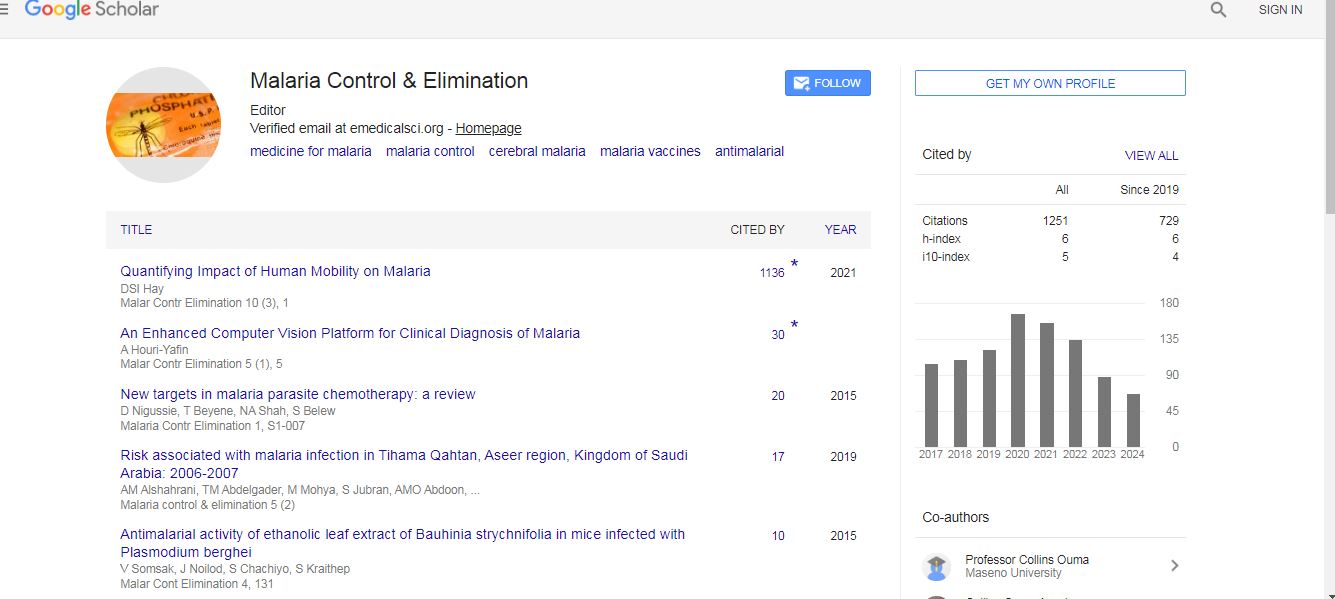
Malaria Control & Elimination received 1187 citations as per Google Scholar report