Commentary - (2026) Volume 16, Issue 1
Received: 01-Jan-2026, Manuscript No. jnt-26-191273;
Editor assigned: 05-Jan-2026, Pre QC No. P-191273;
Reviewed: 19-Jan-2026, QC No. Q-191273;
Revised: 22-Jan-2026, Manuscript No. R-191273;
Published:
29-Jan-2026
, DOI: 10.37421/2161-0959.2026.16.606
Citation: Laurent, Sophia. ”Machine Learning Advances Kidney Disease Prediction and Treatment.” J Nephrol Ther 16 (2026):606.
Copyright: © 2026 Laurent S. This is an open-access article distributed under the terms of the Creative Commons Attribution License, which permits unrestricted use, distribution and reproduction in any medium, provided the original author and source are credited.
Machine learning models are revolutionizing the prediction of kidney disease outcomes, offering unprecedented capabilities in analyzing complex patient data to identify individuals at high risk of disease progression [1].
These advanced models can process a wide array of information, encompassing clinical markers, genetic predispositions, and lifestyle factors, enabling early detection of potential adverse events such as end-stage renal disease [1].
The ability to identify at-risk individuals promptly allows for the implementation of timely interventions and the development of personalized treatment strategies, ultimately enhancing patient prognosis and potentially reducing overall healthcare expenditures [1].
Deep learning approaches, specifically Convolutional Neural Networks (CNNs) and Recurrent Neural Networks (RNNs), are showing significant promise in improving the accuracy of predicting kidney disease progression by analyzing medical images like renal ultrasound and histopathology slides [2].
These sophisticated techniques possess the remarkable ability to discern subtle patterns that may elude human observation, thereby facilitating earlier and more precise diagnoses of various kidney pathologies [2].
The application of ensemble methods, which strategically combine multiple machine learning models, consistently leads to enhanced predictive performance in assessing kidney disease outcomes [3].
By aggregating predictions from a diverse range of algorithms, these ensemble techniques effectively mitigate variance and bias, thereby bolstering the robustness and reliability of predictions, particularly within complex clinical scenarios [3].
Explainable Artificial Intelligence (XAI) is emerging as a critical component for the successful clinical integration of machine learning in nephrology [4].
The capacity to understand the underlying rationale behind model predictions, including the identification of the most influential clinical features, is paramount for fostering trust among clinicians [4].
This transparency allows healthcare professionals to validate the model's outputs, thereby ensuring patient safety and supporting informed decision-making processes [4].
The integration of multi-omics data, encompassing genomics, proteomics, and metabolomics, with machine learning models provides a more holistic and comprehensive understanding of kidney disease pathogenesis [5].
This integrated approach holds the potential to uncover novel biomarkers and identify new therapeutic targets, paving the way for more precise risk stratification and the development of highly personalized treatment plans [5].
Federated learning is emerging as a highly promising solution for training machine learning models on decentralized kidney disease data distributed across multiple institutions, all while rigorously safeguarding patient privacy [6].
This innovative approach permits the development of more generalizable and robust models by effectively leveraging the collective power of larger and more diverse datasets, without the need for data centralization [6].
Reinforcement learning (RL) presents a powerful framework for optimizing treatment strategies tailored for patients suffering from chronic kidney disease (CKD) [7].
By continuously learning from patient responses to various interventions, RL algorithms can dynamically develop personalized treatment policies that adapt to the evolving needs of individual patients, thereby improving long-term health outcomes [7].
The development of accurate and dependable predictive models for kidney transplant outcomes is a crucial endeavor for enhancing graft survival rates and significantly improving the quality of life for transplant recipients [8].
Machine learning models are adept at evaluating complex donor-recipient matching criteria and accurately predicting the likelihood of post-transplant complications [8].
Natural Language Processing (NLP) techniques offer a valuable means to extract critical information from unstructured clinical notes, such as physician narratives and patient histories, thereby substantially enhancing the accuracy of kidney disease risk prediction [9].
NLP empowers the incorporation of qualitative data into quantitative models, providing a more nuanced and comprehensive understanding of individual patient profiles [9].
Transfer learning, a technique where models trained on one dataset are repurposed for a related but distinct task, proves highly beneficial for kidney disease outcome prediction, particularly in clinical settings where labeled data is scarce [10].
This methodology enables the creation of accurate predictive models by leveraging the knowledge acquired from larger, pre-existing datasets, thus overcoming data limitations [10].
Machine learning models are demonstrating significant potential in predicting the future trajectory of kidney disease, offering a sophisticated approach to analyzing intricate patient data [1].
These models are capable of integrating diverse data types, including established clinical markers, genetic information, and lifestyle factors, to pinpoint individuals who are at a heightened risk of progressing towards end-stage renal disease or experiencing other adverse health events [1].
The ability to identify these high-risk individuals early allows for the timely initiation of targeted interventions and the formulation of personalized treatment plans, which can ultimately lead to improved patient outcomes and a reduction in healthcare costs [1].
Deep learning methodologies, particularly Convolutional Neural Networks (CNNs) and Recurrent Neural Networks (RNNs), are increasingly being recognized for their enhanced accuracy in forecasting kidney disease progression by analyzing medical imaging data such as renal ultrasound and histopathology slides [2].
These advanced deep learning techniques can detect subtle patterns within the images that are often imperceptible to the human eye, thereby contributing to earlier and more precise diagnoses of a wide spectrum of kidney pathologies [2].
Ensemble methods, which involve the aggregation of predictions from multiple individual machine learning models, are consistently yielding improved predictive performance when applied to kidney disease outcomes [3].
By combining the outputs of diverse algorithms, ensemble techniques can effectively reduce both variance and bias in predictions, thereby enhancing the overall robustness and reliability of the predictive models, especially when dealing with complex clinical scenarios [3].
Explainable Artificial Intelligence (XAI) is considered indispensable for the successful clinical adoption of machine learning technologies within the field of nephrology [4].
The ability for clinicians to comprehend the underlying reasoning behind a model's predictions, such as identifying the specific clinical features that most influence a given outcome, is crucial for building trust and enabling validation of the model's results [4].
This transparency is essential for ensuring patient safety and facilitating informed clinical decision-making [4].
The integration of multi-omics data, encompassing information from genomics, proteomics, and metabolomics, with sophisticated machine learning models offers a more comprehensive and nuanced understanding of the complex pathogenesis of kidney disease [5].
This holistic analytical approach has the potential to identify novel biomarkers and discover new therapeutic targets, which can subsequently lead to more precise patient risk stratification and the development of highly individualized treatment plans [5].
Federated learning offers a compelling solution for training machine learning models on kidney disease data that is distributed across numerous institutions, thereby circumventing the privacy concerns associated with centralizing sensitive patient information [6].
This privacy-preserving approach allows for the development of machine learning models that are more generalizable and robust, owing to their training on larger and more diverse datasets collected from multiple sources [6].
Reinforcement learning (RL) is a potent machine learning paradigm that can be effectively applied to optimize treatment strategies for patients diagnosed with chronic kidney disease (CKD) [7].
By continuously learning from the observed responses of patients to different therapeutic interventions, RL algorithms can develop dynamic and adaptive treatment policies that are tailored to the unique needs of each individual patient, ultimately aiming to improve long-term health outcomes [7].
The creation of accurate and reliable predictive models for assessing kidney transplant outcomes is of paramount importance for improving graft survival rates and enhancing the overall quality of life for transplant recipients [8].
Machine learning models are well-suited to analyze complex factors related to donor-recipient matching and to predict the likelihood of various post-transplant complications [8].
Natural Language Processing (NLP) techniques provide a powerful mechanism for extracting valuable insights from unstructured clinical text, such as physician notes and patient histories, thereby significantly enhancing the accuracy of kidney disease risk prediction models [9].
NLP enables the incorporation of rich qualitative data into quantitative predictive models, leading to a more sophisticated and nuanced understanding of individual patient profiles and their associated risks [9].
Transfer learning, a method where pre-trained models are adapted for new, related tasks, is particularly advantageous for kidney disease outcome prediction, especially in scenarios characterized by limited availability of labeled data [10].
This approach facilitates the development of accurate predictive models by leveraging the knowledge and patterns learned from larger, pre-existing datasets, thereby overcoming the challenges posed by data scarcity [10].
Machine learning is significantly advancing kidney disease prediction by analyzing complex patient data, including clinical markers, genetics, and lifestyle factors, to identify high-risk individuals for early intervention [1].
Deep learning, particularly CNNs and RNNs, enhances diagnostic accuracy through medical image analysis [2].
Ensemble methods improve prediction reliability by combining multiple models [3].
Explainable AI (XAI) is crucial for clinical trust and validation by clarifying model reasoning [4].
Multi-omics data integration offers a comprehensive understanding of disease pathogenesis, aiding in biomarker discovery and personalized treatment [5].
Federated learning enables privacy-preserving model training on decentralized data [6].
Reinforcement learning optimizes treatment strategies for CKD patients [7].
Machine learning models are vital for predicting kidney transplant outcomes [8].
Natural Language Processing (NLP) extracts valuable information from clinical notes for risk prediction [9].
Transfer learning overcomes data limitations by leveraging pre-trained models [10].
None
None
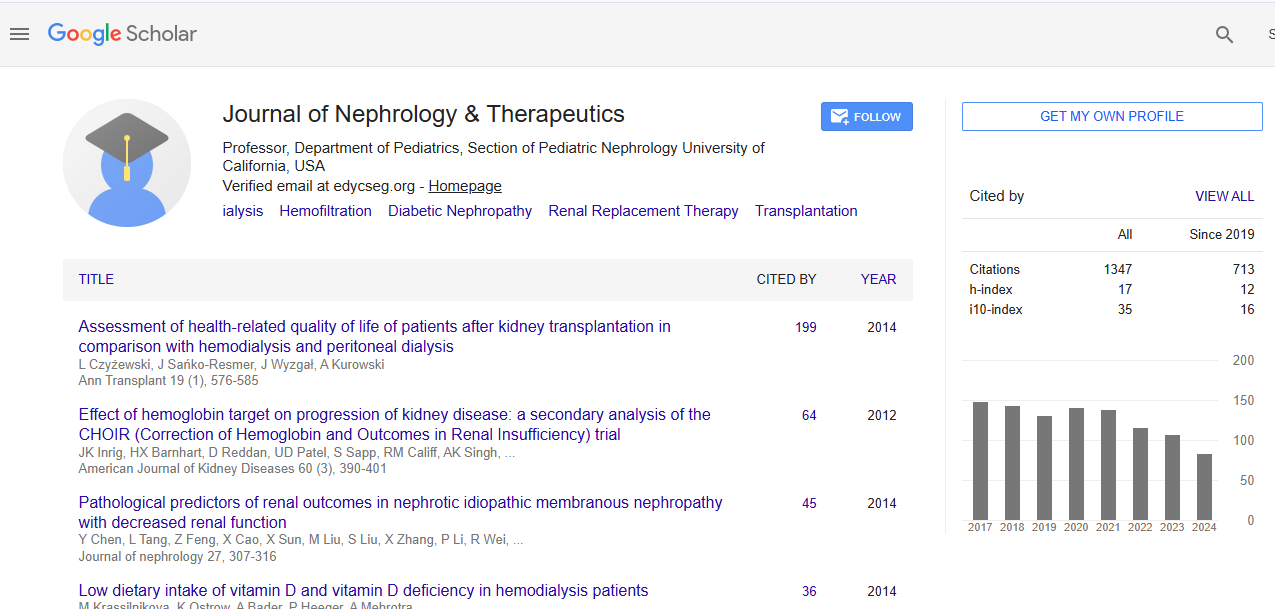
Journal of Nephrology & Therapeutics received 784 citations as per Google Scholar report