Commentary - (2025) Volume 16, Issue 4
Received: 01-Jul-2025, Manuscript No. jpm-26-179437;
Editor assigned: 03-Jul-2025, Pre QC No. P-179437;
Reviewed: 17-Jul-2025, QC No. Q-179437;
Revised: 22-Jul-2025, Manuscript No. R-179437;
Published:
29-Jul-2025
, DOI: 10.37421/2090-0902.2025.16.547
Citation: Rahman, Farid. ”Lyapunov Methods: Versatile Stability Analysis For Physical Systems.” J Phys Math 16 (2025):547.
Copyright: © 2025 Rahman F. This is an open-access article distributed under the terms of the Creative Commons Attribution License, which permits unrestricted use, distribution and reproduction in any medium, provided the original author and source are credited.
The stability of physical systems is a fundamental concern across numerous scientific and engineering disciplines. Lyapunov methods, a powerful theoretical framework, provide a systematic approach to analyzing this critical property without the need for explicit solutions of system dynamics. These methods leverage the concept of a Lyapunov function, an energy-like function whose properties can reveal the stability of an equilibrium point or a trajectory. This article presents a comprehensive overview of Lyapunov methods for analyzing the stability of physical systems. It delves into the theoretical underpinnings of Lyapunov functions and their application to various classes of dynamical systems, highlighting their power in determining asymptotic stability without explicit integration of the system's equations. The work emphasizes practical considerations for constructing Lyapunov functions and discusses their limitations and extensions [1].
Focusing on nonlinear systems, this paper explores the use of generalized Lyapunov functions to establish stability conditions for systems with complex dynamics. It introduces novel techniques for designing such functions, particularly for systems exhibiting chaotic or bifurcating behavior. The authors demonstrate the efficacy of their approach through simulations of a benchmark physical system [2].
This research investigates the application of Lyapunov-Krasovskii functionals to analyze the stability of time-delay systems in physical contexts, such as control systems with communication delays or biological feedback loops. The paper provides theoretical frameworks and computational methods for constructing suitable functionals, demonstrating their power in guaranteeing stability for systems with delays [3].
The authors present a novel approach to stability analysis using numerical methods for constructing Lyapunov functions. This is particularly relevant for systems where analytical solutions are intractable. The paper details algorithms that can find feasible Lyapunov functions, thereby enabling stability verification for complex physical models [4].
This study explores the application of fractional-order Lyapunov methods to analyze the stability of physical systems described by fractional differential equations. The work extends classical Lyapunov theory to accommodate the memory effects inherent in fractional dynamics, providing criteria for stability in a broader class of physical models [5].
The authors examine the use of LaSalle's invariance principle in conjunction with Lyapunov functions to analyze the ultimate boundedness and attractivity of states in physical systems. This is particularly useful for systems where asymptotic stability might not hold but a bounded region of attraction can be established [6].
This paper focuses on the stability analysis of stochastic physical systems using Lyapunov methods. It extends the classical theory to systems subjected to random perturbations, providing conditions for stability in probability and almost sure stability. The authors illustrate their findings with examples from physical phenomena like Brownian motion [7].
The study presents a novel method for designing quadratic Lyapunov functions for linear and nonlinear physical systems using optimization techniques. This approach aims to systematically find suitable Lyapunov functions, making the stability analysis more efficient and less reliant on intuition [8].
This work extends Lyapunov methods to analyze the stability of switched physical systems, where the system dynamics change abruptly between different modes. The authors develop criteria for stability under arbitrary switching and for specific switching laws, crucial for understanding systems like power converters and robotic manipulators [9].
Finally, the paper explores the use of Lyapunov methods for robustness analysis of physical systems against external disturbances and model uncertainties. It establishes conditions under which stability is maintained despite these perturbations, providing a framework for designing resilient physical systems [10].
The foundational principles of Lyapunov stability analysis are thoroughly examined in this work, offering a deep dive into the theoretical underpinnings and practical applications of Lyapunov functions. The authors systematically present how these functions are employed to assess the stability of diverse dynamical systems, emphasizing their capacity to determine asymptotic stability without requiring the explicit integration of the system's differential equations. Crucially, the paper addresses the practical challenges of constructing Lyapunov functions and explores their inherent limitations and potential extensions [1].
In the realm of nonlinear systems, this paper introduces generalized Lyapunov functions as a key tool for establishing stability conditions. The authors highlight novel methodologies for the design of these generalized functions, particularly beneficial for systems exhibiting complex dynamics such as chaos or bifurcation. The effectiveness of this advanced approach is empirically validated through simulations on a representative physical system, showcasing its utility in understanding intricate system behaviors [2].
The stability of physical systems characterized by time delays, a common feature in areas like control engineering and biology, is addressed through the lens of Lyapunov-Krasovskii functionals. This research provides a robust theoretical framework and practical computational techniques for the development of appropriate functionals, thereby enabling the rigorous guarantee of stability even in the presence of time-varying delays in physical systems [3].
A significant contribution to the field is the presentation of a novel strategy for constructing Lyapunov functions via numerical methods. This technique is particularly valuable for complex physical systems where analytical solutions for Lyapunov functions are often elusive. The paper lays out specific algorithms designed to identify viable Lyapunov functions, thereby facilitating the verification of stability for intricate physical models that might otherwise be intractable [4].
Extending the application of Lyapunov methods, this study delves into the stability analysis of physical systems governed by fractional differential equations. By incorporating fractional-order Lyapunov methods, the work effectively accounts for the inherent memory effects present in fractional dynamics, offering new criteria for stability assessment in a wider spectrum of physical models encountered in science and engineering [5].
Complementing the core Lyapunov theory, this research explores the integration of LaSalle's invariance principle with Lyapunov functions. This combined approach proves instrumental in analyzing the ultimate boundedness and attractivity of system states, especially for systems where strict asymptotic stability may not be achievable, but a well-defined bounded region of attraction can be established for physical systems [6].
The challenges posed by stochasticity in physical systems are met with a focused application of Lyapunov methods for stability analysis. This paper extends classical Lyapunov theory to encompass systems subject to random perturbations, thereby establishing criteria for both stability in probability and almost sure stability. Illustrative examples, drawing from phenomena like Brownian motion, underscore the practical relevance of these findings [7].
This study introduces an innovative methodology for the design of quadratic Lyapunov functions, applicable to both linear and nonlinear physical systems. By employing optimization techniques, the authors aim to provide a systematic and efficient means of discovering suitable Lyapunov functions, reducing the reliance on intuition and enhancing the rigor of stability analysis for a broad range of physical models [8].
Addressing the dynamics of switched physical systems, where operational modes can change abruptly, this work develops Lyapunov-based criteria for stability. The research formulates conditions for stability under both arbitrary and predefined switching sequences, a critical requirement for analyzing systems such as power converters and sophisticated robotic manipulators where such switching is inherent [9].
Finally, the robustness of physical systems against external disturbances and model uncertainties is investigated using Lyapunov methods. The paper outlines conditions under which stability is preserved despite the presence of these perturbations, offering a systematic framework for the design and analysis of resilient physical systems capable of maintaining stable operation in challenging environments [10].
This collection of research explores the multifaceted applications of Lyapunov methods for stability analysis in various physical systems. The works cover comprehensive overviews of Lyapunov functions, their extension to nonlinear and time-delay systems, and novel approaches using generalized and fractional-order functions. Numerical and optimization techniques are presented for constructing Lyapunov functions, particularly for complex systems where analytical solutions are difficult to obtain. The application of these methods is also extended to stochastic and switched systems, enhancing their utility. Furthermore, LaSalle's invariance principle is integrated for analyzing boundedness and attractivity, and Lyapunov methods are employed for robustness analysis against disturbances and uncertainties. The research collectively demonstrates the versatility and power of Lyapunov theory in understanding and ensuring the stability of a wide array of physical phenomena.
None
None
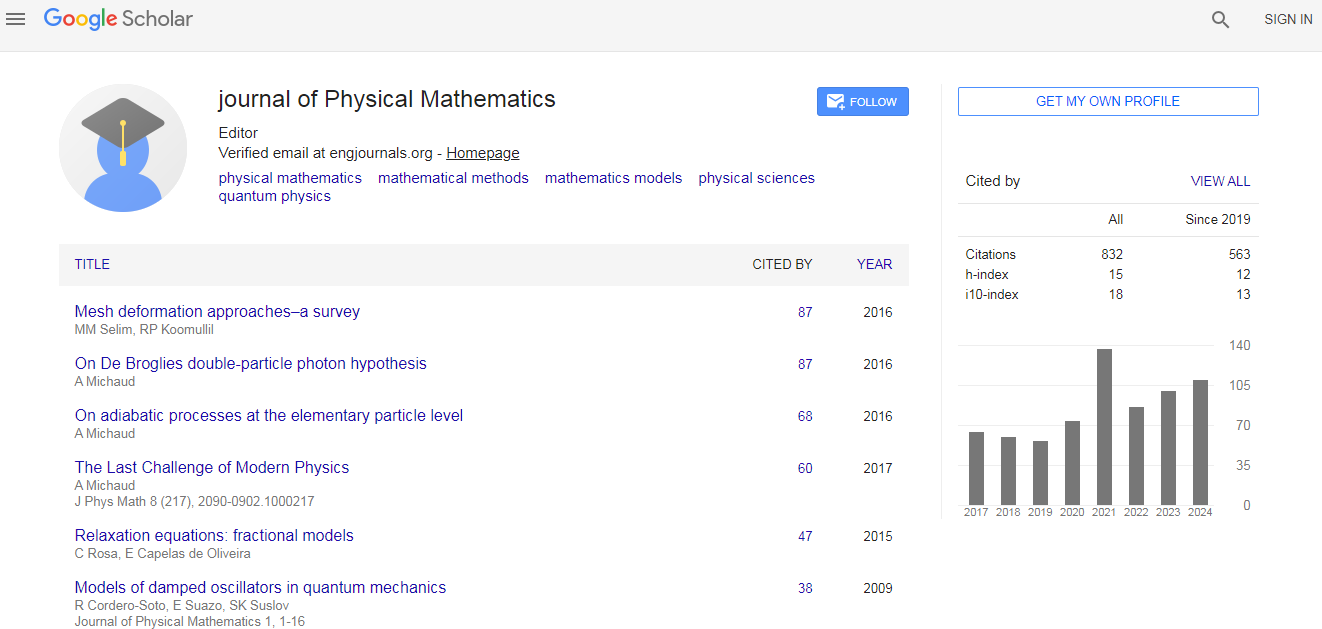
Physical Mathematics received 686 citations as per Google Scholar report