Brief Report - (2025) Volume 21, Issue 5
Received: 01-Sep-2025, Manuscript No. jos-26-185172;
Editor assigned: 03-Sep-2025, Pre QC No. P-185172;
Reviewed: 17-Sep-2025, QC No. Q-185172;
Revised: 22-Sep-2025, Manuscript No. R-185172;
Published:
29-Sep-2025
, DOI: 10.37421/1584-9341.2024.20.221
Citation: Meier, Clara. ”Longer Operative Time Increases Surgical
Site Infections.” J Surg 21 (2025):221.
Copyright: © 2025 Meier C. This is an open-access article distributed under the terms of the Creative Commons Attribution License, which permits unrestricted use, distribution
and reproduction in any medium, provided the original author and source are credited.
Prolonged operative times, defined as exceeding 240 minutes, are significantly associated with an elevated risk of surgical site infections (SSIs) [1].
This association appears to be independent of other known risk factors, underscoring operative duration as a critical modifiable factor in the development of SSIs [1].
Findings from multicenter retrospective studies highlight the importance of optimizing surgical efficiency and exploring innovative techniques to minimize operative time without compromising patient safety or surgical quality [1].
Extended surgical procedures, specifically those lasting over 4 hours, have been investigated for their link to SSI rates in abdominal surgery [2].
A clear correlation has been observed, suggesting that longer surgeries create a more conducive environment for bacterial contamination and tissue damage, thereby increasing the risk of SSIs [2].
Recommendations arising from such studies often include perioperative interventions aimed at reducing operative time to mitigate these identified risks [2].
Analysis of large patient cohorts confirms that operative duration beyond a certain threshold significantly elevates the incidence of SSIs [3].
Specifically, the risk of SSIs escalates with each additional 30 minutes of surgical time [3].
This detailed insight is crucial for surgical teams to implement strategies focused on enhancing workflow efficiency and the judicious use of operative time [3].
A comprehensive systematic review and meta-analysis have consolidated evidence regarding the association between prolonged operative time and SSIs across a spectrum of surgical specialties [4].
The pooled data unequivocally demonstrate a consistent and statistically significant increase in SSI risk correlating with longer surgical durations [4].
These findings strongly advocate for a focused approach dedicated to improving operative efficiency [4].
Studies examining the impact of operative duration on SSI rates in specific surgical contexts, such as elective colorectal surgery, indicate that procedures exceeding 180 minutes exhibit a higher propensity for SSIs [5].
This observation emphasizes the critical need for meticulous surgical planning and the application of efficient surgical techniques within this patient population to effectively reduce postoperative complications [5].
Investigations into the relationship between operative time and SSIs in specific gynecological procedures, such as hysterectomy, reveal a significant increase in SSI risk for procedures lasting longer than 90 minutes [6].
The results suggest that optimizing individual surgical steps and fostering enhanced teamwork can substantially contribute to reducing overall operative duration and, consequently, lowering subsequent infection rates [6].
The impact of extended operative duration on SSI rates within orthopedic surgery, particularly in the context of total joint arthroplasty, has been thoroughly examined [7].
Longer surgical times have been consistently associated with a higher likelihood of patients developing SSIs [7].
This correlation highlights the paramount importance of employing efficient surgical techniques and conducting careful patient selection to minimize the inherent risks involved [7].
A retrospective analysis evaluating the association between operative time and SSIs in patients undergoing complex abdominal wall reconstruction has identified longer operative durations as an independent predictor of SSI development [8].
The study suggests that streamlining surgical processes, where feasible, can play a vital role in reducing operative time and thereby improving overall patient outcomes [8].
Research exploring the impact of operative duration on SSI rates in cardiac surgery indicates that prolonged cardiopulmonary bypass time and aortic cross-clamp time, both contributing factors to extended operative duration, are significantly associated with an increased risk of SSIs [9].
A strong emphasis is placed on optimizing surgical performance to mitigate these risks [9].
Finally, an examination of the relationship between operative time and SSIs in patients undergoing pancreaticoduodenectomy reveals that extended operative durations are a significant risk factor for SSI development [10].
The study advocates for improved surgical planning and execution strategies aimed at minimizing operative time and thereby reducing the incidence of postoperative complications [10].
Prolonged operative times, exceeding 240 minutes, are significantly associated with an increased risk of surgical site infections (SSIs) [1].
This association appears to be independent of other risk factors, highlighting operative duration as a critical modifiable factor for SSI prevention strategies [1].
The findings underscore the importance of optimizing surgical efficiency and exploring innovative techniques to minimize operative time without compromising patient safety or surgical quality [1].
This study investigates the link between extended surgical procedures (over 4 hours) and SSI rates in abdominal surgery [2].
A clear correlation was observed, suggesting that longer surgeries create a more favorable environment for bacterial contamination and tissue damage, thereby increasing SSI risk [2].
The authors recommend perioperative interventions aimed at reducing operative time to mitigate these risks [2].
Analyzing data from a large patient cohort, this research confirms that operative duration beyond a certain threshold significantly elevates the incidence of SSIs [3].
The risk escalates with each additional 30 minutes of surgery [3].
This insight is crucial for surgical teams to implement strategies for efficient workflow and judicious use of operative time [3].
This systematic review and meta-analysis consolidates evidence on the association between prolonged operative time and SSIs across various surgical specialties [4].
The pooled data demonstrate a consistent and statistically significant increase in SSI risk with longer surgical durations [4].
The findings advocate for a focused approach on operative efficiency [4].
The study examines the impact of operative duration on SSI rates in elective colorectal surgery [5].
Results indicate that surgeries exceeding 180 minutes have a higher propensity for SSIs [5].
This emphasizes the need for meticulous surgical planning and efficient technique in this patient population to reduce postoperative complications [5].
This investigation focuses on the relationship between operative time and SSI in patients undergoing hysterectomy [6].
A significant increase in SSI risk was found for procedures lasting longer than 90 minutes [6].
The findings suggest that optimizing surgical steps and teamwork can contribute to reducing operative duration and subsequent infection rates [6].
The impact of extended operative duration on SSI rates in orthopedic surgery, particularly total joint arthroplasty, is examined [7].
Longer surgical times were associated with a higher likelihood of developing SSIs [7].
This highlights the importance of efficient surgical techniques and careful patient selection in minimizing risks [7].
This retrospective analysis evaluates the association between operative time and SSIs in patients undergoing complex abdominal wall reconstruction [8].
Longer operative durations were found to be an independent predictor of SSI [8].
The study suggests that streamlining surgical processes can help reduce operative time and improve patient outcomes [8].
This study explores the impact of operative duration on SSI rates in cardiac surgery [9].
Findings indicate that prolonged cardiopulmonary bypass time and aortic cross-clamp time, both contributing to extended operative duration, are associated with an increased risk of SSIs [9].
Emphasis is placed on optimizing surgical performance [9].
This research examines the relationship between operative time and SSI in patients undergoing pancreaticoduodenectomy [10].
Extended operative durations were found to be a significant risk factor for SSIs [10].
The study advocates for improved surgical planning and execution to minimize operative time and reduce complications [10].
Numerous studies consistently demonstrate a significant association between prolonged operative time and an increased risk of surgical site infections (SSIs). This correlation has been observed across various surgical specialties and patient populations. Longer surgical durations appear to create an environment conducive to infection, independent of other risk factors. Key findings suggest that operative duration is a modifiable factor, emphasizing the importance of surgical efficiency, meticulous planning, and optimized techniques. Strategies to reduce operative time are recommended to mitigate SSI risk and improve patient outcomes. The research highlights the need for continued focus on surgical process improvement and teamwork.
None
None
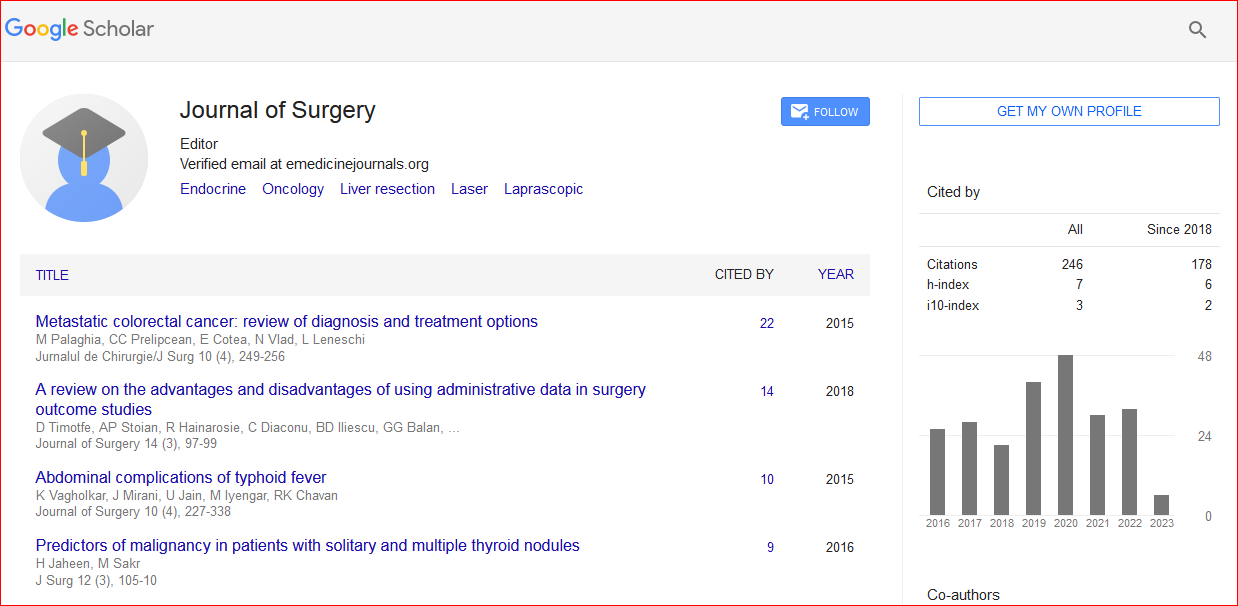
Journal of Surgery received 288 citations as per Google Scholar report