Short Communication - (2025) Volume 11, Issue 2
Received: 02-May-2025, Manuscript No. jotr-25-175582;
Editor assigned: 05-May-2025, Pre QC No. P-175582;
Reviewed: 19-May-2025, QC No. Q-175582;
Revised: 23-May-2025, Manuscript No. R-175582;
Published:
30-May-2025
, DOI: 10.37421/2476-2261. 2025.11.310
Citation: Lin, Yu-Chen. ”Liquid Biopsy: Revolutionizing Cancer Diagnostics and Treatment.” J Oncol Transl Res 11 (2025):310.
Copyright: © 2025 Lin Y. This is an open-access article distributed under the terms of the Creative Commons Attribution License, which permits unrestricted use, distribution and reproduction in any medium, provided the original author and source are credited.
Liquid biopsy represents a transformative approach in cancer management, offering less invasive, real-time insights into tumor evolution. It explores various biomarkers like circulating tumor DNA (ctDNA), circulating tumor cells (CTCs), and exosomes, discussing their clinical applications across different cancer types for diagnosis, prognosis, and treatment monitoring, making it a valuable tool in precision oncology [1].
Specifically in Non-Small Cell Lung Cancer (NSCLC), liquid biopsy is revolutionizing patient care by detecting actionable mutations such as Epidermal Growth Factor Receptor (EGFR), monitoring treatment response, and identifying resistance mechanisms. This allows clinicians to make informed decisions, tailoring therapies and adapting strategies in real time, reducing reliance on tissue biopsies for many critical choices [2].
Advances in sensitive ctDNA assays are transforming post-operative surveillance, enabling earlier intervention and personalized adjuvant therapies. This technology is crucial for assessing minimal residual disease (MRD) and predicting early relapse, offering a precise way to manage patient follow-up and treatment escalation before clinical evidence emerges [3].
Liquid biopsy holds incredible promise for early cancer detection. While non-invasive screening for early-stage cancers is compelling, challenges like sensitivity, specificity, and the need for rigorous validation are crucial to address. The goal is to find the optimal application where liquid biopsy can significantly improve patient outcomes through earlier diagnosis [4].
Exosomes also play a significant role as biomarkers in liquid biopsy. These tiny vesicles carry valuable molecular cargo from parent cells, including cancer cells. Research explores their potential in detecting cancer at early stages and tracking disease progression, opening new avenues for non-invasive diagnostics and personalized treatment strategies. Understanding their unique composition is key to unlocking their full diagnostic power [5].
Liquid biopsy is becoming indispensable in personalized cancer medicine. This approach provides real-time, dynamic information about a tumor's molecular landscape, enabling the selection of targeted therapies, monitoring efficacy, and detecting resistance promptly. This moves us closer to individualized patient care tailored to each person's unique cancer profile [6].
Despite significant progress, challenges remain in liquid biopsy for oncology, including standardization of assays, analytical sensitivity, and clinical validation across diverse cancer types. Overcoming these hurdles is essential for fully integrating liquid biopsy into routine clinical practice, refining its applications for earlier detection, precise prognostication, and optimized therapy selection [7].
A comparative review of circulating tumor cells (CTCs) and cell-free DNA (cfDNA) highlights their distinct clinical utilities. While ctDNA is often preferred for mutation analysis, CTCs offer morphological information and functional study potential, providing complementary insights into tumor biology. Combining these biomarkers often yields a more comprehensive picture for diagnostics and monitoring [8].
Significant strides have also been made in applying liquid biopsy to Colorectal Cancer (CRC). It covers advances from early detection and screening to monitoring treatment response and identifying minimal residual disease. The use of ctDNA in CRC is particularly valuable for guiding adjuvant chemotherapy decisions and predicting recurrence, improving patient stratification and outcomes [9].
Emerging RNA biomarkers, such as microRNAs (miRNAs), long non-coding RNAs (lncRNAs), and messenger RNAs (mRNAs), also show exciting potential in liquid biopsy. These RNA species can detect cancer and monitor therapeutic responses, offering dynamic insights into gene expression changes and epigenetic modifications. This paves the way for more nuanced and sensitive diagnostic and prognostic tools in oncology [10].
Liquid biopsy represents a significant advancement in cancer management, offering a less invasive way to gain real-time insights into tumor evolution and guide precision oncology [1]. This approach leverages various biomarkers, primarily circulating tumor DNA (ctDNA), circulating tumor cells (CTCs), and exosomes, to provide crucial information for diagnosis, prognosis, and treatment monitoring across different cancer types [1, 5, 8]. Understanding the distinct properties and utilities of these biomarkers is essential. For example, while ctDNA is often preferred for mutation analysis, CTCs can offer morphological insights and allow for functional studies, highlighting the complementary nature of these different components in providing a comprehensive picture for diagnostics and monitoring [8]. Exosomes, tiny vesicles carrying molecular cargo, also hold significant potential for early cancer detection and tracking disease progression due to their unique composition [5].
Liquid biopsy is proving indispensable in personalized cancer medicine, enabling precision treatments through dynamic information about a tumor's molecular landscape [6]. This allows for the selection of targeted therapies, efficacy monitoring, and prompt detection of resistance mechanisms, moving towards truly individualized patient care [6]. For instance, in Non-Small Cell Lung Cancer (NSCLC), liquid biopsy is revolutionizing patient care by detecting actionable mutations like Epidermal Growth Factor Receptor (EGFR), monitoring treatment response, and identifying resistance. This helps clinicians make informed decisions, offering tailored therapies and adapting strategies in real time, moving beyond solely relying on tissue biopsies [2]. Similarly, major strides have been made in Colorectal Cancer (CRC) management, where liquid biopsy aids in early detection, screening, monitoring treatment response, and identifying minimal residual disease (MRD). The use of ctDNA in CRC is particularly valuable for guiding adjuvant chemotherapy and predicting recurrence, ultimately improving patient outcomes [9].
The potential of liquid biopsy for early cancer detection is compelling, although it comes with inherent challenges. While non-invasive screening for early-stage cancers is a promising vision, rigorous validation, and addressing issues of sensitivity and specificity are crucial to realize its full potential in improving patient outcomes through earlier diagnosis [4]. A key application is in assessing minimal residual disease (MRD) and predicting early relapse using advanced ctDNA detection. These sensitive assays are transforming post-operative surveillance, enabling earlier intervention and personalized adjuvant therapies by detecting residual disease before it becomes clinically evident. This precision in managing patient follow-up and treatment escalation is a significant advancement [3].
Beyond DNA and cells, the emerging landscape of RNA biomarkers in liquid biopsy presents exciting potential. Various RNA species, including microRNAs (miRNAs), long non-coding RNAs (lncRNAs), and messenger RNAs (mRNAs), offer dynamic insights into gene expression changes and epigenetic modifications. This paves the way for more nuanced and sensitive diagnostic and prognostic tools in oncology [10]. Despite the rapid progress, integrating liquid biopsy into routine clinical practice still faces hurdles. Current challenges include standardizing assays, improving analytical sensitivity, and achieving comprehensive clinical validation across diverse cancer types. Overcoming these will refine its applications for earlier detection, more precise prognostication, and optimized therapy selection, ensuring its full potential is realized in oncology [7].
Liquid biopsy is a revolutionary approach in cancer management, offering non-invasive, real-time insights into tumor biology. It leverages various biomarkers like circulating tumor DNA (ctDNA), circulating tumor cells (CTCs), exosomes, and emerging RNA species for comprehensive cancer diagnosis, prognosis, and treatment monitoring. This technology is transforming patient care by enabling personalized therapies, adapting treatment strategies dynamically, and moving beyond traditional tissue biopsies. For instance, in Non-Small Cell Lung Cancer, liquid biopsy helps detect actionable mutations and monitor treatment response, while in Colorectal Cancer, it guides adjuvant chemotherapy and predicts recurrence. The ability to detect minimal residual disease and predict early relapse is a game-changer for post-operative surveillance. Liquid biopsy also holds immense promise for early cancer detection, though challenges related to sensitivity, specificity, and assay standardization need careful consideration. Despite these hurdles, its potential to provide dynamic insights into gene expression and epigenetic modifications positions it as a valuable tool for refining oncology diagnostics and personalized treatment strategies, ultimately improving patient outcomes.
None
None
Jing P, Wei W, Qing L. "Liquid Biopsy: A Comprehensive Review on Current Status and Future Perspectives".J Cancer 14 (2023):1042-1050.
Indexed at, Google Scholar, Crossref
David RG, Daniel SWT, Martin R. "The evolving role of liquid biopsy in non-small cell lung cancer".Nat Rev Clin Oncol 19 (2022):667-681.
Indexed at, Google Scholar, Crossref
Jian Z, Yan L, Haochen W. "Recent Advances in Circulating Tumor DNA Detection for Minimal Residual Disease Assessment and Early Relapse Prediction".Int J Mol Sci 25 (2024):2305.
Indexed at, Google Scholar, Crossref
Huan L, Zhe H, Yating M. "Liquid biopsy for early cancer detection: Promises and pitfalls".J Exp Clin Cancer Res 40 (2021):227.
Indexed at, Google Scholar, Crossref
Yuanyuan W, Xiaoning Z, Yan L. "The role of exosomes in liquid biopsy for cancer detection and prognosis: A comprehensive review".Front Oncol 13 (2023):1130691.
Indexed at, Google Scholar, Crossref
Jian H, Shuai M, Qi L. "The Clinical Utility of Liquid Biopsy in Personalized Cancer Medicine: A Narrative Review".J Oncol 2022 (2022):8879615.
Indexed at, Google Scholar, Crossref
Yu P, Zhiyao J, Hua L. "Liquid biopsy in oncology: Current challenges and future perspectives".Int J Biol Sci 20 (2024):162-177.
Indexed at, Google Scholar, Crossref
Junli Z, Hong L, Yunhao C. "Circulating Tumor Cells and Cell-Free DNA in Liquid Biopsy: A Comparative Review".Front Oncol 12 (2022):940984.
Indexed at, Google Scholar, Crossref
Martina B, Michele C, Marco F. "Liquid Biopsy in Colorectal Cancer: Advances, Clinical Applications, and Future Directions".J Clin Med 12 (2023):3906.
Indexed at, Google Scholar, Crossref
Yiran L, Qiao R, Ruifang L. "Emerging RNA biomarkers in liquid biopsy for cancer detection and therapy monitoring".J Transl Med 22 (2024):47.
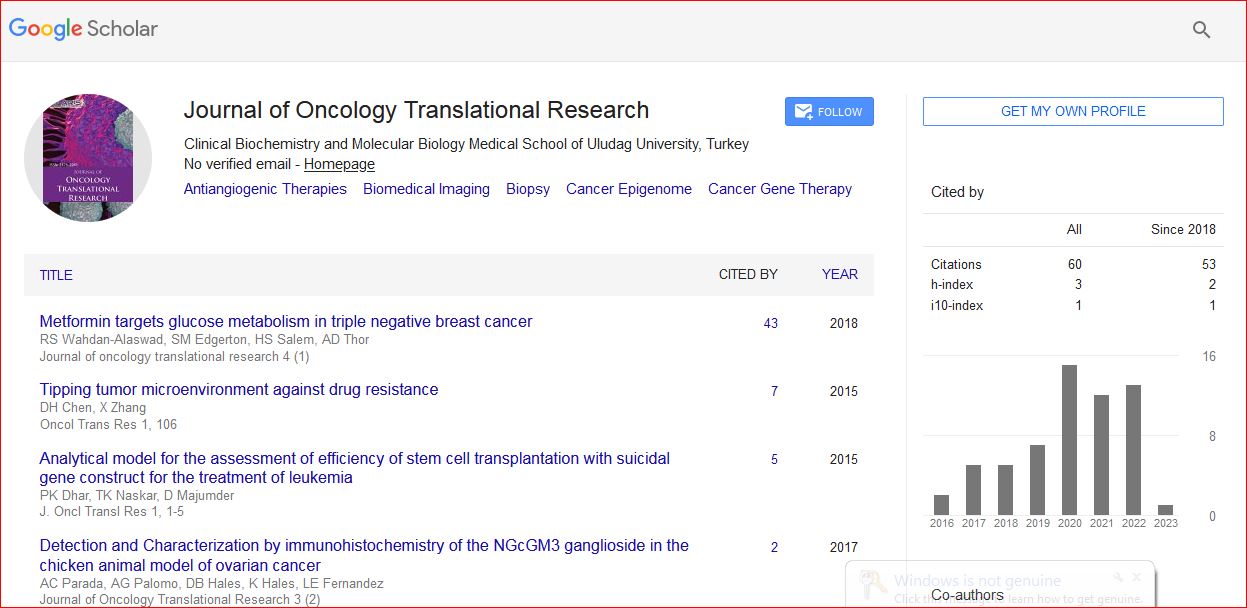
Journal of Oncology Translational Research received 93 citations as per Google Scholar report