Brief Report - (2025) Volume 16, Issue 3
Received: 02-Jun-2025, Manuscript No. jmbd-26-179384;
Editor assigned: 04-Jun-2025, Pre QC No. P-179384;
Reviewed: 15-Jun-2025, QC No. Q-179384;
Revised: 23-Jun-2025, Manuscript No. R-179384;
Published:
30-Jun-2025
, DOI: 10.37421/2155-9929.2025.16.701
Citation: Ivanov, Nikolai. ”Liquid Biopsy: Revolutionizing Cancer Diagnostics And Management.” J Mol Biomark Diagn 16 (2025):701.
Copyright: © 2025 Ivanov N. This is an open-access article distributed under the terms of the Creative Commons Attribution License, which permits unrestricted use, distribution
and reproduction in any medium, provided the original author and source are credited.
Liquid biopsy technologies are ushering in a new era of molecular diagnostics, offering less invasive methods for cancer detection and monitoring through the analysis of circulating tumor DNA (ctDNA), circulating tumor cells (CTCs), and other biomarkers found in bodily fluids. This innovative approach facilitates earlier cancer identification, real-time assessment of treatment effectiveness, and the detection of mechanisms driving resistance to therapy. Significant advancements in next-generation sequencing (NGS) and bioinformatics are instrumental in this revolution, enabling highly sensitive and precise analysis of these analytes, thus transforming patient care and advancing personalized oncology [1].
The detection of circulating tumor DNA (ctDNA) through liquid biopsy presents a highly promising avenue for the management of non-small cell lung cancer (NSLC). This field of research critically examines the analytical and clinical validation of ctDNA assays, with a particular emphasis on their effectiveness in early detection, guiding therapy selection, and monitoring treatment efficacy and recurrence. However, emerging challenges, such as the standardization of methodologies and the complex issue of tumor heterogeneity, still need to be thoroughly addressed [2].
Circulating tumor cells (CTCs) represent a fundamental component of liquid biopsies, providing invaluable insights into tumor progression and the metastatic process. This area of study focuses on the isolation and detailed characterization of CTCs, their crucial role in predicting treatment response and patient prognosis across a spectrum of cancers, and the technological breakthroughs that are progressively enhancing their reliable detection. The potential for CTCs to inform and guide therapeutic decisions is increasingly recognized and highlighted [3].
The integration of artificial intelligence (AI) and machine learning (ML) is proving indispensable for deciphering the intricate data generated by liquid biopsy techniques. This synergy is essential for enhancing the sensitivity and specificity with which cancer signatures within ctDNA and other biomarkers can be detected, predicting treatment outcomes, and identifying novel diagnostic markers. The prospect of AI-driven liquid biopsies to significantly personalize cancer care is substantial and holds immense promise [4].
Exosomes and other extracellular vesicles (EVs) are emerging as a highly promising source of biomarkers for liquid biopsies. Current research extensively examines the role of exosomal non-coding RNAs and proteins in the diagnosis and prognosis of cancer. These studies underscore the capability of these nano-sized vesicles to carry tumor-specific molecular information, thereby offering a valuable tool for non-invasive cancer assessment [5].
The application of liquid biopsy in the early detection of colorectal cancer (CRC) is a significant area of investigation. This research concentrates on leveraging ctDNA methylation patterns and somatic mutations to identify precancerous lesions and tumors in their earliest stages, with the overarching goal of refining screening strategies and improving patient outcomes. Nevertheless, challenges related to achieving adequate sensitivity and specificity for broad clinical implementation remain a key consideration [6].
This review thoroughly investigates the utility of liquid biopsy for the critical tasks of monitoring treatment response and detecting minimal residual disease (MRD) across various cancer types. It emphasizes how serial sampling of ctDNA can furnish dynamic information regarding tumor burden, thereby facilitating adjustments in treatment plans and enabling the early identification of relapse. The article strongly advocates for the potential of liquid biopsy to optimize personalized cancer therapy [7].
The challenges encountered during the clinical implementation of liquid biopsy, alongside future directions for its widespread adoption, are thoroughly discussed. Critical areas requiring attention include the standardization of pre-analytical and analytical processes, the development of robust bioinformatics pipelines, the establishment of appropriate reimbursement policies, and comprehensive clinician education. Successfully navigating these hurdles is paramount for liquid biopsy to achieve broad integration into routine patient care [8].
This article meticulously investigates the potential of circulating cell-free DNA (cfDNA) fragmentation patterns as a novel diagnostic tool. The study explores how specific cfDNA fragmentation profiles can be utilized to differentiate between various cancer types and even to distinguish between benign and malignant conditions, presenting a new paradigm for early cancer detection [9].
Further, the specific role of liquid biopsy in the management of gynecological cancers is carefully examined. This review underscores the application of ctDNA and CTC analysis in the early detection, prognosis, and monitoring of treatment response for common gynecological malignancies such as ovarian, cervical, and uterine cancers. The article strongly emphasizes the potential for developing highly personalized therapeutic strategies informed by liquid biopsy findings [10].
Liquid biopsy technologies are at the forefront of revolutionizing molecular diagnostics by providing minimally invasive avenues for cancer detection and monitoring. These methods leverage circulating tumor DNA (ctDNA), circulating tumor cells (CTCs), and other biomarkers present in bodily fluids. The inherent advantages include the potential for earlier cancer diagnosis, real-time assessment of treatment efficacy, and the identification of resistance mechanisms. The rapid progress in next-generation sequencing (NGS) and sophisticated bioinformatics tools are the primary catalysts, enabling highly sensitive and specific analyses of these analytes, ultimately transforming patient care paradigms and personalizing oncology [1].
In the context of non-small cell lung cancer (NSLC) management, the detection of circulating tumor DNA (ctDNA) via liquid biopsy offers significant promise. This review meticulously explores the analytical and clinical validation processes for ctDNA assays, focusing on their demonstrated utility in early detection, informed therapy selection, and effective monitoring of treatment efficacy and recurrence. Despite these advancements, significant challenges persist, particularly concerning the standardization of methodologies and the inherent complexity of tumor heterogeneity [2].
Circulating tumor cells (CTCs) are recognized as a crucial component of liquid biopsies, yielding critical insights into tumor progression and the capacity for metastasis. This article delves into the methodologies for isolating and characterizing CTCs, their established role in predicting treatment response and prognosis across diverse cancer types, and the technological innovations that are continually improving their reliable detection. The capacity of CTCs to guide therapeutic decisions is a key focus of ongoing research [3].
The synergy between artificial intelligence (AI) and machine learning (ML) is proving to be vital in the analysis of the complex data streams generated by liquid biopsy. This integration is essential for improving the sensitivity and specificity of detecting cancer signatures within ctDNA and other biomarkers, predicting treatment outcomes, and identifying novel diagnostic markers. The substantial potential for AI-driven liquid biopsies to personalize cancer care is a major driving force in the field [4].
Exosomes and other extracellular vesicles (EVs) are emerging as a highly promising source of biomarkers for liquid biopsy applications. This line of inquiry focuses on the role of exosomal non-coding RNAs and proteins in cancer diagnosis and prognosis. The research highlights the inherent potential of these nano-sized vesicles to carry tumor-specific molecular information, thereby providing a valuable tool for non-invasive cancer assessment [5].
The application of liquid biopsy for the early detection of colorectal cancer (CRC) is a subject of intense study. This research prioritizes the use of ctDNA methylation patterns and somatic mutations as indicators for identifying precancerous lesions and early-stage tumors, aiming to enhance screening strategies and improve patient outcomes. However, the challenges associated with achieving sufficient sensitivity and specificity for widespread clinical adoption are also critically examined [6].
This review comprehensively examines the utility of liquid biopsy in monitoring treatment response and detecting minimal residual disease (MRD) in a variety of cancers. It specifically highlights how serial ctDNA sampling can provide dynamic insights into tumor burden, which is crucial for guiding treatment adjustments and identifying early signs of relapse. The article strongly emphasizes the potential of liquid biopsy to significantly optimize personalized cancer therapy [7].
The challenges associated with the clinical implementation of liquid biopsy, alongside crucial future directions, are thoroughly discussed. Key areas of focus include the standardization of pre-analytical and analytical processes, the development of robust bioinformatics pipelines, the establishment of appropriate reimbursement policies, and the imperative for comprehensive clinician education. Overcoming these multifaceted hurdles is essential for the widespread integration of liquid biopsy into routine patient care [8].
This article investigates the promising potential of circulating cell-free DNA (cfDNA) fragmentation patterns as a novel diagnostic tool. The study explores how distinct cfDNA fragmentation profiles can effectively differentiate between various cancer types and even distinguish between benign and malignant conditions, thereby offering a new approach for early cancer detection [9].
Furthermore, the specific role of liquid biopsy in the management of gynecological cancers is thoroughly analyzed. This review concentrates on the application of ctDNA and CTC analysis for the early detection, prognosis, and monitoring of treatment response in ovarian, cervical, and uterine cancers. The potential for developing personalized therapeutic strategies based on the findings from liquid biopsies is a central theme [10].
Liquid biopsy is revolutionizing cancer diagnostics and management through minimally invasive analysis of biomarkers like ctDNA and CTCs. Technologies such as NGS and AI are enhancing sensitivity and specificity, enabling earlier detection, real-time treatment monitoring, and personalized therapies. Applications span various cancers, including NSCLC and CRC, and extend to gynecological malignancies. Emerging areas like exosomal biomarkers and cfDNA fragmentation patterns offer new diagnostic avenues. While promising, challenges in standardization and clinical implementation persist, requiring further research and development for widespread adoption in oncology.
None
None
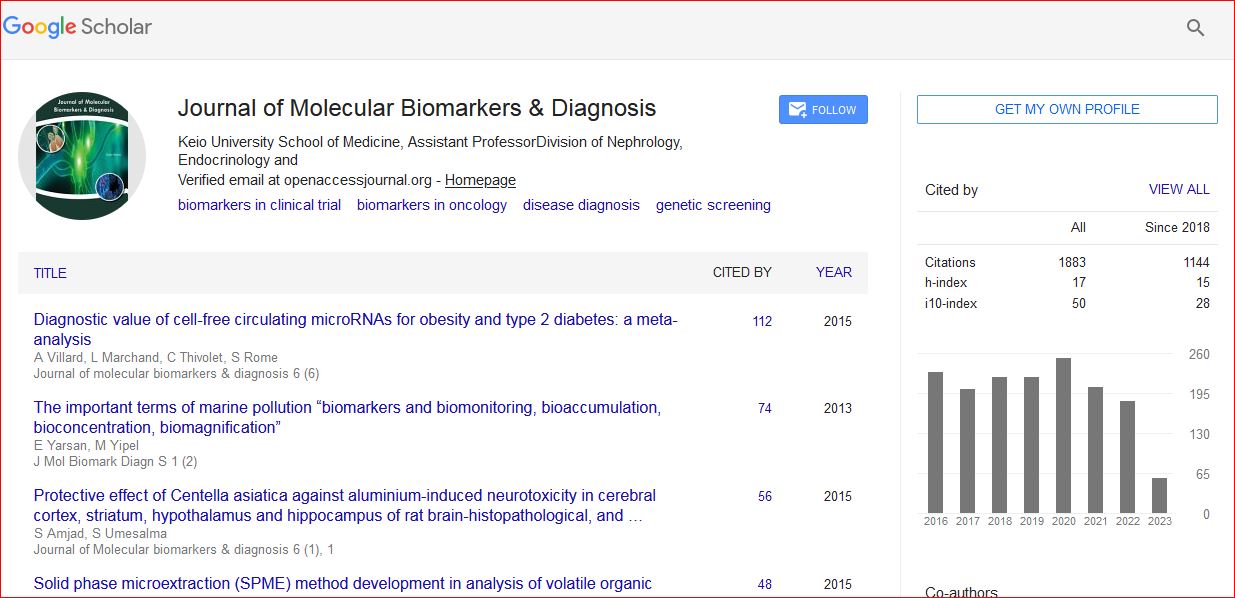
Journal of Molecular Biomarkers & Diagnosis received 2054 citations as per Google Scholar report