Perspective - (2025) Volume 16, Issue 2
Received: 01-Apr-2025, Manuscript No. jmbd-26-179369;
Editor assigned: 03-Apr-2025, Pre QC No. P-179369;
Reviewed: 14-Apr-2025, QC No. Q-179369;
Revised: 22-Apr-2025, Manuscript No. R-179369;
Published:
29-Apr-2025
, DOI: 10.37421/2155-9929.2025.16.694
Citation: Kim, Hana. ”Liquid Biopsies: Revolutionizing Early Cancer Detection.” J Mol Biomark Diagn 16 (2025): 694.
Copyright: © 2025 Kim H. This is an open-access article distributed under the terms of the Creative Commons Attribution License, which permits unrestricted use, distribution and reproduction in any medium, provided the original author and source are credited.
Liquid biopsies represent a transformative approach in oncology, offering a non-invasive method for early cancer detection and monitoring by analyzing circulating tumor DNA (ctDNA), circulating tumor cells (CTCs), and other tumor-derived materials in bodily fluids. These strategies circumvent the need for traditional tissue biopsies, thereby reducing patient risk and facilitating serial monitoring. Significant advancements in next-generation sequencing and bioinformatics have dramatically enhanced the sensitivity and specificity of these techniques, paving the way for earlier and more accurate diagnoses across a wide spectrum of cancer types. The integration of liquid biopsies into routine clinical practice holds immense potential to substantially improve patient outcomes through timely intervention and the implementation of personalized treatment strategies [1].
The identification of specific molecular signatures within blood, such as mutated genes and epigenetic alterations, is a critical component in the development of sensitive and specific liquid biopsy assays for early cancer detection. Research in this area highlights the considerable progress made in detecting low-abundance tumor-derived nucleic acids. However, challenges remain in effectively distinguishing true tumor signals from background noise, particularly during the earliest stages of cancer development. Innovations in amplification and detection technologies are therefore essential for achieving the necessary sensitivity required for early diagnosis [2].
Circulating tumor DNA (ctDNA) analysis stands out as a powerful tool for non-invasive cancer detection, with ongoing research delving into its analytical validation and clinical utility. Understanding ctDNA shedding dynamics and the impact of tumor heterogeneity on detection rates are emphasized as crucial factors. Furthermore, ctDNA shows considerable potential to guide treatment decisions and monitor therapeutic response, extending its role beyond just early detection [3].
The application of circulating tumor cells (CTCs) in early cancer diagnosis is another significant area of focus. As CTCs are rare events in the bloodstream, their detection necessitates highly sensitive methodologies. Various technologies for CTC isolation and characterization, including microfluidic devices and immunomagnetic separation, are being examined. The prognostic value of CTCs and their potential for molecular profiling to inform personalized therapy are also under discussion, underscoring their multifaceted role in cancer management [4].
Epigenetic modifications, particularly DNA methylation patterns within cell-free DNA (cfDNA), are emerging as promising biomarkers for early cancer detection. These aberrant methylation profiles can serve as cancer-specific signals, even in the absence of detectable mutations or circulating tumor cells. The potential for multi-cancer early detection (MCED) using cfDNA methylation represents a significant area of advancement in non-invasive diagnostic tools [5].
The integration of multiple biomarker types within a single liquid biopsy platform is crucial for enhancing the sensitivity and specificity of early cancer detection. Synergistic approaches combining ctDNA, CTCs, and exosomal RNA are being explored. By leveraging orthogonal signals from these different analytes, multi-analyte strategies can overcome the limitations inherent in single-biomarker approaches, leading to more robust and accurate diagnostic panels for a broad range of cancers [6].
Developing highly sensitive assays is paramount for detecting the low-frequency molecular signals characteristic of early-stage cancers. Advancements in technologies such as digital droplet PCR (ddPCR) and other ultra-sensitive molecular detection methods are enabling the precise quantification of rare variants in ctDNA. This capability significantly improves the ability to detect cancer at its nascent stages, which is critical for initiating effective treatment promptly [7].
Circulating microRNAs (miRNAs) are being investigated as potential biomarkers for early cancer detection. These small non-coding RNAs, which regulate gene expression, are detectable in various body fluids. Studies are exploring specific miRNA profiles associated with different cancer types and stages, demonstrating their utility as non-invasive diagnostic indicators due to their stability and tissue specificity [8].
The implementation of liquid biopsies for early cancer detection hinges on robust bioinformatics pipelines capable of analyzing complex genomic and epigenomic data. Computational challenges in identifying cancer signals from noisy biological data are being addressed, with increasing reliance on machine learning and artificial intelligence to enhance the accuracy of these analyses. These advanced computational approaches are vital for interpreting large-scale liquid biopsy datasets for clinical decision-making [9].
Extracellular vesicles (EVs), including exosomes, are being explored as a valuable source of biomarkers for early cancer detection. EVs carry a cargo of proteins, nucleic acids, and lipids that reflect the physiological state of their parent cells. Research highlights the potential of EV-derived biomarkers in blood and other biofluids for identifying cancer at its earliest stages, offering a complementary approach to ctDNA and CTC analysis, with standardization of isolation and characterization being a key focus [10].
Liquid biopsies are revolutionizing oncology by offering non-invasive means to detect and monitor cancer through the analysis of circulating tumor DNA (ctDNA), circulating tumor cells (CTCs), and other tumor-derived materials found in bodily fluids. This approach bypasses the risks associated with tissue biopsies and allows for serial monitoring of disease progression and treatment response. The progress in next-generation sequencing and bioinformatics has significantly boosted the sensitivity and specificity of these methods, enabling earlier and more precise diagnoses across diverse cancer types. Consequently, the widespread adoption of liquid biopsies in clinical practice promises to enhance patient outcomes through prompt interventions and tailored therapeutic strategies [1].
Crucial to the development of effective liquid biopsy assays for early cancer detection is the identification of distinct molecular signatures in blood, encompassing mutated genes and epigenetic alterations. Current research showcases considerable advancements in detecting low-abundance tumor-derived nucleic acids. Nonetheless, distinguishing genuine tumor signals from background noise, especially in the nascent stages of cancer, remains a challenge. Therefore, the continuous innovation in amplification and detection technologies is indispensable for achieving the required sensitivity levels [2].
Circulating tumor DNA (ctDNA) analysis presents itself as a potent method for non-invasive cancer detection. Investigations are increasingly focusing on the analytical validation and clinical utility of ctDNA-based assays. Critical aspects under scrutiny include the dynamics of ctDNA shedding and the influence of tumor heterogeneity on detection success rates. Moreover, the capacity of ctDNA to inform treatment decisions and monitor treatment efficacy positions it as a valuable tool beyond its role in early detection [3].
The role of circulating tumor cells (CTCs) in early cancer diagnosis is also a significant area of research. Given that CTCs are exceptionally rare in the bloodstream, their detection demands highly sensitive methods. A variety of technologies designed for CTC isolation and characterization, such as microfluidic devices and immunomagnetic separation techniques, are under active examination. The prognostic significance of CTCs and their potential for molecular profiling to guide personalized therapies are also being explored, highlighting their comprehensive utility in cancer management [4].
Epigenetic modifications, particularly DNA methylation patterns within cell-free DNA (cfDNA), are emerging as highly promising biomarkers for early cancer detection. These aberrant methylation profiles can act as specific indicators of cancer, even when mutations or circulating tumor cells are not detectable. The development of multi-cancer early detection (MCED) capabilities using cfDNA methylation marks a significant stride in non-invasive diagnostic technologies [5].
To improve the sensitivity and specificity of early cancer detection, integrating multiple biomarker types within a liquid biopsy platform is considered essential. Research is exploring the synergistic benefits of combining ctDNA, CTCs, and exosomal RNA. Utilizing orthogonal signals from these diverse analytes allows multi-analyte approaches to surmount the limitations of single-biomarker strategies, ultimately leading to more reliable and accurate diagnostic panels applicable to a wide range of cancers [6].
The detection of low-frequency molecular signals indicative of early-stage cancers necessitates the development of exceptionally sensitive assays. Progress in technologies like digital droplet PCR (ddPCR) and other ultra-sensitive molecular detection platforms is crucial. These methods facilitate precise quantification of rare variants in ctDNA, thereby substantially enhancing the capacity to identify cancer in its initial stages, which is vital for successful treatment outcomes [7].
Circulating microRNAs (miRNAs) are being investigated for their potential as biomarkers in early cancer detection. These small, non-coding RNA molecules play a role in gene expression regulation and can be found in various body fluids. Studies are identifying specific miRNA profiles associated with different cancer types and stages, showcasing their potential as non-invasive diagnostic markers owing to their inherent stability and tissue specificity [8].
The effective implementation of liquid biopsies for early cancer detection relies heavily on sophisticated bioinformatics pipelines designed to analyze complex genomic and epigenomic data. Addressing the computational challenges associated with identifying cancer signals amidst noisy biological data is paramount. The increasing application of machine learning and artificial intelligence is crucial for improving the accuracy of these analyses and enabling the interpretation of large datasets generated by liquid biopsies for clinical decision-making [9].
Extracellular vesicles (EVs), encompassing exosomes, are being recognized for their potential as a rich source of biomarkers for early cancer detection. EVs encapsulate a diverse array of molecules, including proteins, nucleic acids, and lipids, which reflect the state of their originating cells. Research indicates that EV-derived biomarkers present in blood and other biofluids hold promise for detecting cancer in its earliest phases, offering a complementary approach to ctDNA and CTC analysis, with standardization of EV isolation and characterization being a key area of development [10].
Liquid biopsies, utilizing circulating tumor DNA (ctDNA), circulating tumor cells (CTCs), and other tumor-derived materials in bodily fluids, offer a promising non-invasive approach for early cancer detection. These methods bypass tissue biopsies, reduce patient risk, and enable serial monitoring. Advances in sequencing and bioinformatics are improving sensitivity and specificity, leading to earlier and more accurate diagnoses across various cancer types. Key to early detection are specific molecular signatures like mutated genes and epigenetic alterations in blood. Challenges include distinguishing tumor signals from background noise, necessitating sensitive amplification and detection technologies. ctDNA analysis is a powerful tool, with ongoing research into its validation and clinical utility, including its potential to guide treatment. CTCs, despite being rare, are also valuable for early diagnosis, with various isolation and characterization technologies being developed. Epigenetic modifications, particularly cfDNA methylation patterns, are emerging as reliable biomarkers, even without detectable mutations or CTCs, supporting multi-cancer early detection. Combining multiple biomarkers like ctDNA, CTCs, and exosomal RNA enhances sensitivity and specificity. Ultra-sensitive assays, such as digital droplet PCR, are vital for detecting low-frequency signals in ctDNA. Circulating microRNAs (miRNAs) are also being explored as stable and specific diagnostic indicators. Robust bioinformatics pipelines, increasingly incorporating machine learning, are essential for analyzing complex liquid biopsy data. Extracellular vesicles (EVs) are also promising biomarker sources, offering a complementary approach to ctDNA and CTC analysis.
None
None
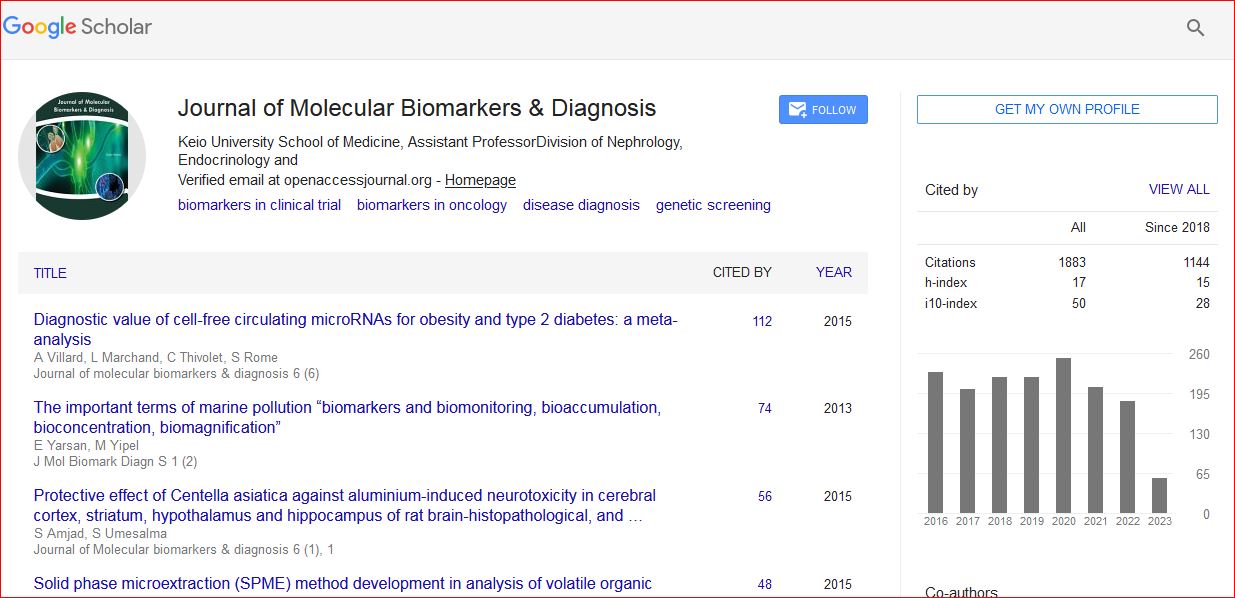
Journal of Molecular Biomarkers & Diagnosis received 2054 citations as per Google Scholar report