Opinion - (2025) Volume 14, Issue 2
Received: 01-Apr-2025, Manuscript No. jeom-26-188152;
Editor assigned: 03-Apr-2025, Pre QC No. P-188152;
Reviewed: 17-Apr-2025, QC No. Q-188152;
Revised: 22-Apr-2025, Manuscript No. R-188152;
Published:
29-Apr-2025
, DOI: 10.37421/2169-026X.2025.14.520
Citation: Kumar, Rajesh. ”Leadership Styles: Impact on Performance and Well-being.” J Entrepren Organiz Manag 14 (2025):520.
Copyright: © 2025 Kumar R. This is an open-access article distributed under the terms of the Creative Commons Attribution License, which permits unrestricted use, distribution and reproduction in any medium, provided the original author and source are credited.
Research consistently highlights the multifaceted nature of leadership and its profound impact on organizational outcomes. Transformational leadership, a style characterized by inspiring followers and fostering innovation, demonstrates a positive association with enhanced organizational performance, particularly within entrepreneurial contexts. This approach encourages employee engagement and commitment, thereby contributing to superior strategic outcomes and adaptability [1].
In parallel, servant leadership, which prioritizes the needs of others, has been shown to positively influence employee well-being and team performance. This philosophy cultivates trust and cooperation, ultimately leading to improved organizational results through a more engaged and motivated workforce [2].
Authentic leadership, rooted in self-awareness and ethical conduct, significantly contributes to a positive organizational climate. By promoting trust and psychological safety, this leadership style fosters increased job satisfaction and enhances overall team effectiveness [3].
Conversely, laissez-faire leadership, defined by a notable lack of leader involvement, is consistently linked to detrimental organizational outcomes. This passive approach can result in decreased employee motivation, compromised decision-making processes, and ultimately, diminished performance levels [4].
Bureaucratic leadership, with its inherent emphasis on adherence to rules and established procedures, can offer a degree of stability and predictability within organizations. However, its rigid structure may inadvertently stifle innovation and adaptability, potentially constraining long-term organizational performance, especially in environments marked by dynamism [5].
Charismatic leadership possesses the capability to inspire and motivate followers, consequently leading to heightened commitment and improved performance. Nevertheless, the efficacy of this style is frequently contingent upon the specific context and the leader's adeptness at sustaining follower trust and enthusiasm [6].
Paternalistic leadership, a model often observed in certain Asian cultural contexts, amalgamates authoritarianism, benevolence, and moral leadership principles. While it can cultivate loyalty and commitment, its authoritarian dimension may inadvertently limit employee autonomy and stifle creativity [7].
Transactional leadership, which operates through exchange mechanisms and contingent rewards, can effectively drive performance by establishing clear expectations and consequences. This style is particularly adept at maintaining operational efficiency but may not be as conducive to fostering long-term innovation compared to transformational styles [8].
Situational leadership theory posits that effective leadership necessitates adapting one's approach to align with the readiness level of followers. The crucial determinant of optimizing performance lies in matching leadership behaviors with follower competence and commitment [9].
Ethical leadership plays a pivotal role in cultivating trust and fostering a positive ethical climate within an organization, which in turn shapes employee conduct and influences organizational performance. Leaders who exemplify ethical behavior are more likely to inspire commitment and effectively curtail unethical practices [10].
Transformational leadership, characterized by its focus on inspiring followers and fostering a climate of innovation, has been empirically linked to superior organizational performance, particularly within the dynamic landscape of entrepreneurial ventures. This leadership paradigm actively encourages heightened employee engagement and a profound sense of commitment, which collectively translate into more robust strategic outcomes and improved organizational adaptability [1].
Servant leadership, an approach that fundamentally prioritizes the needs and growth of others, exerts a positive influence on both employee well-being and overall team performance. By emphasizing empathy and support, this style nurtures an environment of trust and cooperation, thereby contributing to enhanced organizational results through a workforce that is demonstrably more engaged and motivated [2].
Authentic leadership, which is grounded in principles of self-awareness, transparency, and ethical behavior, significantly contributes to the establishment of a positive organizational climate. This leadership modality fosters a sense of psychological safety and deepens trust among team members, leading to greater job satisfaction and improved collective effectiveness [3].
In contrast, laissez-faire leadership, distinguished by its characteristic lack of active leader involvement and decision-making, is consistently associated with adverse organizational consequences. This hands-off approach can precipitate a decline in employee motivation, lead to suboptimal decision-making, and ultimately result in diminished overall organizational performance [4].
Bureaucratic leadership, characterized by its stringent adherence to rules, regulations, and established procedures, can indeed provide a framework of stability and predictability within an organization. However, such a rigid adherence may inadvertently inhibit innovation and limit an organization's capacity for adaptation, potentially hindering long-term performance in rapidly evolving environments [5].
Charismatic leadership possesses a powerful ability to inspire and galvanize followers, often resulting in elevated levels of commitment and improved performance outcomes. Nevertheless, the actual effectiveness of this leadership style is frequently dependent on contextual factors and the leader's sustained capacity to maintain follower trust and enthusiasm [6].
Paternalistic leadership, a leadership model frequently encountered in certain Asian cultural contexts, integrates elements of authoritarianism, benevolence, and moral guidance. While this approach can foster strong loyalty and commitment among followers, its inherent authoritarian component may pose limitations on individual autonomy and the encouragement of creativity [7].
Transactional leadership, which operates on the principle of exchange and the utilization of contingent rewards, serves as an effective mechanism for driving performance by clearly articulating expectations and consequences. This style is highly efficient for maintaining operational stability but may not be as effective in cultivating long-term innovation as more transformational leadership approaches [8].
Situational leadership theory fundamentally proposes that effective leadership hinges on the leader's ability to adapt their style to match the readiness and developmental level of their followers. Optimizing performance is therefore contingent upon aligning leadership behaviors with the specific competence and commitment levels of the team members [9].
Ethical leadership is instrumental in cultivating an environment of trust and establishing a positive ethical climate, which subsequently influences employee behaviors and impacts overall organizational performance. Leaders who consistently demonstrate ethical conduct are more likely to inspire unwavering commitment and effectively mitigate the occurrence of unethical practices within the workplace [10].
This collection of research explores various leadership styles and their impact on organizational performance and employee well-being. Transformational, servant, authentic, charismatic, and ethical leadership styles are generally associated with positive outcomes such as increased engagement, trust, and performance. Conversely, laissez-faire leadership is linked to negative consequences. Bureaucratic leadership offers stability but may hinder innovation, while paternalistic leadership blends authority with benevolence, potentially limiting creativity. Transactional leadership is effective for operational efficiency through clear rewards and expectations. Situational leadership emphasizes adapting the leadership style to follower readiness. Overall, leadership plays a crucial role in shaping organizational success and employee experiences.
None
None
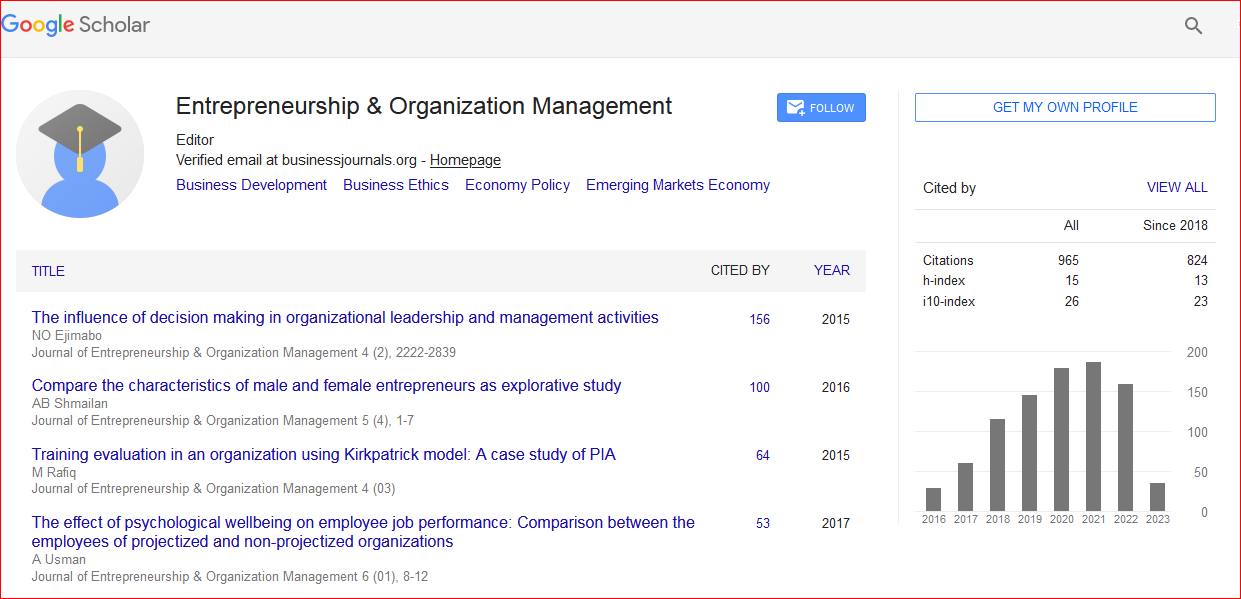
Entrepreneurship & Organization Management received 1115 citations as per Google Scholar report