Brief Report - (2025) Volume 12, Issue 6
Received: 01-Nov-2025, Manuscript No. jlop-26-179094;
Editor assigned: 03-Nov-2025, Pre QC No. P-179094;
Reviewed: 17-Nov-2025, QC No. Q-179094;
Revised: 24-Nov-2025, Manuscript No. R-179094;
Published:
29-Nov-2025
, DOI: 10.37421/2469-410X. 2025.12.230
Citation: Noor, Siti Aisyah. ”Lasers Revolutionize Medicine: Diagnostics, Surgery, Therapy.” J Laser Opt Photonics 12 (2025):230.
Copyright: © 2025 Noor A. Siti This is an open-access article distributed under the terms of the Creative Commons Attribution License, which permits unrestricted use, distribution and reproduction in any medium, provided the original author and source are credited.
The field of biophotonics is experiencing a transformative era driven by advancements in laser technologies, which are profoundly impacting medical diagnostics and therapeutic interventions. Sophisticated optical techniques, encompassing advanced imaging modalities and targeted laser treatments, are revolutionizing patient care and research outcomes, with a strong emphasis on translating laboratory innovations into clinical applications for non-invasive procedures and enhanced disease detection [1].
Within the specialized domain of ophthalmology, femtosecond lasers have emerged as pivotal tools for procedures such as LASIK and cataract surgery. The unique characteristics of ultrashort laser pulses, including minimized thermal damage and heightened precision, contribute to superior surgical outcomes and accelerated patient recovery. Ongoing developments in laser technology continue to be integrated into advanced ophthalmic surgical platforms [2].
A significant stride in early cancer detection involves the synergistic combination of optical coherence tomography (OCT) and laser-induced fluorescence (LIF). This multimodal approach provides both detailed structural imaging and crucial molecular information, enabling real-time differentiation between healthy and cancerous tissues. The technological advancements in this area hold substantial promise for clinical applications in oncology [3].
Photodynamic therapy (PDT) is continuously being refined for targeted cancer treatment through the development of novel photosensitizers activated by specific laser wavelengths. Research focuses on creating new photosensitive drugs and optimizing laser parameters to maximize therapeutic efficacy while minimizing adverse effects. Preclinical and early clinical findings highlight the potential of advanced PDT in various oncological contexts [4].
The integration of laser-based technologies is significantly enhancing minimally invasive surgical procedures, particularly in specialties like urology and gynecology. Lasers offer unparalleled precision in tissue cutting, vaporization, and coagulation, leading to reduced blood loss, shorter hospital stays, and expedited patient recovery. A variety of laser types and their specific surgical applications are being explored and implemented [5].
Novel biocompatible nanomaterials are being developed for targeted drug delivery systems that utilize laser irradiation. Localized laser energy can be employed to trigger the controlled release of therapeutic agents from nanoparticles directly at target sites within the body. This approach promises to enhance drug efficacy and curtail systemic toxicity, with experimental data supporting the viability of photothermal drug delivery systems [6].
Laser speckle imaging (LSI) offers a non-invasive method for real-time monitoring of blood flow in diverse biomedical settings, including surgical interventions and tissue engineering. LSI provides dynamic insights into microcirculation, which is essential for evaluating tissue viability and the success of therapeutic strategies. Continuous improvements in LSI system technology are expanding its capabilities [7].
Pulsed laser therapies are gaining prominence for non-ablative skin rejuvenation and the management of various dermatological conditions. By precisely controlling laser parameters, these treatments can stimulate collagen production and improve skin texture with minimal epidermal damage. The safety profile and clinical effectiveness of these laser therapies for both aesthetic and medical dermatological concerns are well-documented [8].
Infrared lasers are increasingly employed for precise surgical ablation of tissue, especially in procedures where minimizing collateral damage is critical. The inherent properties of infrared wavelengths, such as selective tissue interaction and efficient energy absorption, contribute to enhanced surgical control and reduced healing times. Applications in neurosurgery and reconstructive surgery are particularly noteworthy [9].
Laser-based biosensing platforms are advancing the field of medical diagnostics by enabling rapid and sensitive detection of biomarkers. Techniques such as laser-induced fluorescence and Raman spectroscopy are employed for molecular diagnostics, with significant potential for point-of-care testing and personalized medicine. Recent technological progress is facilitating the clinical translation of these innovative biosensing methods [10].
Biophotonics, a rapidly advancing field, is characterized by the convergence of biology and optics, with laser technologies at its forefront, driving significant progress in medical diagnostics and therapy. The development of novel laser systems and sophisticated optical imaging modalities is revolutionizing how diseases are detected and treated, offering non-invasive solutions and improving research outcomes by facilitating the translation of laboratory discoveries to clinical practice [1].
In ophthalmology, the application of femtosecond lasers has dramatically improved surgical precision and patient outcomes. Procedures like LASIK and cataract surgery benefit immensely from the ultrashort pulses of these lasers, which minimize thermal impact and enhance accuracy, leading to faster healing and better visual results. The continuous evolution of laser technology ensures its ongoing integration into cutting-edge ophthalmic surgical systems [2].
The integration of optical coherence tomography (OCT) with laser-induced fluorescence (LIF) represents a powerful multimodal imaging strategy for the early detection of cancer. This combined approach provides complementary structural and molecular information, allowing for accurate real-time differentiation of healthy versus cancerous tissues. The potential clinical impact of this advanced diagnostic tool is substantial [3].
Photodynamic therapy (PDT) is a promising oncological treatment modality that leverages specific laser wavelengths to activate photosensitive drugs. Ongoing research focuses on developing new photosensitizers and optimizing laser delivery to enhance treatment efficacy and minimize side effects, with promising results emerging from preclinical and early clinical investigations [4].
Laser technologies are instrumental in the advancement of minimally invasive surgery across various medical disciplines, including urology and gynecology. The precise cutting, vaporization, and coagulation capabilities of lasers lead to reduced invasiveness, lower complication rates, and faster patient recovery. The selection of appropriate laser types tailored to specific surgical needs is crucial for optimizing outcomes [5].
Targeted drug delivery systems are being enhanced through the development of laser-responsive nanomaterials. These systems utilize localized laser energy to precisely release therapeutic agents at disease sites, thereby increasing drug concentration where needed and minimizing systemic exposure. This photothermal activation strategy holds significant therapeutic potential [6].
Laser speckle imaging (LSI) provides a non-invasive, real-time method for assessing microcirculatory dynamics. Its application in critical care, surgery, and tissue engineering allows for continuous monitoring of blood flow, which is vital for evaluating tissue health and the effectiveness of interventions. Advancements in LSI technology are continuously expanding its diagnostic utility [7].
Dermatology has benefited greatly from pulsed laser therapies designed for skin rejuvenation and the treatment of various skin conditions. These lasers can effectively stimulate collagen synthesis and improve skin texture by targeting specific tissue components with minimal disruption to the surrounding skin. Their safety and efficacy are well-established for both cosmetic and medical purposes [8].
Infrared lasers are proving invaluable in surgical ablation due to their ability to precisely remove tissue with minimal collateral damage. Their interaction with biological tissues allows for controlled energy delivery, which enhances surgical precision and promotes faster healing. Applications in delicate surgical areas, such as neurosurgery, demonstrate their significant utility [9].
Laser-based biosensors are revolutionizing medical diagnostics by offering sensitive and rapid detection of disease biomarkers. Techniques like fluorescence and Raman spectroscopy, when coupled with lasers, provide detailed molecular information. This technology is poised to transform point-of-care testing and personalized medicine through its sensitivity and speed [10].
This collection of research highlights the pivotal role of laser technologies across various medical applications. It covers advancements in biophotonics for diagnostics and therapeutics, the precision of femtosecond lasers in ophthalmic surgery, and multimodal imaging techniques for early cancer detection. The summaries also touch upon photodynamic therapy, laser-enhanced minimally invasive surgery, laser-triggered drug delivery systems, real-time blood flow monitoring with laser speckle imaging, pulsed laser treatments for dermatological conditions, the precision of infrared lasers in surgical ablation, and laser-based biosensors for biomarker detection. These papers collectively showcase the broad impact of lasers in revolutionizing healthcare through enhanced precision, reduced invasiveness, and improved diagnostic and therapeutic capabilities.
None
None
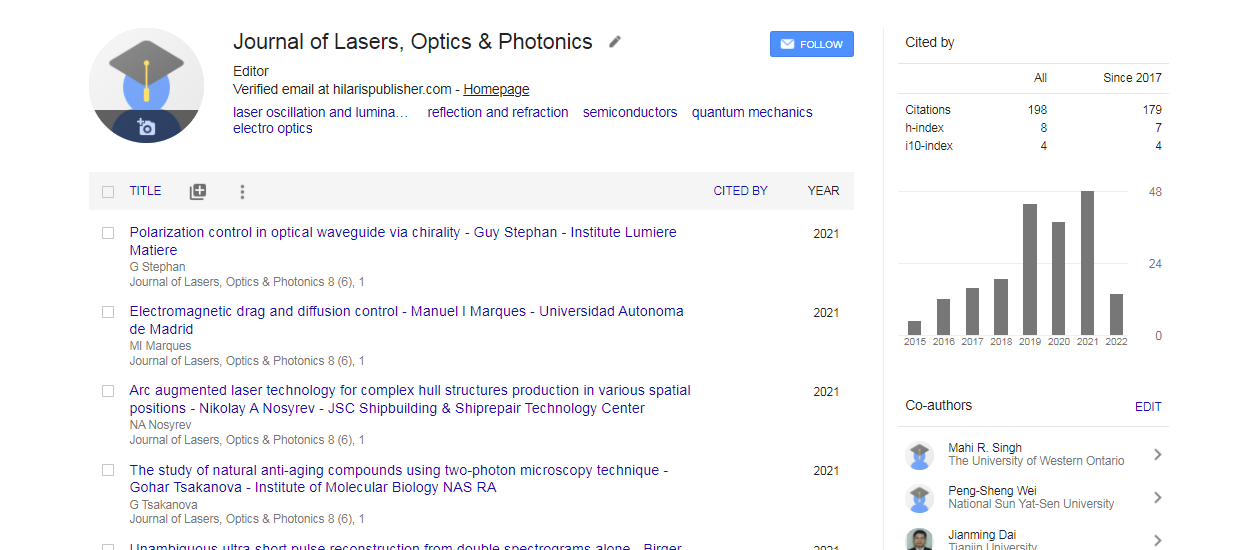
Journal of Lasers, Optics & Photonics received 279 citations as per Google Scholar report