Perspective - (2025) Volume 11, Issue 6
Received: 03-Nov-2025, Manuscript No. OHCR-25-167876;
Editor assigned: 05-Nov-2025, Pre QC No. P-167876;
Reviewed: 17-Nov-2025, QC No. Q-167876;
Revised: 22-Nov-2025, Manuscript No. R-167876;
Published:
29-Nov-2025
, DOI: 10.37421/2471-8726.2025.11.217
Citation: Malcangi, Patano. “Laser-Assisted Oral Hygiene for Aesthetic Gingival Recontouring.” Oral Health Case Rep 11 (2025): 217.
Copyright: © 2025 Malcangi P. This is an open-access article distributed under the terms of the Creative Commons Attribution License, which permits unrestricted use, distribution and reproduction in any medium, provided the original author and source are credited.
Aesthetic gingival recontouring has become a valuable procedure in cosmetic dentistry, aimed at achieving a harmonious gum line and enhancing the overall smile. Traditionally performed with scalpel or electrosurgery, gingival reshaping has evolved with the integration of dental lasers, which offer greater precision, minimal discomfort, and faster healing. Laser-assisted techniques allow for controlled tissue removal with reduced bleeding and inflammation, making them ideal for both functional and cosmetic procedures. This approach aligns well with the goals of modern dentistry, where patient expectations include not just clinical success but also rapid recovery and enhanced appearance. The role of laser technology in oral hygiene now extends beyond periodontal therapy to include aesthetic contouring, especially in cases of excessive gingival display, asymmetrical margins, or altered passive eruption, offering a minimally invasive alternative to traditional surgery [1].
The integration of laser-assisted techniques into oral hygiene and aesthetic management has expanded treatment possibilities in gingival recontouring. Patients increasingly seek procedures that are safe, effective, and deliver immediate cosmetic improvements without significant downtime. Laser technology, particularly diode and erbium lasers, has demonstrated efficacy in reshaping gingival tissues with precision while minimizing trauma. This makes it an attractive option for managing gummy smiles, irregular gingival architecture, or tissue overgrowth linked to plaque accumulation and inflammation. Moreover, the improved comfort and visual outcomes associated with laser procedures often lead to higher patient satisfaction and compliance with follow-up care. As aesthetic expectations grow, the synergy between laser-assisted hygiene and cosmetic soft tissue modification has become a focal point in contemporary dental practice. This evolution calls for refined techniques, patient education, and ethical consideration of cosmetic benefits versus biological cost [2].
Laser-assisted gingival recontouring represents a blend of hygiene, therapeutic, and aesthetic dentistry, offering precise control over soft tissue architecture. Diode lasers, commonly used in soft tissue procedures, operate at wavelengths that target pigmented tissues, allowing for efficient cutting with simultaneous coagulation. This minimizes bleeding, reduces bacterial load, and creates a dry, clean field for enhanced visualization during recontouring. The procedure can address conditions such as gingival hyperplasia, uneven margins, and altered passive eruption all of which contribute to disproportionate smile lines. From a hygiene perspective, removing inflamed or excess tissue also supports better plaque control and reduces pocket depth, reinforcing periodontal health. Aesthetic benefits include more symmetrical gum contours, improved tooth proportions, and enhanced smile balance. Unlike scalpel surgery, laser recontouring often requires no sutures and results in faster healing, less postoperative discomfort, and reduced risk of infection. The absence of mechanical trauma to adjacent tissues further preserves gingival integrity, making it ideal for patients with high esthetic demands. Patient selection and clinical expertise are crucial, as overuse or improper technique can lead to excessive tissue removal or delayed healing. However, when executed correctly, laser-assisted hygiene with aesthetic recontouring delivers predictable, patient-friendly results that address both health and cosmetic concerns in a single, efficient procedure [3].
The growing appeal of laser-assisted recontouring lies in its minimally invasive nature and ability to enhance both oral health and aesthetics without aggressive intervention. Patients often present with cosmetic concerns such as short teeth, uneven gum lines, or gummy smiles that stem from gingival overgrowth or inadequate passive eruption. Laser technology provides a conservative means of reshaping soft tissue to correct these conditions, often in a single visit and without anesthesia in minor cases. Incorporating this technique into hygiene maintenance allows clinicians to address early gingival changes before they become complex periodontal issues. Additionally, lasers can selectively remove inflamed or fibrotic tissue without affecting adjacent healthy areas, supporting individualized treatment plans. The optical precision of lasers enables sculpting of gingival margins to follow natural tooth contours, creating a more esthetic and symmetrical gingival display. Post-procedure discomfort is generally minimal, and healing is rapid, promoting greater acceptance among appearance-conscious patients. The integration of laser therapy into routine care requires proper training, understanding of tissue interactions, and adherence to safety protocols. Clinicians must also communicate realistic expectations to patients, emphasizing that while lasers improve visual outcomes, optimal results still depend on maintaining excellent oral hygiene and health. Overall, this approach reflects the shift toward multifunctional dental treatments that prioritize both wellness and visual satisfaction [4].
Laser-assisted oral hygiene with a focus on aesthetic gingival recontouring is increasingly recognized as a holistic treatment strategy that merges disease prevention with cosmetic enhancement. By using lasers as part of periodontal maintenance, clinicians can address subtle irregularities and early gingival pathology while concurrently refining soft tissue aesthetics. This dual-purpose approach is particularly effective for patients undergoing orthodontic treatment, smile design, or restorative procedures where gum contour directly affects the final result. Diode and erbium lasers enable precise removal of soft tissue around crowns, veneers, or bonding areas without damaging adjacent dental structures. The process also sterilizes the surgical site, reducing the microbial load and contributing to a healthier oral environment. While the cosmetic benefits are clear, ethical considerations must be observed especially regarding patient consent and understanding of biological limits. Not all aesthetic complaints require surgical correction, and over-reliance on lasers without clear clinical justification may lead to unnecessary tissue removal or unsatisfactory outcomes. Therefore, patient education and case selection remain essential. Proper documentation, preoperative imaging, and post-operative care instructions ensure transparency and improve satisfaction. As laser technology becomes more accessible, its incorporation into oral hygiene with an aesthetic objective represents an important advancement in personalized, conservative dental care that respects both function and appearance [5].
Google Scholar Cross Ref Indexed at
Google Scholar Cross Ref Indexed at
Google Scholar Cross Ref Indexed at
Google Scholar Cross Ref Indexed at
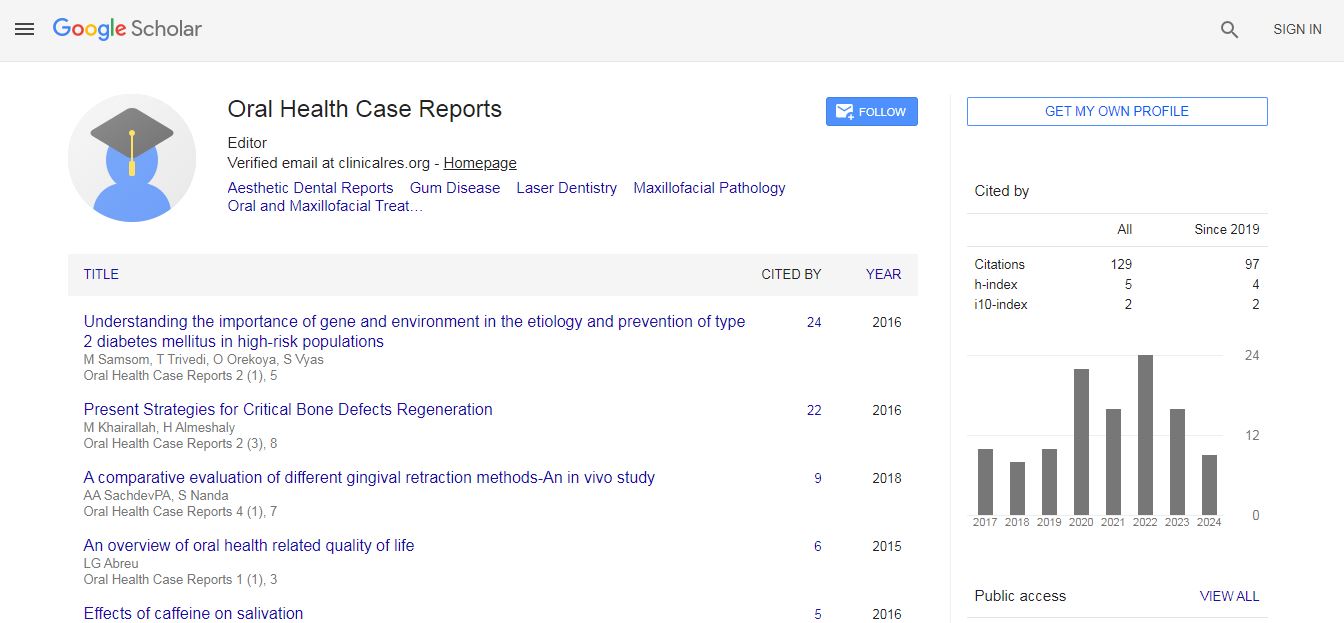
Oral Health Case Reports received 120 citations as per Google Scholar report