Perspective - (2025) Volume 12, Issue 5
Received: 01-Sep-2025, Manuscript No. jlop-26-179072;
Editor assigned: 03-Sep-2025, Pre QC No. P-179072;
Reviewed: 17-Sep-2025, QC No. Q-179072;
Revised: 22-Sep-2025, Manuscript No. R-179072;
Published:
29-Sep-2025
, DOI: 10.37421/2469-410X. 2025.12.223
Citation: Klein, Robert. ”Laser Safety: Risk, Standards and Applications.” J Laser Opt Photonics 12 (2025):223.
Copyright: © 2025 Klein R. This is an open-access article distributed under the terms of the Creative Commons Attribution License, which permits unrestricted use, distribution and reproduction in any medium, provided the original author and source are credited.
The field of laser safety has evolved significantly, driven by the expanding applications of laser technology across diverse sectors. A comprehensive review of laser safety standards and fundamental principles of risk assessment is crucial for identifying, evaluating, and mitigating potential hazards associated with laser use in areas ranging from industrial manufacturing to medical procedures. This necessitates a proactive approach to understanding laser classification, exposure limits, and the implementation of protective measures like eyewear and interlocks, all within the framework of established international and national standards [1].
The practical application of risk assessment methodologies is particularly important for high-power laser systems. This involves detailed hazard identification, analysis of exposure scenarios, and the implementation of robust control measures to ensure worker and public safety. Specific attention is given to scenarios involving industrial laser cutting and welding, where the risk of direct and reflected beam exposure, as well as hazardous emissions, is significant. A systematic, multi-layered safety approach is advocated for these applications [2].
In medical applications, the development and validation of computational models for predicting laser-induced tissue damage are paramount for ensuring safety. Research explores how different laser parameters, such as wavelength, pulse duration, and energy density, influence the depth and extent of thermal damage. This understanding is critical for establishing safe operating parameters and protective protocols in dermatological and surgical laser applications, aligning with current safety standards [3].
Femtosecond lasers, characterized by their high peak power and ultrashort pulses, present unique safety challenges. The risks associated with these lasers, including potential non-linear effects and optical breakdown, require advanced engineering controls and specialized personal protective equipment. Rigorous adherence to safety protocols and specialized training are emphasized, informed by updated standards [4].
The effectiveness of various laser safety eyewear materials in attenuating specific laser wavelengths is a critical area of study. Experimental data on optical density and spectral transmission provide essential insights for selecting appropriate protective eyewear based on laser specifications. These findings offer empirical evidence for the efficacy of protective equipment, contributing to the practical implementation of laser safety standards [5].
The regulatory landscape for laser safety is shaped by international standards such as IEC 60825-1 and ANSI Z136. Harmonization efforts between different regulatory bodies are ongoing, impacting manufacturers and users of laser products. Compliance and the role of risk assessment in meeting these standards are thoroughly examined [6].
Emerging laser technologies, particularly in additive manufacturing and advanced optics, introduce novel risks. Adapting existing risk assessment methodologies and safety standards to address new hazard profiles is essential. Interdisciplinary collaboration and continuous education are highlighted as crucial for maintaining high safety levels as laser applications evolve [7].
Laser safety officers (LSOs) play a pivotal role in implementing and enforcing laser safety programs. Their responsibilities include conducting risk assessments, developing safety protocols, and providing training. Qualified and well-trained LSOs are vital for ensuring compliance with laser safety standards and minimizing workplace accidents [8].
Beyond direct patient exposure, laser radiation in healthcare settings poses potential hazards to healthcare professionals and maintenance staff. Comprehensive risk assessments considering all potential exposure pathways and the development of robust safety procedures for a wide range of medical laser devices, in line with current safety standards, are necessary [9].
Understanding the biological effects of laser radiation on the eye and skin is fundamental to establishing accurate Maximum Permissible Exposure (MPE) limits. The mechanisms of laser-tissue interaction inform the establishment of safety standards, underscoring the importance of accurate hazard evaluation and appropriate control measures to prevent injury [10].
The critical aspects of laser safety standards and the fundamental principles of risk assessment are thoroughly explored within the context of laser applications. The evolution of safety regulations highlights the necessity of a proactive approach to identifying, evaluating, and mitigating potential hazards associated with laser use across various fields, from industrial manufacturing to medical procedures. The discussion encompasses the importance of understanding laser classification, exposure limits, and the use of protective measures such as eyewear and interlocks, all within the framework of established international and national standards [1].
Methodologies for practical risk assessment in high-power laser systems are examined. This includes detailing the process of hazard identification, analyzing exposure scenarios, and implementing effective control measures to ensure the safety of workers and the public. Specific attention is dedicated to scenarios involving industrial laser cutting and welding, where the risks of direct and reflected beam exposure, along with hazardous emissions, are significant. The authors advocate for a systematic, multi-layered safety approach [2].
Research is presented on the development and validation of computational models designed to predict laser-induced tissue damage, a key element in medical laser safety. The study investigates how diverse laser parameters, including wavelength, pulse duration, and energy density, influence the depth and extent of thermal damage. This comprehension is vital for establishing safe operating parameters and protective protocols in dermatological and surgical laser applications, ensuring adherence to current safety standards [3].
The challenges and best practices for ensuring safety during the operation of femtosecond lasers are addressed. These lasers are known for their high peak power and ultrashort pulses, posing specific risks such as non-linear effects and optical breakdown. The paper discusses the advanced engineering controls and personal protective equipment required, emphasizing the need for specialized training and rigorous adherence to safety protocols, informed by updated standards [4].
An investigation into the effectiveness of various laser safety eyewear materials in attenuating specific laser wavelengths commonly employed in industry and research is detailed. The study presents experimental data on optical density and spectral transmission, offering valuable insights for selecting appropriate protective eyewear based on precise laser specifications. The findings contribute to the practical implementation of laser safety standards by providing empirical evidence for the efficacy of protective equipment [5].
A review of the regulatory landscape for laser safety, with a focus on international standards like IEC 60825-1 and ANSI Z136, is provided. The article discusses harmonization efforts among different regulatory bodies and their implications for manufacturers and users of laser products. The importance of compliance and the role of risk assessment in meeting these standards are thoroughly examined [6].
Emerging risks and safety challenges associated with novel laser technologies, particularly in areas such as additive manufacturing and advanced optics, are explored. The paper emphasizes the necessity of adapting existing risk assessment methodologies and safety standards to address new hazard profiles. The authors highlight the significance of interdisciplinary collaboration and continuous education to maintain a high level of safety as laser applications evolve [7].
The critical role of laser safety officers (LSOs) in the implementation and enforcement of laser safety programs is the focus of this article. It outlines the responsibilities of LSOs, which include conducting risk assessments, developing safety protocols, and providing necessary training. The authors underscore the importance of qualified and well-trained LSOs for ensuring compliance with laser safety standards and minimizing workplace accidents [8].
The potential hazards of laser radiation in healthcare settings, extending beyond direct patient exposure to risks for healthcare professionals and maintenance staff, are examined. The paper stresses the need for comprehensive risk assessments that consider all potential exposure pathways and the development of robust safety procedures for a wide array of medical laser devices, in accordance with current safety standards [9].
The biological effects of laser radiation on the eye and skin are reviewed, offering an updated understanding of Maximum Permissible Exposure (MPE) limits. The article details the mechanisms of laser-tissue interaction and discusses how these effects inform the establishment of safety standards. The authors emphasize the importance of accurate hazard evaluation and the utilization of appropriate control measures to prevent injury [10].
This collection of articles comprehensively covers laser safety, emphasizing the critical role of risk assessment and adherence to established standards across various applications. It details the evolution of safety regulations, the specific challenges posed by high-power and femtosecond lasers, and the importance of protective measures like specialized eyewear. The research also extends to medical laser safety, including computational modeling of tissue damage and broader healthcare safety considerations beyond direct patient exposure. Furthermore, the regulatory landscape, the function of laser safety officers, and the biological effects of laser radiation are examined to ensure safe and compliant use of laser technology in industrial, medical, and research settings.
None
None
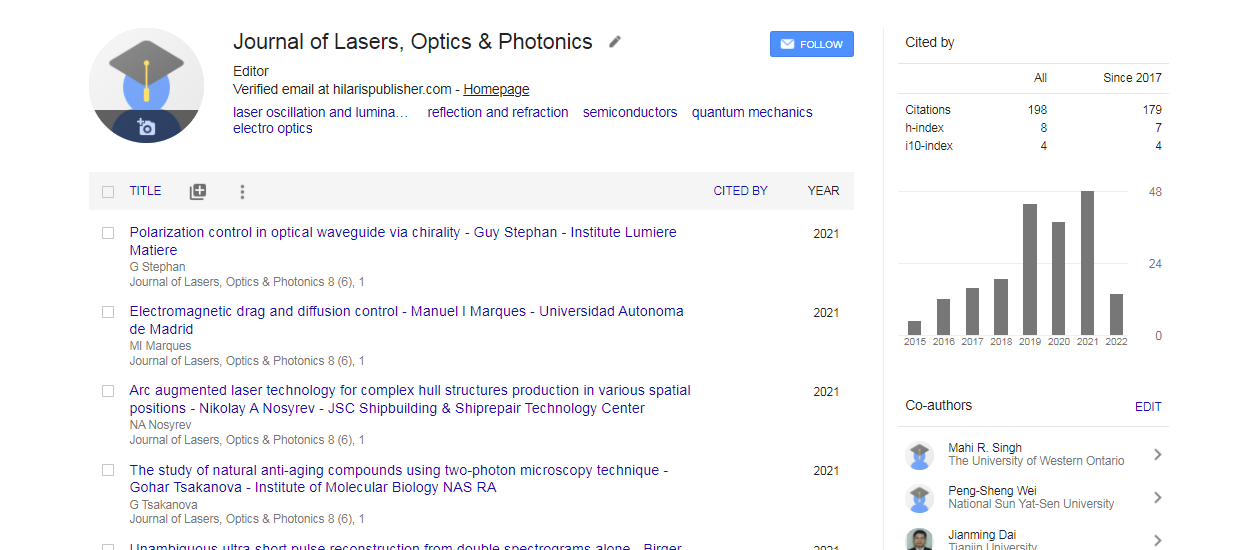
Journal of Lasers, Optics & Photonics received 279 citations as per Google Scholar report