Commentary - (2025) Volume 17, Issue 6
Received: 01-Dec-2025, Manuscript No. jbabm-26-182364;
Editor assigned: 03-Dec-2025, Pre QC No. P-182364;
Reviewed: 17-Dec-2025, QC No. Q-182364;
Revised: 22-Dec-2025, Manuscript No. R-182364;
Published:
29-Dec-2025
, DOI: 10.37421/1948-593X.2025.17.522
Citation: Markova, Elena G.. ”Label-Free Biosensing: Revolutionizing Disease Detection and Drug Discovery.” J Bioanal Biomed 17 (2025):522.
Copyright: © 2025 Markova G. Elena This is an open-access article distributed under the terms of the Creative Commons Attribution License, which permits unrestricted use, distribution and reproduction in any medium, provided the original author and source are credited.
Label-free bioanalytical technologies are fundamentally reshaping the landscape of disease detection and drug development by obviating the necessity for specific labels [1].
These sophisticated advancements are pivotal in enabling real-time monitoring of intricate molecular interactions and dynamic cellular events, consequently delivering enhanced sensitivity and specificity in analytical outcomes [1].
Among the significant breakthroughs in this domain, enhanced surface plasmon resonance (SPR), biolayer interferometry (BLI), quartz crystal microbalance (QCM), and microfluidic-based biosensors stand out, collectively contributing to faster, more accurate diagnostic capabilities and a deeper comprehension of complex biological processes [1].
Optical label-free biosensors, particularly those utilizing surface plasmon resonance (SPR) and interferometry principles, are currently demonstrating remarkable progress and potential [2].
Ongoing improvements in the functionalization of sensor surfaces and the refinement of detection mechanisms are facilitating the sensitive quantification of even low-abundance biomarkers and the precise characterization of protein-protein interactions with high affinity [2].
This continuous progress is critically important for achieving early disease diagnosis and for effectively monitoring the therapeutic efficacy of treatments [2].
Microfluidic devices are increasingly being integrated with label-free detection methodologies, leading to the development of exceptionally powerful bioanalytical platforms [3].
The inherent advantages of microfluidics, such as miniaturization and automation, when combined with sensitive detection techniques like electrochemical and optical sensing, pave the way for high-throughput screening, significant reductions in sample volume requirements, and the realization of point-of-care applications [3].
This synergistic combination is considerably accelerating the pace of biomarker discovery and the development of novel diagnostic assays [3].
Electrochemical label-free biosensors are steadily gaining traction due to their intrinsic high sensitivity, cost-effectiveness, and inherent compatibility with miniaturization strategies [4].
Significant advancements in the field of nanomaterials, including the utilization of graphene and metal nanoparticles, have dramatically enhanced signal transduction efficiency, thereby enabling the detection of a wide spectrum of analytes such as nucleic acids, proteins, and small molecules, which are crucial for accurate clinical diagnostics [4].
Biolayer interferometry (BLI) offers a robust and reliable label-free method for the analysis of biomolecular interactions [5].
Its capacity to monitor binding events in real-time without the need for labeling agents, coupled with its operational simplicity and cost-effectiveness, makes it exceptionally well-suited for a diverse array of applications, including drug discovery, antibody characterization, and the quantification of proteins within complex biological matrices [5].
The development and application of advanced nanomaterials are profoundly impacting the performance characteristics of label-free bioanalytical technologies [6].
Nanostructures, encompassing nanoparticles, nanowires, and quantum dots, provide an augmented surface area and possess unique optical or electronic properties, leading to substantial improvements in sensitivity and specificity across various biosensor platforms, including SPR, electrochemical, and optical sensors, for the detection of subtle biological changes [6].
Quartz crystal microbalance (QCM) sensors are undergoing continuous refinement for enhanced label-free detection of biological targets [7].
Modifications applied to QCM crystals, such as the incorporation of functionalized polymers and nanoparticles, serve to improve both sensitivity and selectivity, facilitating the detection of low-molecular-weight compounds and interactions within complex biological fluids, thus proving valuable for both environmental monitoring and clinical diagnostics [7].
The burgeoning integration of artificial intelligence (AI) and machine learning (ML) with label-free bioanalytical data represents a rapidly evolving field [8].
AI/ML algorithms possess the capability to meticulously analyze complex datasets generated by techniques like SPR and mass spectrometry, enabling the identification of subtle patterns, the prediction of disease states, and the optimization of diagnostic models, thereby substantially enhancing the interpretability and predictive power of label-free analyses [8].
The application of label-free bioanalytical technologies within the realm of drug discovery is experiencing rapid expansion [9].
Techniques such as SPR and BLI are indispensable tools for the high-throughput screening of compound libraries, the precise characterization of drug-target interactions, and the determination of binding kinetics and affinities [9].
This label-free approach facilitates rapid and efficient lead identification and optimization processes, thereby significantly accelerating the overall drug development pipeline [9].
The pursuit of single-molecule detection utilizing label-free techniques represents a significant frontier in bioanalysis, offering unprecedented insights into individual molecular behavior [10].
Advances in technologies such as optical trapping, atomic force microscopy, and single-particle interferometry are enabling the direct visualization and detailed characterization of individual biomolecules and their intricate interactions, thereby opening new avenues for fundamental biological research and the development of advanced diagnostic tools [10].
Label-free bioanalytical technologies are revolutionizing disease detection and drug development by eliminating the need for specific labels, enabling real-time monitoring of molecular interactions and cellular events with higher sensitivity and specificity [1].
Key breakthroughs include enhanced surface plasmon resonance (SPR), biolayer interferometry (BLI), quartz crystal microbalance (QCM), and microfluidic-based biosensors, contributing to faster, more accurate diagnostics and a deeper understanding of biological processes [1].
Optical label-free biosensors, particularly those employing SPR and interferometry, are showing significant progress [2].
Improvements in sensor surface functionalization and detection mechanisms are enabling sensitive quantification of low-abundance biomarkers and characterization of protein-protein interactions with high affinity, critical for early disease diagnosis and therapeutic efficacy monitoring [2].
Microfluidic devices are increasingly integrated with label-free detection methods to create powerful bioanalytical platforms [3].
The miniaturization and automation offered by microfluidics, combined with sensitive detection techniques like electrochemical and optical sensing, allow for high-throughput screening, reduced sample volumes, and point-of-care applications, accelerating biomarker discovery and diagnostic assay development [3].
Electrochemical label-free biosensors are gaining traction due to their inherent sensitivity, low cost, and compatibility with miniaturization [4].
Advances in nanomaterials, such as graphene and metal nanoparticles, have significantly enhanced signal transduction efficiency, enabling the detection of a wide range of analytes crucial for clinical diagnostics [4].
Biolayer interferometry (BLI) offers a robust label-free detection method for biomolecular interactions [5].
Its ability to monitor binding in real-time without labeling agents, combined with its simplicity and cost-effectiveness, makes it suitable for drug discovery, antibody characterization, and protein quantification in complex biological matrices [5].
The development of advanced nanomaterials is significantly impacting the performance of label-free bioanalytical technologies [6].
Nanostructures like nanoparticles, nanowires, and quantum dots provide increased surface area and unique optical or electronic properties, leading to enhanced sensitivity and specificity in SPR, electrochemical, and optical biosensors for detecting subtle biological changes [6].
Quartz crystal microbalance (QCM) sensors are being refined for label-free detection of biological targets [7].
Modifications to QCM crystals, such as the use of functionalized polymers and nanoparticles, improve sensitivity and selectivity for detecting low-molecular-weight compounds and interactions in complex biological fluids, making them valuable for environmental monitoring and clinical diagnostics [7].
The integration of artificial intelligence (AI) and machine learning (ML) with label-free bioanalytical data is a burgeoning field [8].
AI/ML algorithms can analyze complex datasets generated by techniques like SPR and mass spectrometry to identify subtle patterns, predict disease states, and optimize diagnostic models, enhancing the interpretability and predictive power of label-free analyses [8].
The application of label-free bioanalytical technologies in drug discovery is expanding rapidly [9].
Techniques such as SPR and BLI are invaluable for screening compound libraries, characterizing drug-target interactions, and determining binding kinetics and affinities, significantly accelerating the drug development pipeline [9].
Single-molecule detection using label-free techniques is a frontier in bioanalysis, offering unprecedented insight into molecular behavior [10].
Advances in optical trapping, atomic force microscopy, and single-particle interferometry are enabling the visualization and characterization of individual biomolecules and their interactions, opening new avenues for fundamental biological research and advanced diagnostics [10].
Label-free bioanalytical technologies are transforming disease detection and drug development by eliminating the need for labels. These methods offer real-time monitoring of molecular interactions and cellular events, providing enhanced sensitivity and specificity. Key technologies include surface plasmon resonance (SPR), biolayer interferometry (BLI), quartz crystal microbalance (QCM), and microfluidic biosensors. Advances in optical and electrochemical methods, coupled with nanomaterials, are improving detection limits and performance. Microfluidics integrates with label-free techniques for high-throughput screening and point-of-care applications. The integration of artificial intelligence and machine learning is enhancing data analysis and predictive capabilities. These technologies are crucial for early diagnosis, therapeutic monitoring, drug discovery, and fundamental biological research, with single-molecule detection representing a cutting-edge frontier.
None
None
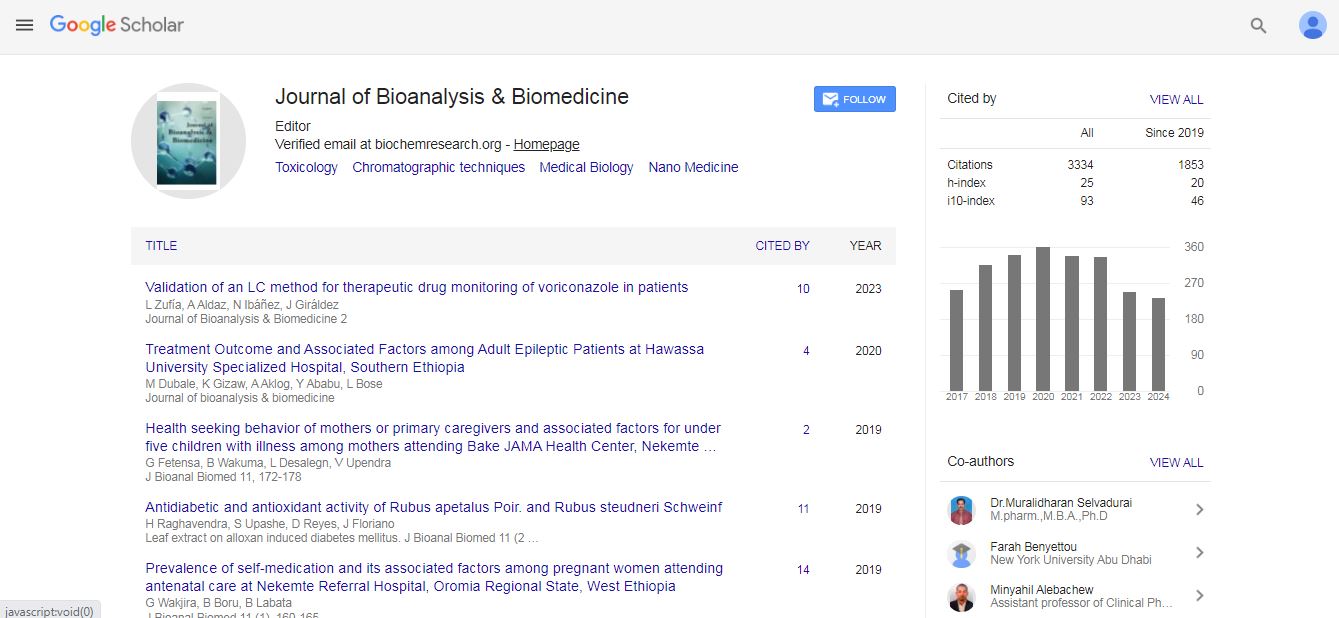
Journal of Bioanalysis & Biomedicine received 3099 citations as per Google Scholar report