Perspective - (2025) Volume 14, Issue 6
Received: 01-Dec-2025, Manuscript No. jeom-26-188200;
Editor assigned: 03-Dec-2025, Pre QC No. P-188200;
Reviewed: 17-Dec-2025, QC No. Q-188200;
Revised: 22-Dec-2025, Manuscript No. R-188200;
Published:
29-Dec-2025
, DOI: 10.37421/2169-026X.2025.14.560
Citation: Khalid, Salma. ”Knowledge Management: Driver of Organizational Success.” J Entrepren Organiz Manag 14 (2025):560.
Copyright: © 2025 Khalid S. This is an open-access article distributed under the terms of the Creative Commons Attribution License, which permits unrestricted use, distribution and reproduction in any medium, provided the original author and source are credited.
The study by Kotelnikova, Kolomiets, and Kopylova examines how entrepreneurial firms leverage organizational learning and knowledge management to gain a competitive edge, highlighting the critical role of knowledge acquisition, dissemination, and utilization for innovation and adaptation in dynamic markets [1].
Pinto, Martins, and Pereira explore the crucial role of knowledge management in fostering innovation, identifying mechanisms for knowledge creation, sharing, and application in developing new products and services [2].
Wei, Chen, and Li investigate the relationship between organizational learning, knowledge sharing, and employee performance within the context of digital transformation, revealing that a firm's ability to learn from digital initiatives significantly impacts employee productivity and engagement [3].
Garcia, Rodriguez, and Rossi delve into the impact of explicit and tacit knowledge management strategies on organizational agility, arguing that effective management of both knowledge types enables organizations to respond more effectively to market changes [4].
Lee, Kim, and Smith explore how social media platforms can be utilized as tools for organizational learning and knowledge sharing, examining the benefits and challenges of using these platforms to foster collaboration and disseminate information [5].
Chen, Brown, and Davis investigate the role of knowledge management systems (KMS) in enhancing organizational performance, analyzing how different types of KMS affect knowledge creation, storage, retrieval, and application, ultimately influencing decision-making quality and operational efficiency [6].
Johnson, Williams, and Miller examine the contribution of organizational learning to the development of a learning organization, identifying key characteristics and discussing how continuous learning processes and knowledge sharing are essential for sustained growth [7].
Lee, Kim, and Park focus on the application of knowledge management in project-based organizations, particularly in the construction industry, exploring how effective practices can improve project outcomes and enhance team collaboration [8].
Silva, Costa, and Fernandes examine the influence of organizational culture on knowledge management effectiveness, arguing that a culture encouraging open communication, trust, and collaboration is vital for successful knowledge sharing [9].
Khan, Al-Farsi, and Hassan explore the role of leadership in promoting organizational learning and knowledge management, highlighting how transformational and supportive leadership styles can foster an environment conducive to learning and innovation [10].
Organizational learning and knowledge management are pivotal for entrepreneurial firms seeking a competitive advantage, with effective knowledge acquisition, dissemination, and utilization being critical for innovation and adaptation in dynamic market environments. Key enablers include absorptive capacity, knowledge sharing routines, and management support, ultimately leading to improved organizational performance and entrepreneurial success [1].
The role of knowledge management in fostering innovation is explored through various mechanisms by which knowledge is created, shared, and applied for new product and service development, emphasizing the importance of a supportive organizational culture and technological infrastructure [2].
In the context of digital transformation, organizational learning and knowledge sharing significantly impact employee performance, productivity, and engagement, suggesting that investing in digital literacy and collaborative environments is vital for navigating change [3].
The effectiveness of explicit and tacit knowledge management strategies is crucial for organizational agility, enabling quicker responses to market shifts and opportunity seizing. The capture and transfer of tacit knowledge are particularly important for complex problem-solving and strategic decision-making [4].
Social media platforms offer avenues for organizational learning and knowledge sharing, fostering collaboration and information dissemination both internally and externally. Strategic implementation can enhance organizational memory and promote a learning-oriented culture [5].
Knowledge management systems (KMS) demonstrably impact organizational performance by influencing knowledge creation, storage, retrieval, and application, thereby improving decision-making quality and operational efficiency, provided there is user engagement and alignment with strategic objectives [6].
The development of a learning organization is intrinsically linked to continuous organizational learning, characterized by key attributes such as knowledge sharing and a commitment to adaptation, which are essential for sustained growth and effectiveness [7].
In project-based organizations, effective knowledge management practices are vital for improving project outcomes, reducing risks, and enhancing team collaboration, with a focus on knowledge transfer between projects and learning from past experiences [8].
Organizational culture plays a significant role in the effectiveness of knowledge management, with a culture that fosters open communication, trust, and collaboration being fundamental for successful knowledge sharing and utilization [9].
Leadership is instrumental in promoting organizational learning and knowledge management, with transformational and supportive styles creating environments conducive to learning, innovation, and knowledge sharing, setting the vision, and reinforcing supportive behaviors [10].
This collection of research highlights the critical role of organizational learning and knowledge management in driving innovation, competitive advantage, and overall organizational performance. Studies emphasize that effective knowledge acquisition, sharing, and utilization are essential for adapting to dynamic markets and achieving success. Factors such as organizational culture, leadership, technological infrastructure, and strategic implementation of knowledge management systems are identified as key enablers. The research also explores the impact of digital transformation, social media, and project-based learning on knowledge management practices and their outcomes. Ultimately, fostering a learning-oriented environment and robust knowledge management processes are crucial for sustained growth and effectiveness in today's business landscape.
None
None
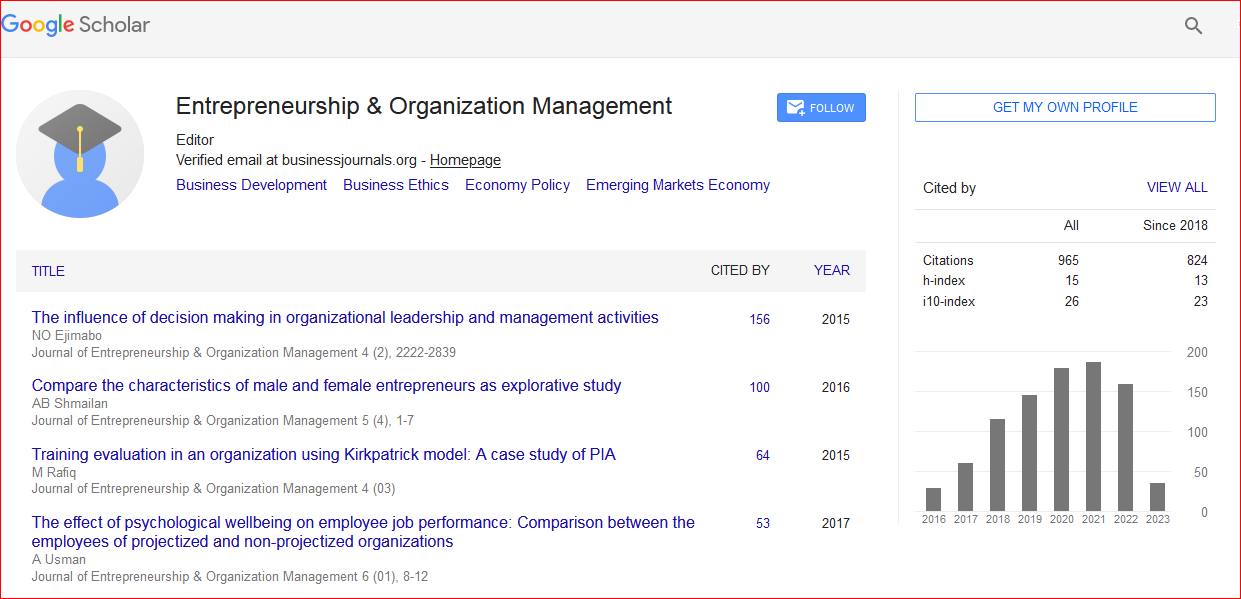
Entrepreneurship & Organization Management received 1115 citations as per Google Scholar report