Short Communication - (2025) Volume 13, Issue 5
Received: 01-Oct-2025, Manuscript No. jcdd-25-177675;
Editor assigned: 03-Oct-2025, Pre QC No. P-177675;
Reviewed: 17-Oct-2025, QC No. Q-177675;
Revised: 22-Oct-2025, Manuscript No. R-177675;
Published:
29-Oct-2025
, DOI: 10.37421/2329-9517.2025.13.698
Citation: Charlotte Dubois. ”Kidney Disease: Mechanisms,
Diagnostics, Therapies, Prevention.” J Cardiovasc Dis Diagn 13 (2025):698.
Copyright: © 2025 D. Charlotte This is an open-access article distributed under the terms of the Creative Commons Attribution License, which permits unrestricted use,
distribution and reproduction in any medium, provided the original author and source are credited.
Acute kidney injury (AKI) involves complex cellular and molecular pathways leading to significant kidney damage. Researchers have detailed mechanisms such as mitochondrial dysfunction, inflammation, oxidative stress, and programmed cell death. Understanding these intricate pathways is crucial for developing new therapeutic strategies aimed at protecting kidney function and preventing progression to chronic kidney disease (CKD) [1].
Significant advances have been made in managing the progression of chronic kidney disease, particularly through new pharmacologic therapies. This includes treatments like Sodium-Glucose Cotransporter 2 (SGLT2) inhibitors, Glucagon-Like Peptide-1 (GLP-1) receptor agonists, and mineralocorticoid receptor antagonists. These therapies play vital roles in slowing disease progression and improving patient outcomes, moving beyond traditional blood pressure and glycemic control approaches [2].
Diabetic kidney disease (DKD) continues to pose a major challenge in clinical nephrology, but promising new therapeutic approaches are emerging. Studies explore novel treatments such as dual SGLT1/2 inhibitors, endothelin receptor antagonists, and various anti-inflammatory and anti-fibrotic agents. These innovations offer considerable hope for improved management and effective prevention of disease progression in patients afflicted with diabetes [3].
Drug-induced acute kidney injury is a prevalent and serious complication, frequently caused by diverse pharmacologic agents. Comprehensive reviews detail its etiology, the underlying pathophysiological mechanisms, and critical management strategies. The emphasis here is on the paramount importance of early recognition and prompt, appropriate interventions to effectively mitigate kidney damage induced by drugs [4].
Ischemia-reperfusion injury stands as a significant contributor to AKI, often occurring when blood supply to the kidney is re-established following a period of deprivation. Investigations delve into the intricate cellular and molecular mechanisms, including oxidative stress, inflammation, and endothelial dysfunction, which collectively contribute to kidney damage during this critical process. This knowledge is essential for formulating potential protective strategies [5].
Glomerular diseases encompass a diverse array of conditions that invariably lead to substantial kidney damage. This area of research summarizes the complex pathogenesis of various glomerular diseases, spanning from immune-mediated mechanisms to genetic factors. Additionally, it highlights both current and emerging therapeutic strategies specifically designed to preserve glomerular function and prevent the devastating onset of kidney failure [6].
Early detection of acute kidney injury is absolutely critical for enhancing patient outcomes. Recent articles highlight novel biomarkers that demonstrate considerable promise for the early identification and accurate prognosis of AKI. These include innovative urine and plasma markers, which offer more sensitive and specific indicators of kidney damage than traditional creatinine measurements, thereby enabling timelier intervention [7].
Renal fibrosis represents a common and often irreversible endpoint for the majority of progressive kidney diseases. It is primarily characterized by the excessive and pathological accumulation of extracellular matrix proteins. Research explores the cellular and molecular mechanisms that drive renal fibrosis, elucidating the crucial roles played by myofibroblasts, inflammation, and various growth factors. Understanding these pathways is pivotal for developing effective anti-fibrotic therapies aimed at preserving kidney function [8].
Hypertension is widely recognized as a leading cause and a significant accelerator of chronic kidney disease. Reviews extensively detail the intricate mechanisms through which elevated blood pressure directly damages the kidneys, encompassing phenomena such as glomerular hypertension, heightened oxidative stress, and persistent inflammation. They also cover comprehensive management strategies for hypertension, designed to mitigate kidney damage and prevent the relentless progression to end-stage renal disease [9].
Exposure to various environmental toxicants contributes substantially to kidney damage and accelerates disease progression. This includes an overview of diverse environmental pollutants, heavy metals, and industrial chemicals that can adversely affect kidney function. Recognizing and understanding these harmful exposures is fundamental for the development of public health initiatives and effective preventive strategies against the widespread incidence of kidney disease [10].
Acute Kidney Injury (AKI) involves intricate cellular and molecular pathways that ultimately lead to kidney damage. Key mechanisms identified include mitochondrial dysfunction, significant inflammation, oxidative stress, and various forms of programmed cell death [1]. A specific and critical cause of AKI is ischemia-reperfusion injury, which occurs when blood supply to the kidney is restored after a period of deprivation. During this process, complex cellular and molecular events, such as heightened oxidative stress, inflammatory responses, and endothelial dysfunction, contribute substantially to the resulting kidney damage [5]. Recognizing AKI early is paramount for improving patient outcomes. To this end, novel biomarkers are proving valuable for early identification and prognosis of AKI. These include advanced urine and plasma markers that offer superior sensitivity and specificity compared to traditional creatinine measurements, enabling more timely interventions and potentially mitigating long-term damage [7].
Managing the progression of chronic kidney disease (CKD) has seen substantial advancements, particularly with the introduction of new pharmacologic therapies. These include the widespread use of SGLT2 inhibitors, GLP-1 receptor agonists, and mineralocorticoid receptor antagonists, which have demonstrated significant roles in slowing disease progression and enhancing patient outcomes beyond conventional blood pressure and glycemic control strategies [2]. Diabetic kidney disease (DKD) represents a major ongoing challenge; however, new therapeutic approaches are actively being explored. This includes promising emerging therapies such as dual SGLT1/2 inhibitors, endothelin receptor antagonists, and novel anti-inflammatory and anti-fibrotic agents, all offering renewed hope for more effective management and prevention of disease progression in diabetic patients [3].
Glomerular diseases constitute a diverse group of conditions that consistently lead to significant kidney damage. Extensive reviews summarize the complex pathogenesis of these diseases, ranging from various immune-mediated mechanisms to specific genetic factors. Research also highlights current and emerging therapeutic strategies specifically designed to preserve crucial glomerular function and prevent the devastating onset of kidney failure [6]. A common and often irreversible endpoint for most progressive kidney diseases is renal fibrosis. This condition is characterized by the excessive and pathological accumulation of extracellular matrix proteins. Understanding the cellular and molecular mechanisms driving renal fibrosis, specifically the critical roles of myofibroblasts, inflammation, and various growth factors, is absolutely crucial for developing effective anti-fibrotic therapies aimed at preserving kidney function [8].
Beyond intrinsic kidney pathologies, external and systemic factors significantly contribute to kidney damage. Drug-induced AKI is a frequent and serious complication, often resulting from diverse pharmacologic agents. Comprehensive reviews detail its etiology, the underlying pathophysiological mechanisms, and crucial management strategies, emphasizing the importance of early recognition and appropriate interventions to mitigate kidney damage [4]. Hypertension is well-established as a leading cause and a significant accelerator of chronic kidney disease. Studies extensively detail the intricate mechanisms through which elevated blood pressure harms the kidneys, including phenomena like glomerular hypertension, oxidative stress, and chronic inflammation. Effective, comprehensive management strategies for hypertension are indispensable for mitigating kidney damage and preventing the progression to end-stage renal disease [9].
Furthermore, exposure to various environmental toxicants also contributes substantially to kidney damage and disease progression. This includes a broad overview of diverse environmental pollutants, heavy metals, and industrial chemicals that can adversely affect kidney function. A thorough understanding of these harmful exposures is fundamentally crucial for developing robust public health initiatives and implementing effective preventive strategies against the widespread incidence and exacerbation of kidney disease [10]. This holistic perspective underscores the complexity of kidney disorders, requiring multi-pronged research and therapeutic approaches.
This collection of articles offers a comprehensive overview of kidney diseases, encompassing acute kidney injury (AKI) and chronic kidney disease (CKD), alongside their underlying mechanisms, causes, and therapeutic advancements. It highlights the complex cellular and molecular pathways involved in AKI, such as mitochondrial dysfunction, inflammation, and oxidative stress, often triggered by events like ischemia-reperfusion injury and drug exposure. Early detection of AKI is crucial, with novel biomarkers showing promise for timely intervention. For CKD, recent pharmacologic therapies including SGLT2 inhibitors and GLP-1 receptor agonists are significantly slowing disease progression and improving patient outcomes. Diabetic kidney disease and various glomerular diseases also benefit from emerging therapeutic strategies aimed at preserving kidney function. The role of systemic factors like hypertension in accelerating CKD and the common progression towards renal fibrosis are detailed, emphasizing the need for anti-fibrotic therapies. Moreover, the impact of environmental toxicants on kidney health underscores the importance of preventive strategies. This body of work collectively emphasizes the multifaceted nature of kidney disorders and the ongoing efforts in understanding pathogenesis, improving diagnostics, and developing targeted treatments to combat kidney damage and prevent end-stage renal disease.
Indexed at, Google Scholar, Crossref
Indexed at, Google Scholar, Crossref
Indexed at, Google Scholar, Crossref
Indexed at, Google Scholar, Crossref
Indexed at, Google Scholar, Crossref
Indexed at, Google Scholar, Crossref
Indexed at, Google Scholar, Crossref
Indexed at, Google Scholar, Crossref
Indexed at, Google Scholar, Crossref
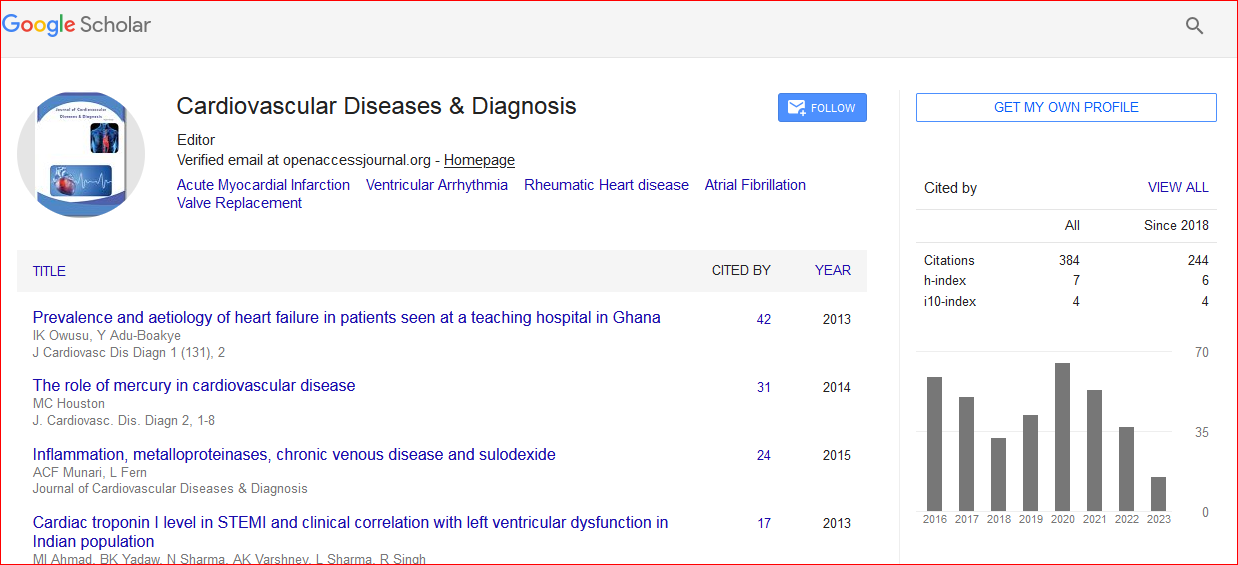
Cardiovascular Diseases & Diagnosis received 427 citations as per Google Scholar report