Short Communication - (2025) Volume 14, Issue 2
Received: 01-Apr-2025, Manuscript No. jeom-26-188164;
Editor assigned: 03-Apr-2025, Pre QC No. P-188164;
Reviewed: 17-Apr-2025, QC No. Q-188164;
Revised: 22-Apr-2025, Manuscript No. R-188164;
Published:
29-Apr-2025
, DOI: 10.37421/2169-026X.2025.14.527
Citation: Gonzalez, Maria. ”Key Factors for Entrepreneurial Competitive Advantage.” J Entrepren Organiz Manag 14 (2025):527.
Copyright: © 2025 Gonzalez M. This is an open-access article distributed under the terms of the Creative Commons Attribution License, which permits unrestricted use, distribution and reproduction in any medium, provided the original author and source are credited.
In today's dynamic and increasingly turbulent business environments, the ability of firms to achieve and sustain competitive advantage is paramount. This pursuit is significantly influenced by a firm's capacity to adapt and evolve in response to market shifts and emerging opportunities. Dynamic capabilities, which encompass the ability to sense, seize, and reconfigure resources, have been identified as a critical mechanism through which organizations can navigate these complex landscapes and enhance their overall competitiveness. Entrepreneurial organizations, in particular, must effectively implement these capabilities to thrive and achieve long-term success [1].
The concept of organizational ambidexterity, defined as the simultaneous pursuit of exploiting existing competencies while exploring new opportunities, emerges as another crucial driver of long-term competitiveness. Firms that can skillfully balance these two seemingly contradictory activities are better positioned to foster innovation and adapt to evolving market demands. This delicate balance is a critical aspect for effective management within entrepreneurial contexts, enabling sustained growth and market relevance [2].
Strategic agility is recognized as a vital attribute for organizations operating in rapidly changing industries. It refers to the capability of an organization to quickly sense and respond to market shifts, coupled with the effective reallocation of resources. This agility is essential not only for survival but also for achieving sustained growth, offering direct implications for the strategic decision-making processes in entrepreneurship and management [3].
The influence of absorptive capacity on a firm's ability to innovate and achieve competitiveness is a well-established area of research. Studies suggest that organizations possessing a higher absorptive capacity are more adept at identifying, assimilating, and exploiting external knowledge. This enhanced capability is crucial for developing and maintaining a sustainable competitive advantage within the dynamic entrepreneurial landscape [4].
Furthermore, the strategic importance of inter-organizational relationships and network ties in contributing to competitive advantage cannot be overstated. Through strategic alliances and collaborative networks, firms can gain access to critical resources, valuable knowledge, and new markets, thereby significantly enhancing the competitiveness of entrepreneurial ventures and expanding their reach [5].
Leadership plays a pivotal role in shaping an organization's ability to compete effectively. Research indicates that specific leadership styles, such as transformational and authentic leadership, can foster an organizational culture that is more innovative and adaptable. This, in turn, leads to improved competitive outcomes, a factor of particular relevance for founder-led businesses [6].
Innovation ecosystems are increasingly recognized as a strategic imperative for fostering organizational competitiveness. By effectively managing external relationships and collaborations within these broader ecosystems, firms can leverage shared knowledge and resources to gain a significant competitive edge. This collaborative approach allows for a more robust and resilient competitive positioning [7].
The pervasive impact of digital transformation on business strategy and organizational competitiveness is undeniable. The adoption of digital technologies offers the potential for enhanced operational efficiency, the development of novel business models, and improved customer engagement, all of which are critical for the success of modern entrepreneurial ventures navigating the digital age [8].
Organizational culture is another key determinant of competitive advantage. A strong and adaptive culture that actively encourages innovation, collaboration, and continuous learning serves as a crucial intangible asset. This cultural foundation contributes significantly to long-term success and market differentiation, providing a unique and enduring source of competitive strength [9].
Finally, effective knowledge management practices are fundamental to organizational competitiveness. The capacity for creating, sharing, and utilizing knowledge is essential for firms to develop unique capabilities and sustain a competitive edge in today's knowledge-intensive economy. This strategic management of knowledge resources underpins a firm's ability to innovate and adapt [10].
Dynamic capabilities are essential for firms to not only achieve but also sustain competitive advantage, especially within volatile and unpredictable market conditions. The ability to effectively sense emerging trends, seize emerging opportunities, and reconfigure internal resources is crucial for adapting to constant market shifts. This adaptive capacity directly influences an organization's overall competitiveness, making its effective implementation a cornerstone for entrepreneurial firms aiming for enduring success [1].
Organizational ambidexterity represents a strategic imperative for long-term competitiveness. It involves the dual capacity to exploit current, well-established competencies while simultaneously exploring new avenues and opportunities. This balancing act is critical for fostering a continuous stream of innovation and ensuring that a firm can effectively adapt to the ever-evolving demands of the market, a key challenge for management in entrepreneurial settings [2].
Strategic agility is a critical capability that enables organizations to thrive in industries characterized by rapid change. It is defined by the swiftness with which a firm can identify market shifts and respond to them, complemented by the efficient reallocation of its resources. This responsiveness is vital for both the survival and growth of businesses, offering tangible benefits for entrepreneurial endeavors and management practices [3].
Absorptive capacity plays a significant role in a firm's ability to innovate and maintain its competitive standing. Organizations that excel in their absorptive capacity are better equipped to recognize, internalize, and leverage external knowledge. This proficiency is a key determinant of sustained competitive advantage within the dynamic and often unpredictable entrepreneurial landscape [4].
Network ties and inter-organizational relationships are instrumental in building and enhancing firm competitiveness. Through the formation of strategic alliances and participation in collaborative networks, businesses can gain access to a broader range of resources, specialized knowledge, and new markets. These external connections are vital for strengthening the competitive position of entrepreneurial ventures [5].
The impact of leadership styles on organizational competitiveness is profound. Research highlights that transformational and authentic leadership approaches are particularly effective in cultivating an organizational culture that is inherently innovative and adaptable. Such cultures foster an environment conducive to improved competitive outcomes, especially in contexts where entrepreneurial leadership is prominent [6].
Innovation ecosystems are increasingly recognized as strategic assets that can significantly boost organizational competitiveness. By actively managing their external relationships and engaging in collaborative efforts within these ecosystems, firms can gain a distinct competitive advantage. This is achieved through the synergistic exchange of knowledge and resources, fostering collective innovation and resilience [7].
Digital transformation is fundamentally reshaping business strategies and influencing organizational competitiveness. The strategic integration of digital technologies empowers firms to achieve greater operational efficiency, develop innovative business models, and forge stronger connections with their customers. These advancements are crucial for modern entrepreneurial ventures seeking to remain competitive [8].
Organizational culture serves as a critical driver of competitive advantage. A robust and adaptable culture that actively promotes innovation, encourages collaboration among employees, and fosters a commitment to continuous learning acts as a vital intangible asset. This cultural strength is essential for achieving long-term market success and differentiation [9].
Knowledge management practices are foundational to achieving and maintaining organizational competitiveness. The systematic processes of creating, sharing, and effectively utilizing knowledge allow firms to develop unique capabilities and secure a lasting competitive edge. In today's knowledge-driven economy, this strategic management of intellectual capital is indispensable [10].
This collection of research highlights key factors contributing to organizational competitiveness, particularly within entrepreneurial contexts. Dynamic capabilities such as sensing, seizing, and reconfiguring resources are crucial for navigating turbulent environments. Organizational ambidexterity, balancing exploration and exploitation, drives innovation and long-term success. Strategic agility, the ability to sense and respond quickly to market changes, is vital for survival and growth. Absorptive capacity enhances a firm's ability to leverage external knowledge for innovation. Inter-organizational networks provide access to resources and markets, while effective leadership fosters adaptability. Innovation ecosystems and digital transformation offer significant competitive advantages through collaboration and technology adoption. Finally, a strong, adaptive organizational culture and effective knowledge management practices are presented as essential intangible assets for sustained competitive advantage.
None
None
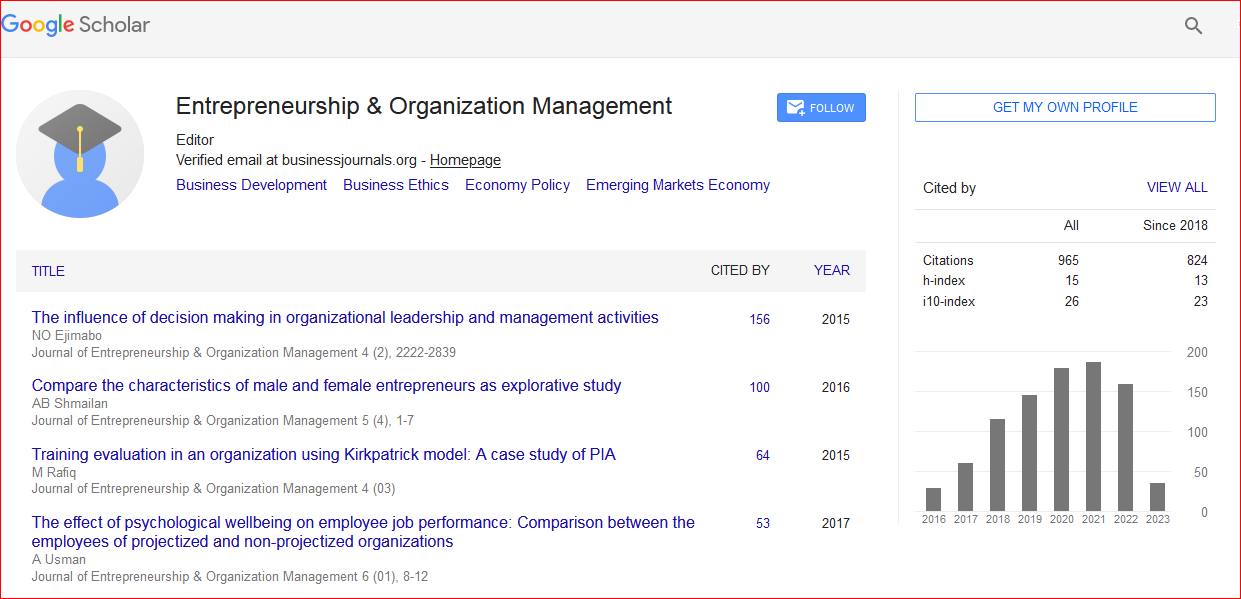
Entrepreneurship & Organization Management received 1115 citations as per Google Scholar report