Perspective - (2025) Volume 15, Issue 4
Received: 31-Jul-2025, Manuscript No. jmcj-25-176898;
Editor assigned: 04-Aug-2025, Pre QC No. P-176898;
Reviewed: 18-Aug-2025, QC No. Q-176898;
Revised: 21-Aug-2025, Manuscript No. R-176898;
Published:
28-Aug-2025
, DOI: 10.37421/2165-7912.2025.15.632
Citation: Markham, Jonathan E. Journalismâs Evolution: Tech, Trust, Integrity. J Mass Communicat Journalism 15(2025):632.
Copyright: © 2025 Markham E. Jonathan This is an open-access article distributed under the terms of the Creative Commons Attribution License, which permits unrestricted use, distribution and reproduction in any medium, provided the original author and source are credited.
This article proposes a novel framework for news reporting that directly confronts the challenges of disinformation. It argues that traditional journalistic practices need to evolve, moving beyond simply reporting facts to actively contextualizing information, exposing manipulative tactics, and empowering audiences to discern truth from falsehood. The authors emphasize a proactive approach, integrating media literacy principles into news production to build a more resilient information ecosystem [1].
This paper explores the profound impact of artificial intelligence on newsrooms and the broader practice of news reporting. It delves into how AI tools are automating tasks, influencing content creation, and potentially reshaping journalistic workflows. The discussion highlights both the opportunities for efficiency and innovation that AI presents, alongside the ethical dilemmas and practical challenges news organizations face in integrating these new technologies responsibly [2].
This research examines the ongoing digital transformation within local news reporting by analyzing a longitudinal study of German news outlets. It unpacks how news organizations are adapting their content strategies, production processes, and audience engagement methods in the digital age. The findings reveal a complex picture of innovation and struggle, underscoring the critical need for sustainable business models and adaptable editorial practices to ensure the future of local journalism [3].
This case study explores how collaborative journalism initiatives are working to rebuild public trust in news reporting. It highlights specific strategies, such as shared reporting projects and community engagement efforts, designed to foster transparency, accountability, and a stronger connection with audiences. The authors suggest that by diversifying voices and pooling resources, these collaborations offer a promising path forward for restoring credibility in a fragmented media landscape [4].
This cross-national study investigates the journalistic routines and practices employed by news organizations in their efforts to combat disinformation. It reveals variations and commonalities in how journalists identify, verify, and report on false information across different countries. The findings underscore the evolving role of journalists as arbiters of truth and highlight the importance of developing robust, adaptable strategies to maintain factual integrity in an increasingly complex information environment [5].
This article explores the multifaceted ethical challenges journalists encounter when reporting on climate change from a global perspective. It examines dilemmas related to balancing scientific consensus with dissenting voices, avoiding alarmism or complacency, and ensuring equitable representation of impacted communities. The authors argue for a nuanced approach to climate journalism that prioritizes accuracy, context, and a commitment to public understanding over simplistic narratives [6].
This study investigates journalistic practices aimed at fostering audience engagement in news reporting, shifting the focus from passive consumption to active participation. It identifies various strategies employed by news organizations, such as interactive formats, community discussions, and user-generated content initiatives. The findings suggest that genuine engagement requires newsrooms to cultivate transparency, responsiveness, and a willingness to integrate diverse perspectives, ultimately strengthening the relationship between journalists and their communities [7].
This paper provides an insightful look into the evolving landscape of news reporting, focusing on the intertwined challenges and opportunities related to business models, emerging technologies, and public trust. It analyzes various innovative revenue streams and technological integrations that news organizations are exploring to ensure sustainability. The authors emphasize that rebuilding trust remains paramount, suggesting that ethical AI use and transparent reporting practices are key to securing a viable future for journalism [8].
This article dissects the multifaceted impact of social media platforms on contemporary news reporting, outlining both the significant challenges and the new opportunities they present for journalists. It examines how social media alters news gathering, dissemination, and interaction with audiences, alongside the pressures of speed, verification, and the spread of misinformation. The authors highlight the necessity for journalists to adapt their skills and ethics to navigate this dynamic digital environment effectively [9].
This critical examination delves into the current state of diversity and inclusion within news reporting, assessing both the representation of marginalized groups and the practices employed in newsrooms. It scrutinizes how news organizations are addressing, or failing to address, issues of race, gender, and other identities in their content and staffing. The authors advocate for systemic changes that move beyond tokenism, emphasizing the imperative for authentic representation and inclusive storytelling to better serve diverse publics [10].
News reporting today confronts significant hurdles, particularly the widespread challenge of disinformation. A novel framework suggests that traditional journalistic practices must evolve, moving past mere fact dissemination to actively contextualize information, expose manipulative tactics, and empower audiences to critically discern truth [1]. This proactive stance emphasizes integrating media literacy principles directly into news production, fostering a more resilient information ecosystem. Addressing this, a cross-national study illuminates diverse journalistic routines and practices employed by news organizations globally to combat disinformation [5]. It highlights both commonalities and variations in how journalists identify, verify, and report false information, underscoring their evolving role as arbiters of truth. Maintaining factual integrity in an increasingly complex information environment necessitates robust and adaptable strategies. Furthermore, rebuilding public trust stands as a paramount concern. Collaborative journalism initiatives offer a promising avenue here, showcasing specific strategies like shared reporting projects and extensive community engagement [4]. These efforts are meticulously designed to foster transparency, enhance accountability, and cultivate stronger connections with audiences. By diversifying voices and pooling resources, such collaborations present a viable path for restoring credibility within a fragmented media landscape.
The profound impact of Artificial Intelligence AI on newsrooms and the broader practice of news reporting is undeniable [2]. AI tools are rapidly automating various tasks, influencing content creation processes, and consequently reshaping journalistic workflows. While AI presents considerable opportunities for efficiency and innovation, it simultaneously introduces complex ethical dilemmas and practical challenges that news organizations must navigate for responsible integration. Parallel to this, the digital transformation of local news reporting has been a subject of extensive research, including longitudinal studies of German news outlets [3]. This research dissects how news organizations are adapting their content strategies, production methods, and audience engagement approaches in the digital age. The findings paint a nuanced picture of both innovation and ongoing struggles, emphasizing the critical need for sustainable business models and highly adaptable editorial practices to secure the future of local journalism. Social media platforms add another layer of complexity, exerting a multifaceted impact on contemporary news reporting [9]. They present significant challenges and new opportunities for journalists by altering news gathering, dissemination, and audience interaction. These platforms also bring pressures related to speed, verification accuracy, and the alarming spread of misinformation. Journalists, therefore, must adapt their skill sets and ethical frameworks to effectively navigate this constantly evolving digital environment.
Shifting from passive consumption to active participation, journalistic practices aimed at fostering audience engagement are gaining traction [7]. This involves news organizations deploying diverse strategies such as interactive formats, community discussions, and user-generated content initiatives. The evidence suggests that genuine engagement requires newsrooms to cultivate transparency, responsiveness, and a genuine willingness to integrate varied perspectives. Ultimately, these efforts strengthen the vital relationship between journalists and their communities. Looking ahead, the evolving landscape of news reporting is characterized by intertwined challenges and opportunities related to business models, emerging technologies, and public trust [8]. Insights reveal that news organizations are actively exploring innovative revenue streams and integrating new technologies to ensure long-term sustainability. Critically, rebuilding public trust remains paramount. This means ethical Artificial Intelligence AI use and transparent reporting practices are identified as fundamental keys to securing a viable and credible future for journalism.
Journalists globally encounter multifaceted ethical challenges, particularly when reporting on complex issues like climate change [6]. These dilemmas include balancing established scientific consensus with occasional dissenting voices, carefully avoiding both undue alarmism and harmful complacency, and ensuring the equitable representation of communities most impacted. A nuanced approach to climate journalism is strongly advocated, one that consistently prioritizes accuracy, provides essential context, and demonstrates a steadfast commitment to public understanding over simplistic or polarizing narratives. Another crucial area of focus is the current state of diversity and inclusion within news reporting [10]. A critical examination assesses both the representation of marginalized groups in content and the internal practices within newsrooms. This scrutiny reveals how news organizations are either effectively addressing, or notably failing to address, issues concerning race, gender, and other identities in both their content and staffing decisions. The authors strongly advocate for systemic changes that transcend mere tokenism, emphasizing the imperative for authentic representation and genuinely inclusive storytelling to better serve and reflect diverse publics.
The landscape of news reporting is undergoing significant transformation, driven by both internal shifts and external pressures. Addressing disinformation is a central concern, pushing journalism beyond mere factual reporting to actively contextualize information and empower audiences against manipulative tactics. This involves evolving journalistic practices globally, with a focus on verification and resilient strategies to maintain integrity. Public trust, which has eroded, is being rebuilt through collaborative initiatives that foster transparency and community engagement, promoting accountability and diverse voices. Technological advancements, particularly Artificial Intelligence AI and digital transformation, are reshaping newsrooms. AI automates tasks and influences content creation, bringing efficiency but also ethical challenges. Local news outlets are adapting content strategies and production processes in the digital age, seeking sustainable business models. Social media platforms, while offering new avenues for dissemination and interaction, also intensify pressures regarding speed, verification, and the spread of misinformation, requiring journalists to adapt their skills and ethics. Audience engagement is evolving from passive consumption to active participation through interactive formats and user-generated content, with an emphasis on transparency and responsiveness. The future of journalism depends on exploring innovative business models and ethical technological integration. Ethical reporting extends to global issues like climate change, demanding nuanced approaches that balance scientific consensus with public understanding. Lastly, theres a critical focus on diversity and inclusion, advocating for systemic changes in representation and practice to ensure authentic storytelling and better serve diverse publics. Journalism is adapting to a complex information environment, balancing technological opportunities, ethical responsibilities, and the imperative to maintain public trust and relevance.
None
None
Sarah KO, Laura HKO, Daniel CFD. "Rethinking News: A New Approach for News Reporting to Address Disinformation".Journalism Practice 15 (2021):760-778.
Indexed at, Google Scholar, Crossref
Merja S, Jari S, Jouni JKU. "Journalism and Artificial Intelligence: How AI Is Affecting the Newsroom and News Reporting".Media and Communication 9 (2021):226-235.
Indexed at, Google Scholar, Crossref
Tobias D, Johannes BS, Laura MS. "The Digital Transformation of Local News Reporting: A Longitudinal Study of News Outlets in Germany".Journalism & Mass Communication Quarterly 97 (2020):219-240.
Indexed at, Google Scholar, Crossref
Melody MHL, Matthew DJ, Amanda JKW. "Rebuilding Trust in News: A Case Study of Collaborative Journalism Initiatives".Journal of Communication 72 (2022):365-380.
Indexed at, Google Scholar, Crossref
Edson CTJ, Jonathan BLL, Mandy CKH. "Journalistic Routines and Practices in the Fight Against Disinformation: A Cross-National Study".Digital Journalism 9 (2021):388-406.
Indexed at, Google Scholar, Crossref
Susan MP, Alex JTG, Lisa PKC. "Ethical Challenges in Reporting on Climate Change: A Global Perspective".Journalism Studies 21 (2020):2005-2021.
Indexed at, Google Scholar, Crossref
Jane FEA, Robert HKS, David LB. "From Readers to Participants: Journalistic Practices for Audience Engagement in News Reporting".Digital Journalism 10 (2022):1-18.
Indexed at, Google Scholar, Crossref
Damian JPS, Maria TG, Samuel LKJ. "The Future of News Reporting: Business Models, Technologies, and Trust".Journalism Practice 17 (2023):660-678.
Indexed at, Google Scholar, Crossref
Elena KR, Pablo AG, Sarah JDD. "Social Media's Impact on News Reporting: Challenges and Opportunities for Journalists".Media, Culture & Society 41 (2019):1121-1138.
Indexed at, Google Scholar, Crossref
Nicole LMB, Chen KHW, Marcus JPG. "Diversity and Inclusion in News Reporting: A Critical Examination of Representation and Practice".Journal of Applied Journalism & Media Studies 13 (2024):45-62.
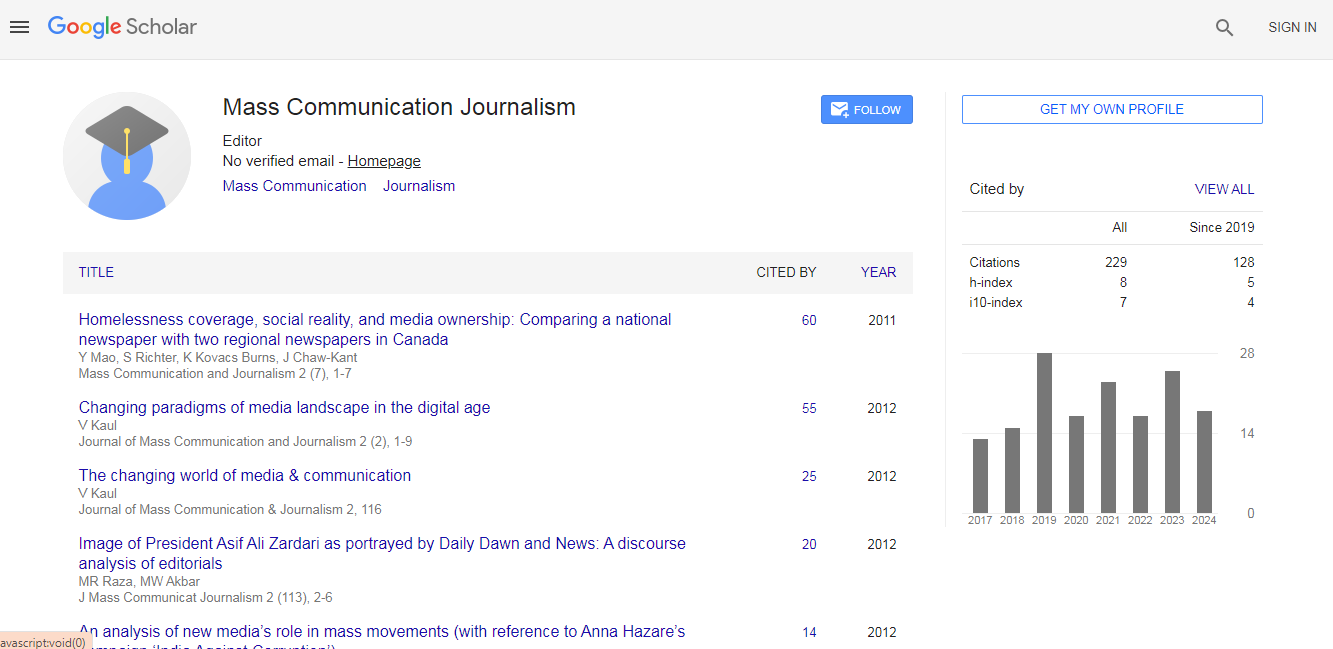
Journal of Mass Communication & Journalism received 205 citations as per Google Scholar report