Brief Report - (127) Volume 15, Issue 3
Received: 30-May-2025, Manuscript No. jmcj-25-176493;
Editor assigned: 02-Jun-2025, Pre QC No. P-176493;
Reviewed: 13-May-2025, QC No. Q-176493;
Revised: 20-Jun-2025, Manuscript No. R-176493;
Published:
27-Jun-2025
, DOI: 10.37421/2165-7912.2025.15.621
Citation: Imogen Price. ”Journalism’s Crisis: Trust, Ethics, Accountability.” J Mass Communicat Journalism 15(2025):621.
Copyright: © 2025 P. Imogen This is an open-access article distributed under the terms of the Creative Commons Attribution License, which permits unrestricted use,
distribution and reproduction in any medium, provided the original author and source are credited
The modern media landscape confronts significant challenges regarding public trust and ethical conduct, particularly within the United States. Research consistently points to an evolving dynamic where public perceptions of news media are shaped by numerous factors, placing a substantial burden on journalists to maintain credibility [1].
This erosion of public confidence not only signals a systemic issue but also accentuates the urgent need for more robust accountability mechanisms. Many suggest that a formal Press Council could effectively fulfill this oversight role, offering an external body to uphold standards and address grievances [1].
Beyond public perception, the internal pressures faced by news organizations also critically impact ethical considerations. One such pressure comes from audience metrics, which profoundly influence journalistic decision-making and, at times, create conflicts with established ethical principles [2].
The relentless pursuit of engagement, while crucial for media viability, can inadvertently compromise traditional journalistic integrity. This raises pertinent questions about the efficacy of self-regulation versus the need for external entities, such as a Press Council, to mediate these emerging pressures and ensure ethical boundaries are respected [2].
Further complicating the operational landscape are innovative approaches to news production. 'Solutions journalism,' for instance, represents a shift towards new forms of news creation and entrepreneurial models [3].
While promising, such innovations require careful examination as they can either inadvertently create new accountability gaps or, conversely, offer novel ways to address existing ones. These developments underscore the dynamic nature of the media industry, highlighting areas where traditional oversight bodies, like a Press Council, could adapt and continue to play a crucial role in maintaining quality and responsibility [3].
Meanwhile, the pervasive issue of 'fake news' continues to pose significant ethical dilemmas for journalists. The sheer volume and rapid dissemination of misinformation in the contemporary environment intensify debates regarding media accountability [4].
This context makes the necessity of independent oversight more pronounced than ever. A Press Council or a similar independent body becomes critically relevant here, serving to uphold and enforce journalistic standards against the backdrop of widespread disinformation [4].
Relatedly, concerns about fairness and media bias remain paramount for both public trust and the fundamental integrity of journalism. A game-theoretic approach provides valuable insights into the complex dynamics that influence news coverage, particularly in how bias can manifest [5].
The findings from such analyses consistently emphasize the vital importance of established mechanisms, whether they are internal editorial guidelines or external regulatory bodies like a Press Council, to ensure impartial reporting and to maintain rigorous accountability across the news industry [5].
The very concept of the 'public' in public journalism has also undergone a transformation. Traditional participatory norms are increasingly being re-evaluated in light of the growing influence of audience analytics [6].
This shift explores how news organizations engage with their audiences today, carrying direct implications for how media accountability is perceived and implemented. Ultimately, the question of how the public can effectively hold the press accountable points directly to functions often attributed to well-structured Press Councils [6].
Concurrently, significant geographical disparities in news access present another critical challenge. A national assessment of 'news deserts' across the United States reveals the alarming impact of these areas on local news ecosystems [7].
The dwindling presence or complete disappearance of local news sources severely undermines community accountability and limits access to reliable information. This situation highlights a profound societal need for oversight, support, and resource allocation that a national or even regional Press Council could potentially address, ensuring critical information flows remain intact [7].
To counter these pervasive issues, there is ongoing research into actionable steps journalists can take. Studies aim to identify concrete strategies that help rebuild public confidence and trust in news media [8].
These investigations emphasize practical approaches to ethical reporting and meaningful public engagement, directly aligning with the core objectives of any Press Council: fostering responsible journalism and consistently enhancing overall media credibility [8].
Looking ahead, the rise of Artificial Intelligence (AI) in journalism, particularly in automated news production, introduces a new frontier of ethical considerations. As AI tools become more integrated and prevalent in newsrooms, the imperative for clear ethical guidelines and robust accountability frameworks becomes undeniable [9].
These frameworks, which a proactive Press Council could spearhead, are essential to ensure that AI-driven media practices remain responsible and uphold the public interest [9].
The broader 'journalistic field' is, therefore, grappling with a period of profound crisis, marked by challenges to traditional standards and evolving professional norms [10].
Discussions centered on maintaining journalistic integrity and sustaining public trust in these tumultuous times inevitably lead back to the necessity of strong accountability structures, including the pivotal role a Press Council can play in defining and enforcing these crucial standards [10].
Public trust in news media in the United States faces considerable challenges, driven by various factors influencing audience perceptions and the ethical duties of journalists [1]. The decline in public confidence highlights a pressing need for stronger accountability measures, a role often envisioned for a formal Press Council [1]. Concurrent with these trust issues, the impact of audience metrics on journalistic ethics and decision-making is becoming increasingly apparent [2]. The drive for engagement can clash with established ethical principles, prompting questions about how self-regulation or external bodies like a Press Council can effectively manage these modern pressures [2]. These dynamics suggest a complex interplay between public expectation, professional conduct, and the structural forces shaping news production.
Innovation in journalism, such as 'solutions journalism,' introduces new models for news production that demand scrutiny [3]. While these approaches offer potential benefits, they also might create or expose new accountability gaps. This evolving landscape requires adaptive oversight, where traditional bodies like a Press Council could offer guidance [3]. Adding to this complexity is the pervasive 'fake news' environment, which presents significant ethical dilemmas for journalists [4]. The spread of misinformation intensifies calls for media accountability and independent oversight, making a Press Council or similar entity crucial for maintaining journalistic standards in an era of disinformation [4]. Ensuring fairness and addressing media bias are also central to upholding public trust and journalistic integrity [5].
A game-theoretic analysis of fairness and media bias demonstrates the intricate forces at play in news coverage, reinforcing the need for mechanisms, both internal and external, to ensure impartial reporting and accountability [5]. The relationship between news organizations and their audiences is also transforming. Research shows a shift in how the 'public' is considered in public journalism, moving from traditional participatory norms to the influence of audience analytics [6]. This evolution has direct consequences for media accountability and how citizens can hold the press responsible, functions often associated with Press Councils [6]. The geographical distribution of news access further compounds these issues, with 'news deserts' profoundly affecting local communities [7].
The disappearance of local news sources in the US compromises community accountability and limits access to reliable information, underscoring a vital need for oversight and support that a national or regional Press Council could provide [7]. Journalists are actively seeking ways to counteract these trends by rebuilding public confidence [8]. Studies explore concrete actions and practical strategies for ethical reporting and engagement, directly linking to the core aims of a Press Council: fostering responsible journalism and boosting media credibility [8]. This proactive stance by journalists is essential for restoring faith in the media profession.
Looking to the future, the ethical implications of Artificial Intelligence (AI) in journalism, especially automated news production, are becoming increasingly prominent [9]. As AI tools become more integrated into newsrooms, the need for clear ethical guidelines and robust accountability frameworks becomes paramount. A Press Council could be instrumental in developing and enforcing such frameworks to ensure responsible AI-driven media practices [9]. Finally, the broader 'journalistic field' is navigating a period of profound crisis, where traditional standards and professional norms are continually challenged [10]. Maintaining journalistic integrity and public trust in these uncertain times necessitates strong accountability structures, with a Press Council potentially playing a key role in establishing and enforcing these standards [10].
The contemporary media landscape faces profound challenges concerning public trust, ethical integrity, and robust accountability. A pervasive erosion of public confidence in news media in the United States underscores a critical need for effective oversight mechanisms, a function potentially fulfilled by a formal Press Council. This imperative is further intensified by the inherent tension between the pursuit of audience engagement metrics and traditional journalistic ethical principles, frequently leading to conflicts that demand resolution. The proliferation of 'fake news' also significantly exacerbates these ethical dilemmas, making strong independent oversight crucial for maintaining credible journalistic standards and combating misinformation effectively. Emerging journalistic models, such as 'solutions journalism,' while innovative, may inadvertently create or reveal new accountability gaps that require careful consideration. Concurrently, the rise of 'news deserts' profoundly impacts local communities by diminishing access to reliable information and undermining civic accountability. The rapid integration of Artificial Intelligence (AI) into journalism, particularly in automated news production, introduces a novel set of ethical implications, necessitating the development of clear guidelines and comprehensive accountability frameworks. The broader journalistic field itself is experiencing a profound crisis, challenging long-held standards and professional norms. In response, journalists are actively investigating practical strategies to rebuild public trust through enhanced ethical reporting and meaningful community engagement, directly mirroring the fundamental objectives of Press Councils. Ultimately, a concerted effort to fortify media accountability—through a combination of internal ethical rigor, external oversight bodies, and adaptive strategies for technological advancements—is indispensable for sustaining public trust and ensuring the continued practice of responsible, credible journalism.
None
None
Indexed at, Google Scholar, Crossref
Indexed at, Google Scholar, Crossref
Indexed at, Google Scholar, Crossref
Indexed at, Google Scholar, Crossref
Indexed at, Google Scholar, Crossref
Indexed at, Google Scholar, Crossref
Indexed at, Google Scholar, Crossref
Indexed at, Google Scholar, Crossref
Indexed at, Google Scholar, Crossref
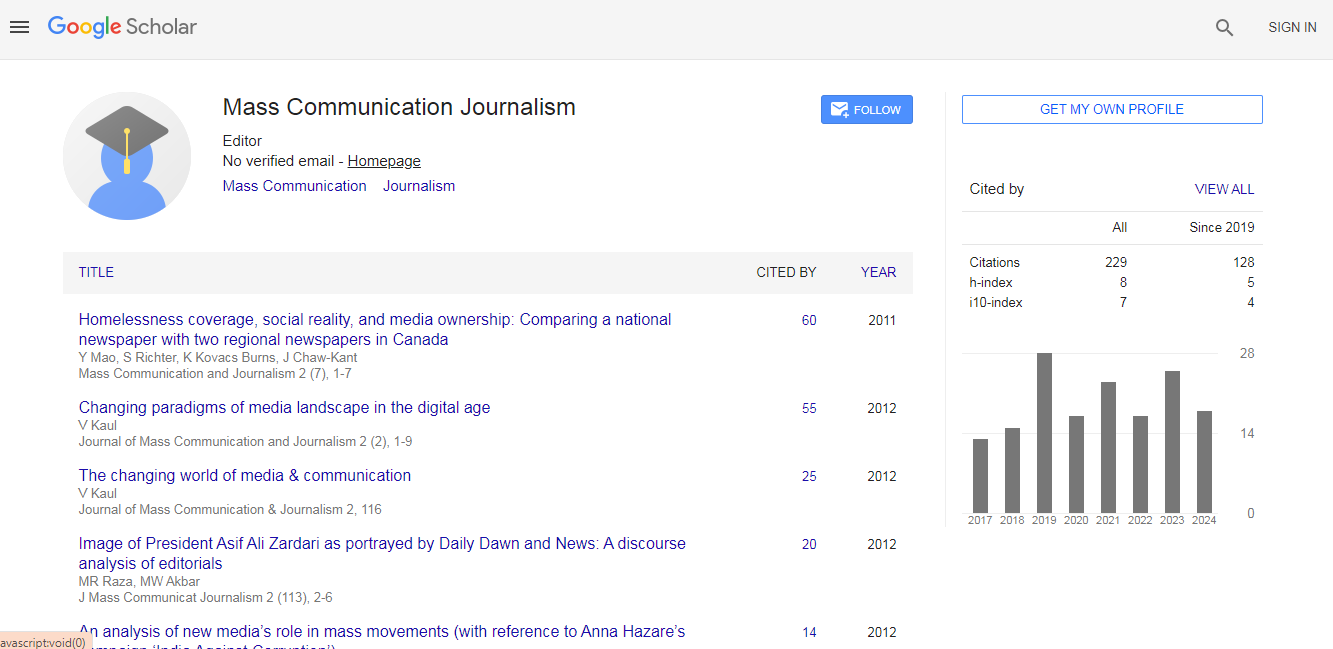
Journal of Mass Communication & Journalism received 205 citations as per Google Scholar report