Opinion - (2025) Volume 14, Issue 4
Received: 01-Aug-2025, Manuscript No. idse-26-182833;
Editor assigned: 04-Aug-2025, Pre QC No. P-182833;
Reviewed: 18-Aug-2025, QC No. Q-182833;
Revised: 22-Aug-2025, Manuscript No. R-182833;
Published:
29-Aug-2025
, DOI: 10.37421/2168-9768.2025.14.501
Citation: Ros, Juan Pablo. "Irrigation System Design: Principles,
Performance, and Innovations." Irrigat Drainage Sys Eng 14 (2025):501.
Copyright: © 2025 Ros P. Juan This is an open-access article distributed under the terms of the Creative Commons Attribution License, which permits unrestricted use,
distribution and reproduction in any medium, provided the original author and source are credited.
The design and effective management of irrigation systems are paramount for ensuring agricultural productivity and optimizing water resource utilization, especially in regions facing water scarcity. This review delves into the fundamental principles and practical considerations associated with both open channel and pipeline irrigation systems, highlighting their distinct characteristics and design requirements. Understanding these systems is crucial for engineers and agricultural practitioners alike. The exploration of hydraulic calculations forms a cornerstone of effective irrigation system design, ensuring that water is delivered efficiently to the crops. This involves precise estimation of flow rates, pressure heads, and energy losses within the system to prevent inefficiencies and ensure adequate water supply to all areas. Material selection plays a vital role in the longevity and cost-effectiveness of any irrigation infrastructure, directly influencing its ability to withstand environmental factors and operational stresses. Conveyance efficiency is a critical metric that quantifies the amount of water delivered to the field relative to the amount withdrawn from the source, with losses occurring through seepage, evaporation, and operational inefficiencies. Water distribution uniformity is another key aspect, aiming to ensure that all parts of the field receive the same amount of water, which is essential for optimal crop growth and preventing issues like waterlogging or drought stress in different areas. The overarching goal of proper irrigation system design is to achieve a balance between meeting crop water demands, minimizing water losses, and ensuring the economic viability and environmental sustainability of agricultural practices. This comprehensive approach allows for tailored solutions that address the specific needs of different crops, soil types, and topographical conditions. The selection of appropriate irrigation technologies and their meticulous design are fundamental to achieving these objectives. Optimizing agricultural productivity through efficient water management is a continuous challenge that requires ongoing research and development in irrigation technologies and practices. The integration of advanced design principles and modern technologies can lead to significant improvements in water use efficiency and overall agricultural output. Thus, a thorough understanding of the interplay between design, performance, and environmental impact is indispensable for sustainable agriculture. [1]
The performance of irrigation systems is heavily influenced by their hydraulic characteristics, which dictate the efficiency of water delivery. For open channel systems, minimizing seepage losses, particularly in arid regions, is a significant challenge that necessitates careful consideration of channel design and lining materials. Evaporation from exposed water surfaces also contributes to water loss, which can be substantial in hot, dry climates. Empirical data and simulation results are invaluable tools for engineers seeking to select appropriate channel cross-sections, lining materials, and construction techniques that enhance water delivery and reduce operational costs. These data-driven approaches allow for informed decisions that optimize the performance of open channel networks. The choice of lining material, for instance, can dramatically affect seepage rates, with impervious linings significantly reducing water loss into the soil. Furthermore, the geometry of the channel, including its width and depth, impacts flow velocity and turbulence, which in turn influence energy losses and the potential for sediment transport. Construction techniques also play a role, ensuring that the channel is built to specifications and that the lining is properly installed and maintained to prevent leaks and erosion. The focus on improving water delivery and reducing operational costs underscores the economic importance of efficient open channel design. These cost savings can be reinvested in other aspects of farm management or contribute to the overall profitability of agricultural enterprises. Therefore, a meticulous approach to the hydraulic performance of lined open channels in arid environments is essential for sustainable water management. The development of robust empirical data and sophisticated simulation models is key to advancing our understanding and practice in this field. Such advancements contribute to the resilience of agricultural systems in water-stressed regions. [2] Pressurized pipeline irrigation systems offer distinct advantages, including reduced water losses due to evaporation and seepage, and the ability to deliver water under pressure to meet specific crop needs. However, these systems are susceptible to hydraulic transients, such as water hammer, which can cause significant damage to pipes, pumps, and other components if not properly managed. Analyzing these energy losses and transient phenomena is crucial for ensuring the safety, reliability, and energy efficiency of pressurized systems. A systematic methodology for optimizing pipe diameters, pump selection, and the inclusion of surge control devices is essential for mitigating these risks, especially in complex terrains or during rapid changes in flow, like valve closures. The selection of appropriate pipe diameters, for example, directly influences flow velocity and friction losses, impacting both energy consumption and the potential for pressure surges. Similarly, the choice of pumps must be aligned with the system's flow and pressure requirements, while also considering their operational efficiency and susceptibility to transient events. Surge control devices, such as air chambers, surge tanks, or relief valves, are critical for absorbing pressure fluctuations and preventing damaging water hammer effects. The presence of complex terrain can exacerbate hydraulic transient issues due to variations in elevation and the potential for increased flow resistance. Therefore, a thorough analysis of these factors is paramount for the successful design and operation of pressurized irrigation networks. Ensuring system safety and reliability protects the significant investment in irrigation infrastructure and prevents costly downtime and repairs. The focus on energy efficiency also contributes to the economic sustainability of these systems, reducing operational expenses and minimizing the environmental footprint associated with energy consumption. Thus, a comprehensive understanding of hydraulic transients is indispensable for the effective implementation of pressurized irrigation solutions. Continued research in this area can lead to more resilient and efficient systems. [3] The efficient operation of open channel irrigation networks hinges significantly on effective irrigation scheduling strategies. These strategies must account for a multitude of factors, including the dynamic availability of water from the source, the specific water requirements of different crops at various growth stages, and the operational constraints imposed by the network's infrastructure and management practices. Adaptive scheduling, which involves making real-time adjustments to irrigation timings and volumes based on current conditions, offers a promising approach to enhancing water use efficiency. Such adaptive strategies can significantly reduce the likelihood of waterlogging, which occurs when excess water saturates the soil, hindering root respiration and potentially leading to crop damage, as well as drought stress, where plants experience insufficient water, impacting growth and yield. By precisely matching water application to crop needs, adaptive scheduling minimizes waste and maximizes the benefits derived from available water resources. The flexibility inherent in adaptive scheduling allows for a more responsive and efficient management of the irrigation network, adapting to unforeseen changes in weather patterns or water supply. This precision in water application contributes to healthier crops and potentially higher yields, leading to improved agricultural outcomes. Furthermore, by reducing water losses through over-irrigation, adaptive scheduling supports broader water conservation efforts, which are increasingly critical in many agricultural regions. The careful consideration of operational constraints ensures that the scheduling strategies are practical and implementable within the existing framework of the irrigation system. Therefore, the development and implementation of optimized irrigation scheduling for open channel networks are crucial for maximizing agricultural productivity and promoting sustainable water management practices. This proactive approach to water management is essential for addressing the challenges of modern agriculture. [4] Integrated system design, combining irrigation with sub-surface drainage, is a crucial strategy for enhancing soil health and preventing the detrimental effects of salinization. Sub-surface drainage systems play a vital role in improving soil aeration, which is essential for healthy root development and microbial activity, and crucially, in preventing the accumulation of salts in the root zone. Salinization can render agricultural land infertile, making integrated design an indispensable approach for sustainable agriculture in many regions. A coupled modeling approach allows for a sophisticated assessment of the complex interactions between irrigation water application and the drainage of excess water and salts from the soil profile. This integrated modeling provides valuable guidelines for the efficient design of dual-purpose systems that effectively manage both water supply and soil salinity. By understanding these interactions, engineers can design systems that not only deliver water efficiently for crop growth but also actively manage soil conditions to prevent long-term degradation. The prevention of salinization is particularly important in arid and semi-arid regions where evaporation rates are high, and irrigation water often contains dissolved salts. Effective drainage helps to leach these salts below the root zone, maintaining soil fertility and productivity over time. The concept of dual-purpose design emphasizes the synergistic benefits of combining these two essential components of water management in agriculture. This holistic approach to system design leads to more resilient and productive agricultural systems, safeguarding land resources for future generations. Therefore, the integrated design of irrigation and sub-surface drainage systems is a cornerstone of sustainable land and water management. Such integrated approaches are vital for the long-term viability of agriculture in vulnerable environments. [5] The selection of appropriate materials for irrigation pipelines is a critical factor influencing the durability, lifespan, and overall cost-effectiveness of the entire system. Irrigation systems are often exposed to harsh environmental conditions, including prolonged exposure to ultraviolet (UV) radiation from sunlight, abrasion from soil particles and water flow, and chemical interactions with water, fertilizers, and soil components. Therefore, investigating the material properties of commonly used pipes, such as their resistance to UV degradation, abrasion, and chemical attack, is essential for making informed decisions. Providing clear recommendations for selecting materials based on these factors ensures that irrigation pipelines can withstand these stresses over an extended period, minimizing the need for frequent replacements and reducing maintenance costs. Durable materials contribute to the reliability of the irrigation system, preventing unexpected failures that can disrupt agricultural operations and lead to crop losses. The initial investment in high-quality, durable materials can lead to significant long-term savings by reducing repair and replacement expenses throughout the system's operational life. Furthermore, durable materials contribute to environmental sustainability by reducing waste generated from frequent component replacements. The chemical compatibility of pipe materials is also crucial to prevent leaching of harmful substances into the soil or water supply, ensuring the safety of crops and the environment. Therefore, a thorough understanding of material science in the context of irrigation infrastructure is fundamental for developing robust and sustainable agricultural water management systems. This focus on material selection directly translates to improved system performance and reduced lifecycle costs. [6] Effective management of water flow within open channel irrigation networks relies heavily on the precise design and operation of flow control structures. These structures, including gates, weirs, and flumes, are integral to regulating water levels and directing flow to different parts of the network, ensuring equitable water distribution among users and efficient utilization of available water resources. Hydraulic modeling serves as a powerful tool for optimizing the design and operational protocols of these structures. By simulating various flow conditions and gate settings, engineers can determine the optimal configurations that ensure accurate water delivery, minimize water losses, and prevent operational issues such as flooding or water shortages in specific areas. The goal is to achieve a dynamic and responsive system that can adapt to changing demands and supply conditions. Equitable distribution is a cornerstone of effective water management, ensuring that all stakeholders receive their fair share of water, fostering cooperation and preventing conflicts. Efficient flow management contributes to overall system performance by minimizing energy losses associated with turbulent or stagnant flow conditions. The integration of advanced hydraulic modeling techniques allows for a more precise and data-driven approach to managing these complex networks. This optimization process can lead to significant improvements in water use efficiency and crop yields across the irrigated area. The design of these structures must also consider factors such as sediment transport and debris accumulation, which can impact their functionality and require regular maintenance. Therefore, the careful design and operational strategy of flow control structures are critical for the success of open channel irrigation systems. [7] Pressurized irrigation systems, particularly those covering large areas or operating under demanding conditions, rely on efficient and reliable pumping units to deliver water at the required pressure and flow rates. A comparative analysis of different pumping technologies is essential for selecting the most suitable options based on a variety of performance metrics. Key considerations include energy consumption, as pumps are often a significant operational expense; reliability, to ensure consistent water supply and minimize downtime; and maintenance requirements, which can impact long-term operational costs and system availability. Guidance on selecting pumps should be tailored to specific system designs, water sources (e.g., wells, rivers, reservoirs), and the unique operational objectives of the irrigation scheme, such as meeting peak crop water demands or operating under specific pressure regimes. The efficiency of pumping units directly impacts the overall energy footprint of the irrigation system, making energy consumption a critical factor in both economic and environmental assessments. Reliable pumps are vital for preventing disruptions to irrigation schedules, which can have severe consequences for crop health and yield. Understanding the maintenance needs of different pump types allows for better planning of operational resources and minimizes unexpected failures. Therefore, a comprehensive evaluation of pumping technologies is indispensable for optimizing the performance and economic viability of pressurized irrigation systems. This comparative approach ensures that investments in pumping infrastructure are aligned with the overall goals of the irrigation project. [8] Micro-irrigation systems, including drip and micro-sprinkler systems, are often integrated within larger pressurized pipeline networks and are characterized by their high water application efficiency. A key determinant of their performance is the achievement of water distribution uniformity, ensuring that water is applied evenly across the entire irrigated area. This uniformity is influenced by several design and operational factors, including the selection of appropriate emitters (drippers or micro-sprinklers) with consistent discharge rates, the strategic layout of the system to minimize pressure variations along laterals, and effective pressure regulation to maintain optimal operating pressures. Achieving high water distribution uniformity is crucial for maximizing crop yield, as uneven water application can lead to areas of water stress or over-watering, both of which negatively impact plant growth and productivity. Emitter selection involves considering factors such as flow rate, spacing, clogging resistance, and the type of water being applied. System layout must account for topography and pipe friction losses to ensure that pressure remains relatively constant across all emitters. Pressure regulation is often achieved through pressure-reducing valves or regulators to maintain the desired operating pressure within the micro-irrigation network. Therefore, meticulous attention to these design parameters is essential for realizing the full potential of micro-irrigation systems in terms of water use efficiency and crop performance. This focus on uniformity is a hallmark of advanced irrigation techniques. [9] The advent of remote sensing and Geographic Information System (GIS) technologies has revolutionized the monitoring and management of large-scale irrigation systems, encompassing both open channel and pipeline networks. These powerful tools offer unprecedented capabilities for collecting, analyzing, and visualizing spatial data, enabling more effective and efficient irrigation management. Remote sensing, through satellite or aerial imagery, can provide valuable information for detecting subtle changes in soil moisture, crop health, and vegetation cover, allowing for early identification of potential issues such as leaks, water stress, or areas of over-irrigation. GIS technology facilitates the integration of this spatial data with other relevant information, such as topographic maps, soil surveys, and system infrastructure layouts, creating a comprehensive platform for analysis and decision-making. The application of these integrated technologies can significantly aid in tasks such as precisely locating leaks in pipelines or channels, assessing the overall performance of the irrigation network, and optimizing water allocation among different users or zones. This data-driven approach enhances water resource governance by providing managers with accurate, up-to-date information for making informed decisions about water distribution and system maintenance. The ability to monitor vast areas remotely and analyze the data within a GIS framework streamlines the management process and improves the overall efficiency of irrigation operations. Consequently, the integration of remote sensing and GIS represents a significant advancement in the sustainable management of agricultural water resources. [10]The fundamental principles and practical design considerations for both open channel and pipeline irrigation systems are explored in depth, encompassing critical aspects such as hydraulic calculations, material selection, conveyance efficiency, and water distribution uniformity. The objective is to optimize agricultural productivity and water resource management by ensuring that proper design directly impacts system performance, cost-effectiveness, and environmental sustainability. This comprehensive review provides a foundation for understanding the complexities involved in creating efficient and effective irrigation infrastructure. The study highlights how meticulous planning and execution are essential for achieving the desired outcomes in agricultural water management. By addressing these core elements, designers can create systems that are not only functional but also economically viable and environmentally sound. The interconnectedness of these factors underscores the need for a holistic approach to irrigation system design. [1]
In arid regions, the hydraulic performance of lined open channels is paramount for minimizing water losses due to seepage and evaporation. The research assesses different open channel designs, providing empirical data and simulation results to guide engineers in selecting appropriate channel cross-sections, lining materials, and construction techniques. The goal is to achieve improved water delivery efficiency and reduced operational costs, which are critical in water-scarce environments. This focus on minimizing losses ensures that more water reaches the intended fields, thereby maximizing the utility of available water resources. The selection of robust lining materials is crucial for preventing seepage, while optimized cross-sections can reduce the surface area exposed to evaporation. Furthermore, appropriate construction techniques ensure the integrity of the channel and its lining over time. The economic benefits of reduced operational costs can significantly contribute to the profitability of agricultural operations. Thus, understanding and applying the principles of hydraulic performance in open channel design is essential for sustainable irrigation in arid climates. [2] Pressurized pipeline irrigation systems are susceptible to energy losses and hydraulic transients, such as water hammer, which can compromise system safety and reliability. This study evaluates these phenomena and presents a methodology for optimizing pipe diameters, pump selection, and surge control devices. The aim is to ensure system safety, reliability, and energy efficiency, particularly in challenging terrains or during rapid operational changes. Proper management of these transients is vital to prevent damage to system components and ensure uninterrupted water supply. The optimization process involves careful consideration of flow dynamics and pressure fluctuations. By implementing appropriate surge control measures, engineers can effectively mitigate the risks associated with hydraulic transients, safeguarding the system's longevity and performance. The focus on energy efficiency also contributes to reducing operational costs and the environmental impact of the system. Therefore, a thorough analysis of hydraulic transients is indispensable for the successful operation of pressurized irrigation pipelines. [3] The impact of different irrigation scheduling strategies on the performance of open channel systems is examined, considering water availability, crop water requirements, and operational constraints. The paper provides insights into how adaptive scheduling can improve water use efficiency and reduce the risks of waterlogging or drought stress. This approach allows for a more precise and responsive management of water resources, aligning irrigation practices with actual crop needs and environmental conditions. By dynamically adjusting irrigation schedules, farmers can optimize water application, minimizing waste and maximizing crop yield. Adaptive strategies are particularly valuable in regions with variable water supplies or unpredictable weather patterns. The ability to respond to these changes ensures that crops receive adequate water at critical growth stages, preventing yield losses and improving overall agricultural productivity. Therefore, implementing effective irrigation scheduling is crucial for maximizing the benefits of open channel irrigation systems. [4] This study concentrates on the integrated design of irrigation and sub-surface drainage systems, aiming to enhance soil aeration and prevent salinization, which are critical for maintaining soil fertility and long-term agricultural productivity. It presents a coupled modeling approach to assess the complex interactions between irrigation and drainage processes within the soil. The research offers valuable guidelines for the efficient design of dual-purpose systems that effectively manage both water supply and soil salinity, ensuring sustainable land use. By addressing these interconnected issues, the study contributes to the development of more resilient and productive agricultural landscapes. The prevention of salinization is particularly important in arid and semi-arid regions where water evaporation is high. Effective drainage helps to leach salts from the root zone, preserving soil health and crop yields. Therefore, integrated design approaches are essential for long-term agricultural sustainability. [5] The article investigates the material properties and durability of commonly used pipes in irrigation systems, addressing factors such as UV resistance, abrasion, and chemical compatibility. It offers recommendations for selecting appropriate materials that can extend the system's lifespan and reduce maintenance costs. Durable materials are essential for ensuring the reliability and longevity of irrigation infrastructure, minimizing the need for frequent repairs and replacements. By choosing materials that can withstand environmental stresses and operational demands, system owners can achieve significant long-term cost savings. The selection of materials also plays a role in the environmental sustainability of irrigation systems, as it reduces waste generated from component replacements. Therefore, understanding material properties is a critical aspect of designing and maintaining efficient and durable irrigation pipelines. [6] The research focuses on the design and operation of gate structures and flow control mechanisms within open channel irrigation networks. It explores the use of hydraulic modeling to optimize the operation of gates, weirs, and flumes, ensuring equitable water distribution and efficient flow management throughout the network. By employing advanced modeling techniques, engineers can fine-tune the performance of these structures, leading to improved water allocation and reduced operational inefficiencies. This optimization is crucial for maximizing the benefits of water resources and ensuring that all users receive their fair share of water. The careful design and management of flow control structures are fundamental to the overall efficiency and effectiveness of open channel irrigation systems. This leads to enhanced agricultural productivity and more sustainable water management practices. [7] A comparative analysis of different pumping technologies for pressurized irrigation systems is presented, evaluating their energy consumption, reliability, and maintenance requirements. The study offers guidance on selecting the most suitable pumps based on system design, water source, and operational objectives. Choosing the right pumping technology is critical for ensuring the efficient and cost-effective operation of pressurized irrigation systems. Energy consumption is a major operational cost, so selecting energy-efficient pumps is paramount. Reliability is also essential to prevent disruptions to irrigation schedules and ensure crop health. The study provides a framework for making informed decisions about pump selection, considering the unique needs of each irrigation project. This systematic approach contributes to optimizing system performance and economic viability. [8] This article examines the principles of water distribution uniformity in micro-irrigation systems, such as drip and micro-sprinkler systems, which are often integrated with pressurized pipelines. It discusses emitter selection, system layout, and pressure regulation as key factors for achieving uniform water application and enhancing crop yield. High water distribution uniformity is essential for maximizing the benefits of micro-irrigation, ensuring that all plants receive the optimal amount of water. Proper emitter selection and system design help to minimize variations in water application across the irrigated area. Effective pressure regulation further contributes to maintaining consistent flow rates from all emitters, thereby ensuring uniform water distribution. This focus on uniformity is critical for optimizing crop performance and water use efficiency in micro-irrigation systems. [9] The research explores the integration of remote sensing and GIS technologies for the effective monitoring and management of large-scale open channel and pipeline irrigation systems. It demonstrates how these tools can aid in detecting leaks, assessing system performance, and optimizing water allocation for improved water resource governance. By leveraging remote sensing and GIS, managers can gain a comprehensive understanding of their irrigation systems, enabling proactive maintenance and more efficient water distribution. These technologies allow for the early identification of issues, such as leaks or areas of water stress, facilitating timely intervention and minimizing water losses. The optimization of water allocation ensures that water resources are distributed equitably and efficiently among users. Therefore, the integration of remote sensing and GIS represents a significant advancement in the sustainable management of irrigation systems. [10]This collection of research examines various aspects of irrigation system design and performance. It covers the fundamental principles of both open channel and pipeline systems, focusing on hydraulic calculations, material selection, and efficiency [1].
Specific attention is given to open channel performance in arid regions, aiming to minimize water losses [2], and the challenges of hydraulic transients in pressurized pipeline systems [3].
Irrigation scheduling strategies are analyzed for open channels to enhance water use efficiency [4].
Integrated designs of irrigation and sub-surface drainage systems are discussed for soil health and salinity prevention [5].
Material selection for durable irrigation pipelines is explored [6], alongside the design of flow control structures in open channels for equitable distribution [7].
Pumping technologies for pressurized systems are compared for efficiency and reliability [8], and water distribution uniformity in micro-irrigation systems is detailed [9].
Finally, the integration of remote sensing and GIS for monitoring large-scale irrigation systems is presented [10].
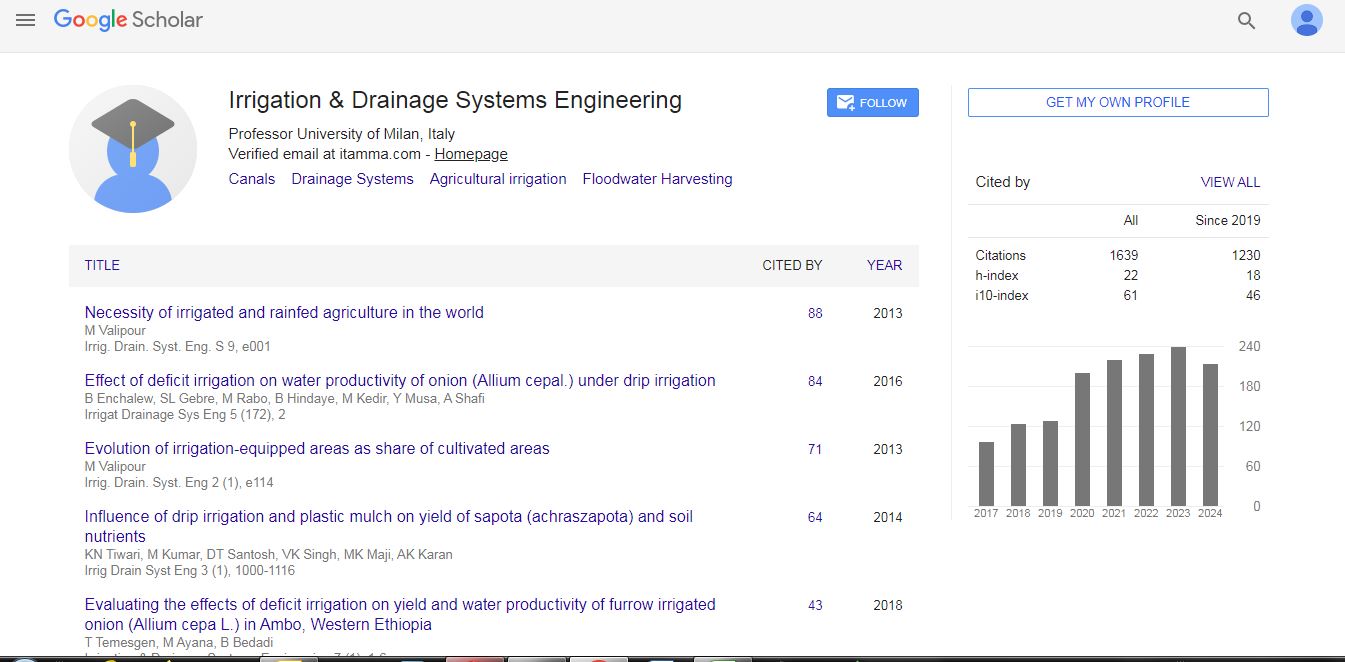
Irrigation & Drainage Systems Engineering received 835 citations as per Google Scholar report