Short Communication - (2025) Volume 14, Issue 4
Received: 01-Aug-2025, Manuscript No. idse-26-182840;
Editor assigned: 04-Aug-2025, Pre QC No. P-182840;
Reviewed: 18-Aug-2025, QC No. Q-182840;
Revised: 22-Aug-2025, Manuscript No. R-182840;
Published:
29-Aug-2025
, DOI: 10.37421/2168-9768.2025.14.505
Citation: Moyo, Tawanda. ”Irrigation Engineering: Sustainable
Agriculture Water Management Advancements.” Irrigat Drainage Sys Eng
14 (2025):505.
Copyright: © 2025 Moyo T. This is an open-access article distributed under the terms of the Creative Commons Attribution License, which permits unrestricted use, distribution
and reproduction in any medium, provided the original author and source are credited.
The intricate field of irrigation engineering is fundamentally concerned with the efficient management of water resources to support agricultural productivity. A core aspect of this discipline involves the conveyance of water from its source to the fields, a process that necessitates robust infrastructure designed to minimize losses and ensure timely delivery. This includes the selection and implementation of suitable conveyance structures, such as canals and pipelines, each with its own set of advantages and limitations in terms of cost, efficiency, and environmental impact. The choice of conveyance method is often dictated by geographical factors, water source availability, and the scale of the irrigation project, with modern advancements continually seeking to optimize these systems [1].
Following conveyance, the application of water to crops is another critical phase that directly influences crop health and yield. Various irrigation application methods exist, ranging from traditional techniques to highly sophisticated systems, each designed to deliver water to the root zone effectively while minimizing wastage. Sprinkler and drip irrigation are prominent examples of advanced methods that offer greater control over water application and can significantly improve water use efficiency compared to older methods. The selection of an appropriate application technique is paramount for matching crop water needs with available resources and environmental conditions [1].
Furthermore, effective drainage systems are indispensable in irrigated agriculture, particularly in regions prone to waterlogging and soil salinization. These systems are designed to remove excess water from the soil profile, thereby preventing detrimental conditions that can harm crops and degrade soil quality. The implementation of adequate drainage is crucial for maintaining optimal soil aeration and preventing the accumulation of salts, which can render land infertile. Integrated approaches that combine conveyance, application, and drainage are essential for sustainable irrigated agriculture [1].
The research presented investigates the impact of different irrigation scheduling strategies on water productivity and crop yield in arid regions. It offers a comparative analysis between conventional flood irrigation and more advanced deficit irrigation techniques. This study specifically examines the water savings that can be achieved through deficit irrigation and its subsequent effects on soil moisture dynamics and the physiological responses of crops. The findings highlight the potential for optimized deficit irrigation to significantly enhance water use efficiency without compromising crop yields, offering valuable insights for water-scarce environments [2].
This study focuses on the design and performance of subsurface drip irrigation systems, examining their effectiveness in reducing water loss through evaporation and deep percolation. It meticulously analyzes the influence of critical design parameters, such as emitter spacing, irrigation frequency, and water application rates, on soil moisture distribution and nutrient movement within the soil profile. The research provides a foundational framework for the development of efficient subsurface drip systems that can be specifically tailored to a variety of soil types and distinct crop requirements, thereby contributing significantly to the goals of sustainable water management [3].
The paper examines the vital role of drainage in mitigating the pervasive issues of soil salinization and waterlogging that frequently plague irrigated lands. It offers a comprehensive evaluation of the effectiveness of different subsurface drainage systems, considering variations in their spacing and depth, in achieving a reduction in the water table and facilitating the crucial process of salt leaching. The research underscores the profound importance of adopting integrated land and water management practices, wherein drainage is recognized as an indispensable component for sustaining long-term agricultural productivity and safeguarding overall environmental health [4].
This work presents a comprehensive analysis of the energy requirements and operational efficiency of pumping systems that are integral to irrigation operations. It delves into the various factors that significantly influence energy consumption, including pump type, system head, and flow rate, and subsequently proposes actionable strategies for achieving energy conservation and system optimization. The study emphasizes the substantial economic and environmental advantages that can be realized through the enhancement of energy efficiency in irrigation pumping, particularly in regions that are heavily reliant on powered irrigation infrastructure [5].
The article investigates the application of sophisticated remote sensing and Geographic Information System (GIS) technologies for the precise monitoring and effective management of irrigation water resources. It demonstrates, with clear examples, how advanced satellite imagery and comprehensive spatial data analysis can be effectively utilized to accurately assess crop water requirements, pinpoint areas experiencing water stress, and subsequently optimize irrigation scheduling at a broad regional scale. The research strongly highlights the immense potential of these cutting-edge technologies to significantly improve both the efficiency and equity of water distribution within large-scale irrigation projects [6].
This paper critically evaluates the performance characteristics of various canal lining materials that are employed to reduce seepage losses and enhance water conveyance efficiency within irrigation systems. It provides a detailed comparison of the hydraulic and economic impacts associated with different lining types, including concrete, geomembrane, and compacted clay, under a range of operational conditions. The study offers practical recommendations for the judicious selection of appropriate lining materials, aiming to minimize water losses in open canal systems and thereby improve the overall reliability of water delivery [7].
The research explores the multifaceted challenges and promising opportunities associated with the management of irrigation water in the context of a rapidly changing global climate. It meticulously analyzes the projected impacts of altered precipitation patterns and escalating temperatures on both water availability and the demand for irrigation water. The study critically discusses essential adaptation strategies, including the proactive adoption of water-efficient technologies and the implementation of improved water governance frameworks, all aimed at ensuring the long-term resilience of irrigated agriculture in the face of evolving climate change challenges [8].
The critical aspects of water conveyance, application, and drainage within irrigation engineering are thoroughly examined in this review, emphasizing their collective role in achieving efficient water management. The article discusses a variety of conveyance structures, including canals and pipelines, evaluating their respective merits and drawbacks in delivering water from source to field [1].
Different irrigation application methods are assessed, such as sprinkler and drip irrigation, highlighting their effectiveness in delivering water precisely to the crop root zone. The importance of establishing and maintaining effective drainage systems is also underscored, as these are crucial for preventing waterlogging and the detrimental effects of soil salinization, which can severely impact agricultural productivity [1].
The work emphasizes the necessity of adopting integrated approaches that consider the interplay between conveyance, application, and drainage to optimize water usage. This holistic strategy aims to enhance crop yields, ensure the sustainability of irrigated agriculture, and incorporate recent advancements in design and technology for improved efficiency [1].
In arid regions, the impact of various irrigation scheduling strategies on water productivity and crop yield is a subject of significant investigation. The research compares conventional flood irrigation with more advanced deficit irrigation techniques. This comparison aims to quantify the water savings achieved through deficit irrigation and understand its subsequent effects on soil moisture dynamics and the physiological responses of the crop [2].
The findings suggest that optimized deficit irrigation strategies can lead to a substantial enhancement in water use efficiency. Crucially, this improvement can be achieved without negatively impacting crop yields, providing valuable and actionable insights for agricultural practices in environments where water resources are critically scarce [2].
This study centers on the design and performance analysis of subsurface drip irrigation systems. A key objective is to evaluate their effectiveness in minimizing water loss, particularly through evaporation from the soil surface and deep percolation below the root zone. The research scrutinizes the influence of specific design parameters on water distribution and nutrient movement within the soil [3].
Parameters such as emitter spacing, the frequency of irrigation events, and the rates at which water is applied are analyzed for their impact on soil moisture distribution and nutrient leaching. The findings contribute to developing a robust framework for designing efficient subsurface drip systems that are precisely tailored to the unique characteristics of different soil types and the specific requirements of various crops, thereby supporting water-saving agriculture [3].
The paper critically examines the indispensable role of drainage in the context of irrigated agriculture, specifically focusing on its capacity to mitigate the pervasive issues of soil salinization and waterlogging. The research provides a detailed evaluation of the efficacy of diverse subsurface drainage systems [4].
This evaluation considers variations in system spacing and depth, assessing their ability to effectively lower the water table and promote the essential process of salt leaching from the soil profile. The study strongly emphasizes the paramount importance of integrating land and water management practices, recognizing drainage as a cornerstone for maintaining long-term agricultural productivity and ensuring the ecological health of irrigated lands [4].
This work offers a comprehensive analysis of the energy requirements and the operational efficiency of pumping systems commonly employed in irrigation. It systematically explores the various factors that exert a significant influence on energy consumption. These factors include the type of pump utilized, the system head (the total height the water must be lifted), and the flow rate of the water being pumped [5].
Based on this analysis, the study proposes practical strategies aimed at achieving energy conservation and optimizing the overall performance of these pumping systems. The research highlights the considerable economic and environmental benefits that can be attained by improving the energy efficiency of irrigation pumping, which is particularly relevant in regions that heavily depend on powered irrigation infrastructure [5].
The article investigates the application of advanced technologies, specifically remote sensing and Geographic Information System (GIS), for the effective monitoring and management of irrigation water resources. It illustrates how satellite imagery and spatial data analysis can be leveraged to accurately assess the water requirements of crops, identify areas within fields that are experiencing water stress, and optimize irrigation scheduling on a regional scale [6].
The research underscores the significant potential of these integrated technologies to enhance both the efficiency and the equity of water distribution, especially within large-scale irrigation projects. By providing detailed spatial and temporal information, remote sensing and GIS enable more informed decision-making for better water resource management [6].
This paper evaluates the performance of different materials used for lining canals, with the primary goal of reducing seepage losses and improving the overall efficiency of water conveyance. The study compares the hydraulic performance and economic implications of various lining types, including concrete, geomembrane, and compacted clay, under diverse operational conditions [7].
The research provides evidence-based recommendations for the selection of appropriate lining materials. The aim is to minimize water losses in open canal systems, which in turn enhances the reliability and effectiveness of water delivery to agricultural areas, contributing to more efficient irrigation practices [7].
The research delves into the complex challenges and emerging opportunities associated with managing irrigation water resources in an era of significant climate change. It critically analyzes the anticipated impacts of alterations in precipitation patterns and rising temperatures on both the availability of water and the demand for irrigation water [8].
The study discusses crucial adaptation strategies that can be implemented to build resilience in irrigated agriculture. These strategies include the adoption of water-efficient technologies and the enhancement of water governance frameworks, all designed to ensure the long-term viability of irrigated farming in the face of evolving climatic conditions [8].
This article evaluates the effectiveness of various field drainage techniques in managing soil moisture levels to achieve optimal crop production. It examines the fundamental design principles and the practical performance of different field drainage methods, such as mole drainage and tile drainage [9].
The goal of these techniques is to improve soil aeration and prevent the detrimental saturation of the root zone. The study offers valuable insights into how efficient field drainage directly contributes to enhanced crop growth and improved yield stability, particularly in agricultural areas characterized by heavy-textured soils that are highly susceptible to waterlogging [9].
The study investigates the intricate impacts of urban irrigation and drainage practices on the hydrological cycle and water quality within peri-urban areas. It specifically examines the challenges inherent in managing stormwater runoff originating from impervious surfaces and its subsequent implications for downstream receiving water bodies [10].
The research proposes comprehensive, integrated urban water management strategies. These strategies often incorporate elements like green infrastructure and sustainable drainage systems (SuDS) to effectively mitigate negative environmental impacts and enhance the overall resilience of urban environments to water-related challenges [10].
This collection of research highlights advancements and critical considerations in irrigation engineering, focusing on water management for sustainable agriculture. Studies address the optimization of water conveyance through improved structures like lined canals and efficient pipelines. Irrigation application methods, including sprinkler and drip irrigation, are evaluated for their water-saving potential and impact on crop yields, with deficit irrigation showing promise in arid regions. Effective drainage systems, such as subsurface and field drainage, are crucial for preventing waterlogging and soil salinization, thereby improving soil moisture management and crop production. The research also explores the integration of technologies like remote sensing and GIS for better water resource monitoring, the energy efficiency of pumping systems, and the adaptation strategies required for irrigation in a changing climate. Urban irrigation and drainage impacts are also considered, emphasizing integrated management approaches.
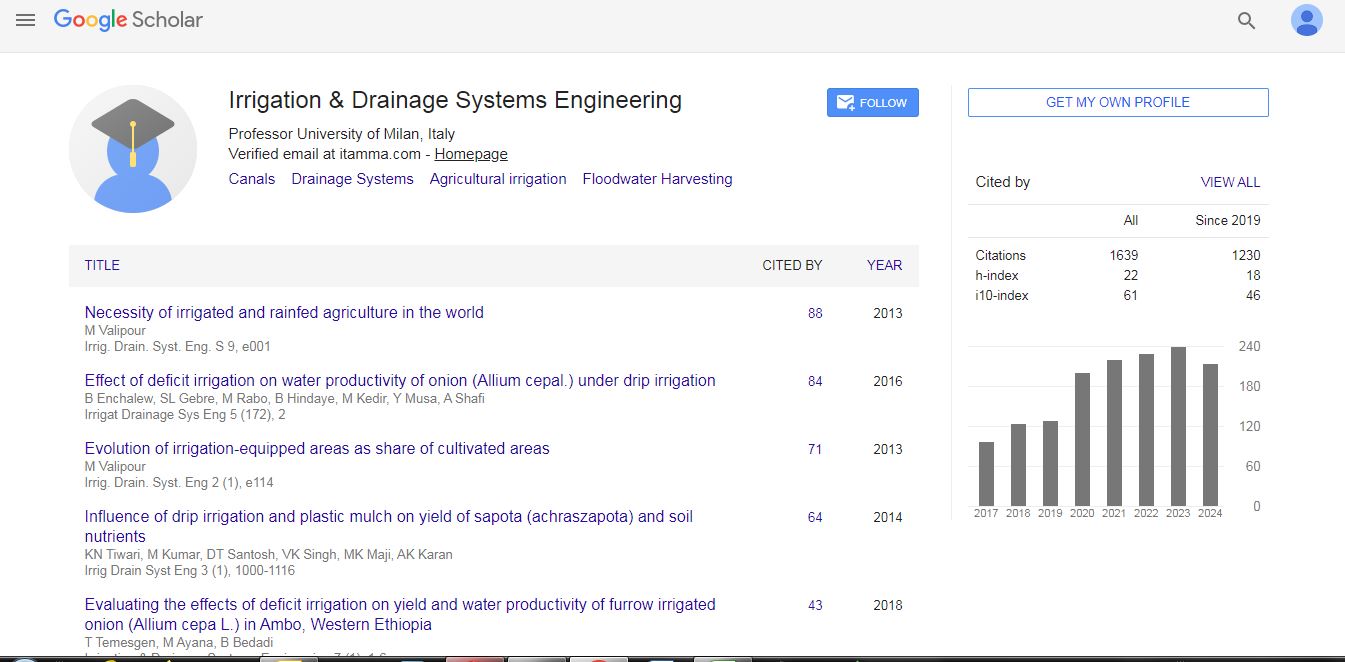
Irrigation & Drainage Systems Engineering received 835 citations as per Google Scholar report