Commentary - (2025) Volume 14, Issue 2
Received: 01-Apr-2025, Manuscript No. idse-26-182763;
Editor assigned: 03-Apr-2025, Pre QC No. P-182763;
Reviewed: 17-Apr-2025, QC No. Q-182763;
Revised: 22-Apr-2025, Manuscript No. R-182763;
Published:
29-Apr-2025
, DOI: 10.37421/2168-9768.2025.14.479
Citation: El-Sayed, Ahmed. ”Irrigation and Drainage Systems:
Design, Management, and Sustainability.” Irrigat Drainage Sys Eng 14
(2025):479.
Copyright: © 2025 El-Sayed A. This is an open-access article distributed under the terms of the Creative Commons Attribution License, which permits unrestricted use,
distribution and reproduction in any medium, provided the original author and source are credited.
The fundamental engineering principles governing the design and operation of irrigation water conveyance and drainage networks are critically examined, delving into hydraulic considerations for efficient water transport, including channel design, flow measurement, and energy loss calculations. The importance of proper drainage in maintaining soil health and preventing waterlogging is also highlighted, with discussions on drainage system layout, component selection, and performance evaluation, emphasizing the interplay between conveyance and drainage for sustainable agricultural water management [1].
The design of efficient irrigation conveyance systems is explored through the lens of computational fluid dynamics (CFD) to optimize canal cross-sections and minimize seepage losses, analyzing the impact of different lining materials and hydraulic structures on water delivery performance, and addressing strategies for reducing energy consumption in pumped conveyance systems, offering a pathway for more sustainable and cost-effective irrigation infrastructure [2].
Challenges and solutions for subsurface drainage system design in waterlogged agricultural lands are investigated, presenting a novel approach to characterizing soil hydraulic properties and predicting drainage requirements based on climate data and crop water needs, with an emphasis on the economic and environmental benefits of effective subsurface drainage, including increased crop yields and reduced salinity, illustrated through practical case studies [3].
The integration of smart technologies in irrigation water conveyance networks for improved efficiency and water conservation is explored, discussing the role of sensors, remote sensing, and data analytics in real-time monitoring of flow, pressure, and water quality, highlighting how these technologies enable proactive management, reduce water losses due to leaks, and optimize water distribution, leading to significant water savings and enhanced agricultural productivity [4].
The hydraulic performance and environmental impact of different types of drainage structures in agricultural lands are evaluated, comparing the effectiveness of open ditches, tile drains, and controlled drainage systems in removing excess water and improving soil aeration, while also assessing the potential for nutrient leaching and mitigation strategies, providing insights for selecting appropriate drainage solutions balancing water management needs with environmental protection [5].
A comprehensive analysis of water losses in irrigation conveyance systems identifies major sources of loss, including seepage, evaporation, operational inefficiencies, and unauthorized use, proposing a range of strategies for minimizing these losses, such as canal lining, leak detection technologies, improved operational procedures, and community engagement, underscoring the critical importance of reducing conveyance losses for enhancing water use efficiency in agriculture [6].
The impact of climate change on the design and operation of irrigation and drainage networks is evaluated, examining how changes in precipitation patterns, temperature, and extreme weather events affect water availability, drainage requirements, and the structural integrity of infrastructure, emphasizing the need for adaptive design strategies and robust management practices to ensure the resilience of these systems in the face of future climatic uncertainties [7].
The use of Geographic Information Systems (GIS) and remote sensing for the planning and management of irrigation and drainage networks is investigated, demonstrating how these tools can be utilized for mapping existing infrastructure, identifying areas prone to waterlogging or water scarcity, and optimizing network design and expansion, highlighting the cost-effectiveness and efficiency gains achieved through the application of spatial technologies in water resources management [8].
The economic assessment of different irrigation conveyance technologies, comparing open canals, pipelines, and sprinkler systems, analyzes capital costs, operational and maintenance expenses, water use efficiency, and crop yield benefits, providing a framework for selecting the most economically viable and technically appropriate conveyance system for diverse agricultural contexts, emphasizing long-term sustainability and profitability [9].
Principles and practices of integrated water resources management in the context of irrigation and drainage networks are examined, highlighting the importance of considering water quality, ecological impacts, and social equity alongside engineering efficiency, advocating for a holistic approach that links water conveyance, drainage, and agricultural practices to achieve sustainable development goals and ensure long-term water security [10].
This article examines the fundamental engineering principles governing the design and operation of irrigation water conveyance and drainage networks. It delves into hydraulic considerations for efficient water transport, including channel design, flow measurement, and energy loss calculations. The importance of proper drainage in maintaining soil health and preventing waterlogging is also highlighted, with discussions on drainage system layout, component selection, and performance evaluation. The interplay between conveyance and drainage is emphasized for sustainable agricultural water management [1].
Focusing on the design of efficient irrigation conveyance systems, this research explores the application of computational fluid dynamics (CFD) to optimize canal cross-sections and minimize seepage losses. It analyzes the impact of different lining materials and hydraulic structures on water delivery performance. The study also addresses strategies for reducing energy consumption in pumped conveyance systems. This work provides a pathway for more sustainable and cost-effective irrigation infrastructure [2].
This paper investigates the challenges and solutions for subsurface drainage system design in waterlogged agricultural lands. It presents a novel approach to characterizing soil hydraulic properties and predicting drainage requirements based on climate data and crop water needs. The research emphasizes the economic and environmental benefits of effective subsurface drainage, including increased crop yields and reduced salinity. Case studies illustrate the practical application of the proposed methodology [3].
The study explores the integration of smart technologies in irrigation water conveyance networks for improved efficiency and water conservation. It discusses the role of sensors, remote sensing, and data analytics in real-time monitoring of flow, pressure, and water quality. The research highlights how these technologies can enable proactive management, reduce water losses due to leaks, and optimize water distribution, leading to significant water savings and enhanced agricultural productivity [4].
This research focuses on the hydraulic performance and environmental impact of different types of drainage structures in agricultural lands. It compares the effectiveness of open ditches, tile drains, and controlled drainage systems in removing excess water and improving soil aeration. The study also assesses the potential for nutrient leaching and its mitigation strategies. The findings provide valuable insights for selecting appropriate drainage solutions that balance water management needs with environmental protection [5].
This article presents a comprehensive analysis of water losses in irrigation conveyance systems. It identifies major sources of loss, including seepage, evaporation, operational inefficiencies, and unauthorized use. The study proposes a range of strategies for minimizing these losses, such as canal lining, leak detection technologies, improved operational procedures, and community engagement. The research underscores the critical importance of reducing conveyance losses for enhancing water use efficiency in agriculture [6].
This paper evaluates the impact of climate change on the design and operation of irrigation and drainage networks. It examines how changes in precipitation patterns, temperature, and extreme weather events can affect water availability, drainage requirements, and the structural integrity of infrastructure. The research emphasizes the need for adaptive design strategies and robust management practices to ensure the resilience of these systems in the face of future climatic uncertainties [7].
This study investigates the use of Geographic Information Systems (GIS) and remote sensing for the planning and management of irrigation and drainage networks. It demonstrates how these tools can be utilized for mapping existing infrastructure, identifying areas prone to waterlogging or water scarcity, and optimizing network design and expansion. The research highlights the cost-effectiveness and efficiency gains achieved through the application of spatial technologies in water resources management [8].
This research focuses on the economic assessment of different irrigation conveyance technologies, comparing open canals, pipelines, and sprinkler systems. It analyzes capital costs, operational and maintenance expenses, water use efficiency, and crop yield benefits. The study provides a framework for selecting the most economically viable and technically appropriate conveyance system for diverse agricultural contexts, emphasizing long-term sustainability and profitability [9].
This paper examines the principles and practices of integrated water resources management in the context of irrigation and drainage networks. It highlights the importance of considering water quality, ecological impacts, and social equity alongside engineering efficiency. The research advocates for a holistic approach that links water conveyance, drainage, and agricultural practices to achieve sustainable development goals and ensure long-term water security [10].
This collection of research addresses critical aspects of irrigation and drainage systems. It covers hydraulic design principles for water conveyance and drainage channels, emphasizing efficiency and soil health. The application of advanced techniques like computational fluid dynamics (CFD) for optimizing canal design and minimizing losses is explored. Investigations into subsurface drainage for waterlogged lands, including novel methodologies and economic/environmental benefits, are presented. The integration of smart technologies, such as sensors and remote sensing, for real-time monitoring and management of conveyance networks to enhance efficiency and conserve water is highlighted. A comparative analysis of different drainage structures examines their hydraulic performance and environmental implications. The quantification and reduction of water losses in conveyance systems through various strategies are discussed. The impact of climate change on the design and operation of these systems, necessitating adaptive strategies, is evaluated. The use of GIS and remote sensing for effective planning and management is demonstrated. Economic assessments of various irrigation conveyance technologies are provided to guide selection based on viability and sustainability. Finally, the principles of integrated water resources management for irrigation and drainage networks, considering ecological and social factors alongside engineering efficiency, are examined to promote sustainable development and water security.
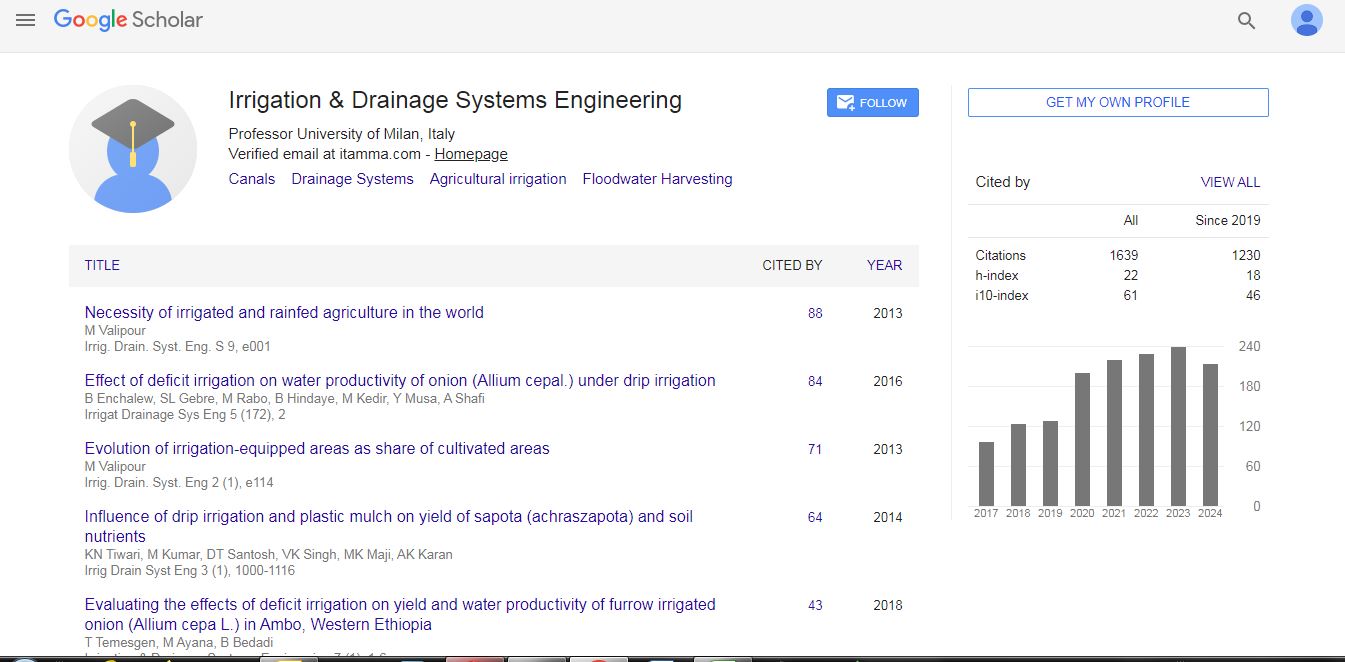
Irrigation & Drainage Systems Engineering received 835 citations as per Google Scholar report