Short Communication - (2025) Volume 14, Issue 2
Received: 01-Apr-2025, Manuscript No. idse-26-182786;
Editor assigned: 03-Apr-2025, Pre QC No. P-182786;
Reviewed: 17-Apr-2025, QC No. Q-182786;
Revised: 22-Apr-2025, Manuscript No. R-182786;
Published:
29-Apr-2025
, DOI: 10.37421/2168-9768.2025.14.486
Citation: Tanaka, Hiroshi. ”Irrigation and Drainage for Sustainable
Agriculture.” Irrigat Drainage Sys Eng 14 (2025):486.
Copyright: © 2025 Tanaka H. This is an open-access article distributed under the terms of the Creative Commons Attribution License, which permits unrestricted use,
distribution and reproduction in any medium, provided the original author and source are credited.
The sustainable management of agricultural water resources is paramount for ensuring global food security and environmental health. Efficient irrigation and drainage engineering forms the bedrock of productive agriculture, especially in regions grappling with water scarcity and the unpredictable impacts of climate change [1].
This field integrates hydrological principles, soil science, and engineering design to develop comprehensive water management strategies [1].
Optimizing irrigation scheduling is a critical aspect of this discipline, focusing on delivering the right amount of water at the right time to maximize crop yields while minimizing water consumption [2].
Empirical data and comparative studies of various irrigation systems, from surface to drip, provide valuable insights into water-saving techniques and yield enhancement [2].
Preventing waterlogging is another key concern addressed by agricultural drainage engineering. The design and performance of subsurface drainage systems are crucial for maintaining optimal soil conditions, preventing the accumulation of excess groundwater, and ensuring healthy root zone development [3].
Beyond productivity, the environmental implications of agricultural water management practices are increasingly significant. Assessing the impact of irrigation and drainage on water quality, nutrient leaching, and ecosystem health is vital for developing sustainable solutions [4].
Technological advancements are revolutionizing irrigation and drainage management. The application of remote sensing and Geographic Information Systems (GIS) allows for precise monitoring of soil moisture, crop stress, and water resource distribution, enabling more effective water allocation and system management [5].
In developing regions, the socio-economic aspects of irrigation and drainage technology adoption play a crucial role. Understanding the costs, benefits, and social dynamics associated with new technologies is essential for designing implementable and equitable solutions [6].
Climate change presents significant challenges and opportunities for irrigation and drainage engineering. Adapting to changing precipitation patterns, rising temperatures, and extreme weather events requires innovative strategies and resilient infrastructure [7].
Traditional surface irrigation methods, such as furrow and border irrigation, continue to be widely used. Evaluating their performance in terms of water uniformity and energy efficiency is important for optimizing their design and operation and for considering potential upgrades [8].
Agricultural drainage plays a vital role in combating soil salinization, particularly in arid and semi-arid regions. Effective drainage systems are necessary to flush excess salts from the root zone and maintain crop productivity [9].
Managed Aquifer Recharge (MAR) is emerging as a promising supplementary strategy for irrigation and drainage management, especially in water-scarce areas. MAR techniques can augment groundwater resources and be integrated with drainage systems to optimize water availability while preventing waterlogging and salinization [10].
The fundamental principles of irrigation methods and agricultural drainage engineering are explored in depth, emphasizing the crucial role of efficient water management in maintaining crop yields and agricultural productivity, particularly amidst evolving climatic conditions and escalating water scarcity [1].
The authors examine a spectrum of irrigation techniques, from conventional to advanced pressurized systems, detailing their respective merits, drawbacks, and applicability across diverse agricultural settings. Simultaneously, the paper addresses the engineering facets of agricultural drainage, highlighting its necessity in averting waterlogging and salinization to optimize soil health and crop performance. The integration of both irrigation and drainage is posited as a holistic strategy for bolstering the resilience and sustainability of agricultural systems, underscoring the importance of hydrological principles, soil science, and engineering design in crafting effective water management solutions [1].
This research provides empirical evidence on optimizing irrigation practices by examining the impact of various irrigation scheduling strategies on water use efficiency and crop yield [2].
A comparative analysis of surface, sprinkler, and drip irrigation systems under differing soil and climatic conditions quantifies the water savings and yield improvements achievable through precision irrigation techniques, stressing their economic and environmental advantages. The authors also discuss the utility of sensors and data analytics in real-time irrigation management to curb water wastage and bolster crop health, concluding that a personalized approach considering crop type, growth stage, and local environmental factors is paramount [2].
Investigations into the design and operational performance of subsurface drainage systems for agricultural lands susceptible to waterlogging are presented [3].
The paper outlines the engineering tenets for selecting appropriate pipe sizes, materials, and installation depths to guarantee effective removal of surplus groundwater. It includes an analysis of the hydraulic performance of different drainage configurations and their influence on soil aeration and root zone development, offering recommendations for cost-effective and sustainable drainage solutions that minimize environmental impacts and enhance long-term soil productivity, with a clear emphasis on the significance of soil properties and topography in the design process [3].
The environmental consequences of diverse irrigation and drainage practices are assessed, with a specific focus on water quality and ecosystem health [4].
This study scrutinizes how varied methodologies can affect nutrient leaching, sediment transport, and the overall hydrological dynamics of agricultural landscapes. Mitigation strategies, such as adopting conservation tillage, establishing buffer strips, and implementing constructed wetlands for water treatment, are discussed, advocating for integrated water management approaches that harmonize agricultural output with environmental sustainability by considering broader ecosystem impacts [4].
Advancements in irrigation and drainage management are being driven by remote sensing and GIS technologies [5].
This work showcases how satellite imagery, aerial photography, and drone-based data can be harnessed to evaluate soil moisture, crop stress, and the spatial distribution of water resources. The integration of GIS with hydrological models is explored as a means to optimize water allocation, identify issues within drainage networks, and forecast the outcomes of different management scenarios, positioning these technological innovations as powerful tools for enhancing the efficiency and effectiveness of agricultural water management [5].
Examining the economic viability and social acceptance of different irrigation and drainage technologies in developing regions reveals critical insights [6].
The research analyzes the costs and benefits associated with various systems, taking into account initial investment, operational expenditures, and labor needs. Furthermore, it delves into the social factors influencing technology adoption, including farmer training, credit access, and community engagement, providing guidance for the development and deployment of sustainable and equitable water management solutions tailored to local necessities and contexts [6].
Climate change's impact on irrigation and drainage engineering is highlighted, detailing how altered precipitation patterns, elevated temperatures, and more frequent extreme weather events affect water availability and soil moisture [7].
The authors review adaptation strategies, encompassing the development of drought-resistant irrigation systems, enhanced water storage solutions, and improved drainage infrastructure to manage intense rainfall, stressing the importance of climate-informed planning and resilient design in agricultural water management for robust systems [7].
The performance of surface irrigation techniques like furrow and border irrigation is evaluated concerning water application uniformity and energy consumption [8].
This research provides a detailed examination of factors influencing performance, such as field topography, soil infiltration rates, and water management practices. It offers recommendations for optimizing the design and operation of surface irrigation systems to curtail water losses and boost overall efficiency, while also discussing potential upgrades to enhance these traditional methods [8].
The pivotal role of agricultural drainage in averting soil salinization, a significant impediment to crop productivity in arid and semi-arid environments, is addressed [9].
The paper elucidates the mechanisms of salt accumulation in the root zone and underscores the necessity of drainage for effective salt flushing. Various drainage techniques, including open ditches and tile drains, are discussed in terms of their efficacy in salinity management, alongside strategies for integrated soil and water management to combat salinization, emphasizing the synergistic benefits of proper irrigation and drainage [9].
Managed Aquifer Recharge (MAR) is explored as a supplementary approach for irrigation and drainage management, particularly in water-scarce areas [10].
The study examines different MAR techniques, such as infiltration basins and injection wells, and their capacity to replenish groundwater reserves for irrigation. It also investigates the synergistic relationship between MAR and drainage systems to optimize water availability while preventing waterlogging and salinization, highlighting MAR's advantages in improving water quality and enhancing the resilience of agricultural water supply systems [10].
This compilation of research addresses the critical aspects of irrigation and drainage engineering for sustainable agriculture. It covers fundamental principles, the optimization of irrigation scheduling, and the design of drainage systems to prevent waterlogging and salinization. The environmental impacts, technological advancements like remote sensing and GIS, and socio-economic considerations for technology adoption are also examined. Furthermore, the challenges posed by climate change and adaptation strategies are discussed, alongside the performance evaluation of surface irrigation methods and the role of managed aquifer recharge. The overarching theme is the integration of these practices for enhanced water use efficiency, crop productivity, and environmental sustainability.
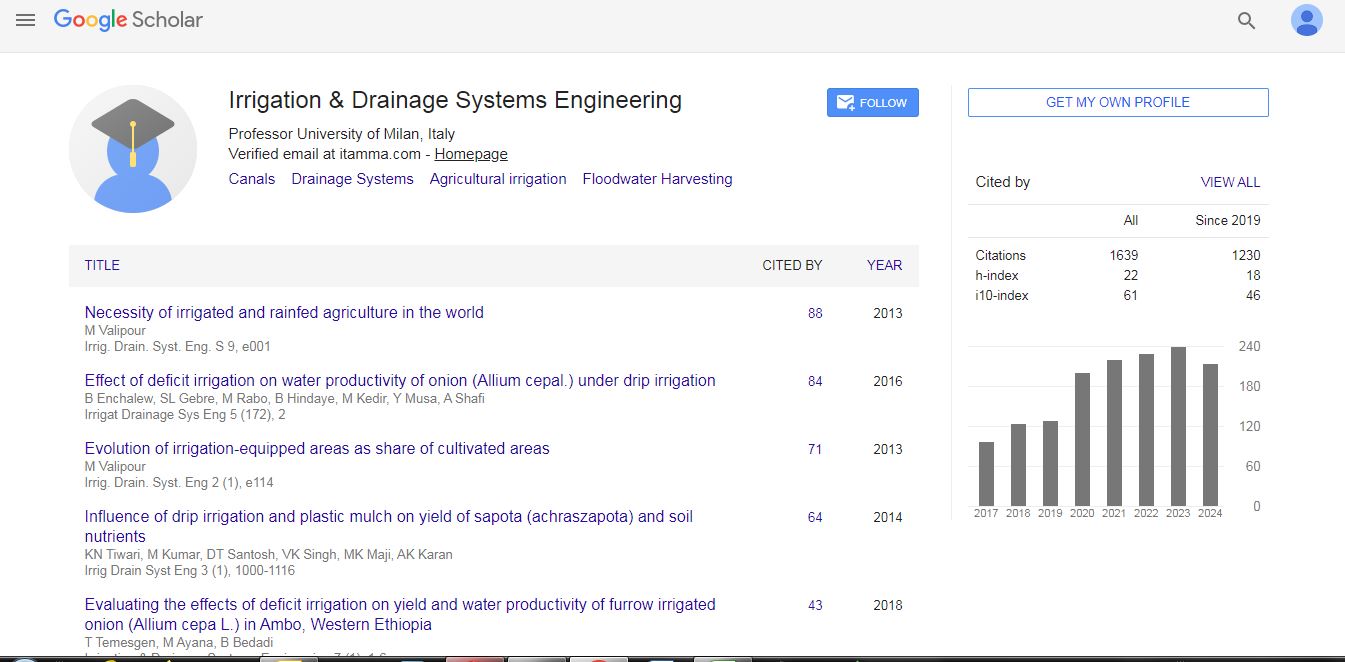
Irrigation & Drainage Systems Engineering received 835 citations as per Google Scholar report