Short Communication - (2025) Volume 14, Issue 2
Received: 01-Apr-2025, Manuscript No. idse-26-182784;
Editor assigned: 03-Apr-2025, Pre QC No. P-182784;
Reviewed: 17-Apr-2025, QC No. Q-182784;
Revised: 22-Apr-2025, Manuscript No. R-182784;
Published:
29-Apr-2025
, DOI: 10.37421/2168-9768.2025.14.485
Citation: Dubois, Claire. ”Irrigation And Drainage: Efficiency,
Sustainability, And Technology.” Irrigat Drainage Sys Eng 14 (2025):485.
Copyright: © 2025 Dubois C. This is an open-access article distributed under the terms of the Creative Commons Attribution License, which permits unrestricted use,
distribution and reproduction in any medium, provided the original author and source are credited.
The advancement of modern irrigation projects hinges critically on the sophisticated design of water conveyance and drainage systems. These systems are instrumental in ensuring the efficient delivery of water to agricultural lands, thereby bolstering agricultural productivity and sustainability. Integrated design approaches are paramount in optimizing these complex networks to meet the evolving demands of agriculture in the 21st century. This article delves into the multifaceted aspects of designing and implementing robust irrigation and drainage infrastructure.
The foundation of effective irrigation lies in the meticulous design of canals and pipelines, which are responsible for transporting water from its source to the fields. Optimizing water conveyance efficiency is a primary goal, aiming to minimize water losses that can occur through seepage and evaporation. This optimization is crucial for ensuring that a sufficient quantity of water reaches the intended areas without undue wastage, contributing to water conservation efforts. [1] Furthermore, the design of irrigation pipelines requires a deep understanding of hydraulic principles to ensure efficient flow and pressure management. Factors such as pipe diameter, roughness, and flow velocity must be carefully considered to minimize energy dissipation and prevent detrimental phenomena like cavitation. Economic considerations also play a significant role in selecting appropriate materials and designing durable, low-maintenance systems that offer long-term operational efficiency. [2] Addressing seepage losses from canals is a persistent challenge in irrigation engineering. Advanced techniques for designing canal linings have been developed to mitigate this issue. Comparative analyses of various lining materials, including geomembranes and concrete, are essential for identifying the most effective solutions. The choice of lining material and design significantly impacts water flow and sediment transport within the canal system, as well as contributes to environmental benefits by reducing water loss. [3] In many agricultural regions, waterlogging and soil salinization pose significant threats to crop production. The design of efficient subsurface drainage systems is therefore crucial for managing excess water and preventing the accumulation of salts in the soil. This involves considering soil properties, crop water requirements, and optimizing drainage depth and spacing to improve soil aeration and facilitate salt removal, ultimately enhancing crop yields. [4] Technological advancements have opened new avenues for improving the design and management of irrigation and drainage networks. Geographic Information Systems (GIS) and remote sensing technologies are increasingly being employed for site selection, hydraulic modeling, and monitoring water distribution. These tools enable a more informed and precise approach to designing and managing these critical infrastructures, leading to more sustainable water resource management. [5] Surface drainage systems play a vital role in managing excess rainfall and irrigation runoff in agricultural fields. The design of these systems involves careful field leveling and the creation of efficient open ditches and field drains that are integrated with main drainage channels. Considering the potential impacts of climate change on rainfall patterns necessitates the development of resilient drainage infrastructure capable of handling extreme events. [6] Pressurized irrigation pipeline networks present unique design challenges, particularly in undulating terrains. These challenges include managing pressure regulation, controlling surges, and selecting appropriate pump stations. Closed conduit systems offer advantages over open canals, including reduced water losses and improved irrigation uniformity, making them a preferred choice in many scenarios. [7] The integration of smart technologies is transforming the design and operation of irrigation and drainage systems. Sensor networks, automation, and data analytics allow for real-time monitoring of soil moisture, weather conditions, and water levels. This data enables optimized irrigation scheduling and drainage system operation, leading to increased water use efficiency and minimized environmental impact. [8] Coastal agricultural areas face specific drainage challenges, including salinity intrusion and high water tables. Designing effective drainage systems for these regions requires addressing the complex interactions between surface and subsurface drainage, as well as the influence of tidal actions. Strategies that improve drainage efficiency are vital for maintaining agricultural productivity in these sensitive zones. [9] The application of computational fluid dynamics (CFD) has become an indispensable tool in the design and analysis of complex canal and pipeline networks. CFD simulations allow for accurate predictions of flow patterns, pressure distributions, and erosion potential. This capability aids in optimizing system hydraulics, preventing structural failures, and assessing the impact of various design modifications, leading to more robust and efficient water management systems. [10]The efficient delivery of water for agricultural purposes necessitates a holistic approach to the design of interconnected canal, pipeline, and drainage systems. This integrated strategy aims to optimize the conveyance of water, thereby minimizing substantial losses due to seepage and evaporation, which are common in traditional irrigation methods. Furthermore, ensuring effective drainage is paramount to avert issues such as waterlogging and soil salinization, both of which can severely impair agricultural productivity and land usability. The overarching goal is the creation of sustainable and productive agricultural landscapes through intelligent system design. [1]
In the realm of irrigation pipelines, hydraulic design and optimization are central to minimizing energy consumption and preventing operational anomalies. Careful consideration of parameters such as pressure head, flow velocity, and the inherent roughness of the pipe material is essential for reducing energy dissipation throughout the network. This focus on hydraulic efficiency is complemented by an equally important assessment of economic factors, including the long-term durability of selected materials and the implementation of effective maintenance strategies to ensure sustained operational efficiency in complex irrigation networks. [2] Minimizing water loss through seepage is a critical concern in the management of irrigation canals. Research has focused on the development and comparative evaluation of advanced canal lining technologies. Studies have assessed the efficacy of various materials, such as geomembranes and concrete, in reducing seepage. The impact of different lining designs on water flow dynamics and sediment transport within the canals is also a key area of investigation, alongside the environmental advantages gained from such water loss reduction measures. [3] Agricultural lands susceptible to waterlogging and soil salinity present significant challenges to crop cultivation. The design of effective subsurface drainage systems is crucial for mitigating these adverse conditions. This involves a detailed understanding of soil characteristics and specific crop water requirements. By employing modeling approaches, researchers can optimize drainage depth and spacing to ensure adequate soil aeration and facilitate the removal of accumulated salts, thereby improving crop yields and land quality. [4] Modern advancements in Geographic Information Systems (GIS) and remote sensing technologies are revolutionizing the design and management of irrigation and drainage infrastructures. These powerful tools facilitate precise site selection, enable sophisticated hydraulic modeling, and provide capabilities for monitoring water distribution across vast networks. Their application helps identify areas where drainage improvements are most needed, ultimately contributing to more sustainable and efficient water resource management practices. [5] Effective management of excess water from rainfall and irrigation runoff in agricultural fields relies on well-designed surface drainage systems. Key design considerations include precise field leveling and the strategic placement of open ditches and field drains. The integration of these localized drainage elements with larger main drainage channels is essential for overall system effectiveness. Furthermore, accounting for the potential impacts of climate change on rainfall variability necessitates the design of resilient drainage infrastructure. [6] Designing pressurized irrigation pipeline networks for regions with uneven topography, such as hilly areas, presents unique engineering challenges. These include the critical need for precise pressure regulation, effective surge control mechanisms to prevent damage, and the appropriate selection and sizing of pump stations. The benefits of employing closed conduit systems, such as reduced water losses and enhanced irrigation uniformity, are often favored over open canal systems in such terrains. [7] The integration of smart technologies into irrigation and drainage systems represents a significant leap forward in water management. This includes the deployment of sensor networks for real-time data collection on soil moisture and weather, coupled with advanced automation and data analytics. Such integrated systems enable optimized irrigation scheduling and dynamic adjustment of drainage operations, leading to substantial improvements in water use efficiency and a reduction in the overall environmental footprint. [8] Coastal agricultural lands face the dual challenges of salinity intrusion and high water tables, requiring specialized drainage system designs. These systems must carefully manage the interplay between surface and subsurface water flows, while also accounting for the influence of tidal cycles. The development and implementation of strategies to enhance drainage efficiency are paramount for preserving the agricultural viability of low-lying coastal zones. [9] Computational Fluid Dynamics (CFD) is increasingly utilized in the design and analysis of intricate canal and pipeline networks within irrigation systems. CFD simulations offer high-fidelity predictions of flow dynamics, including velocity profiles, pressure distributions, and erosion potential. This detailed understanding allows engineers to optimize hydraulic performance, mitigate risks of structural failure, and accurately assess the consequences of design modifications, ultimately leading to more robust and efficient water conveyance and drainage infrastructure. [10]This collection of research explores various facets of irrigation and drainage system design, emphasizing efficiency, sustainability, and technological integration. Key areas include optimizing water conveyance through canal and pipeline networks, minimizing seepage with advanced lining materials, and designing effective subsurface and surface drainage for waterlogged and saline lands. The role of GIS, remote sensing, and smart technologies in enhancing design and management is highlighted, alongside specific considerations for pressurized systems and coastal environments. Computational fluid dynamics is presented as a vital tool for detailed hydraulic analysis and design optimization.
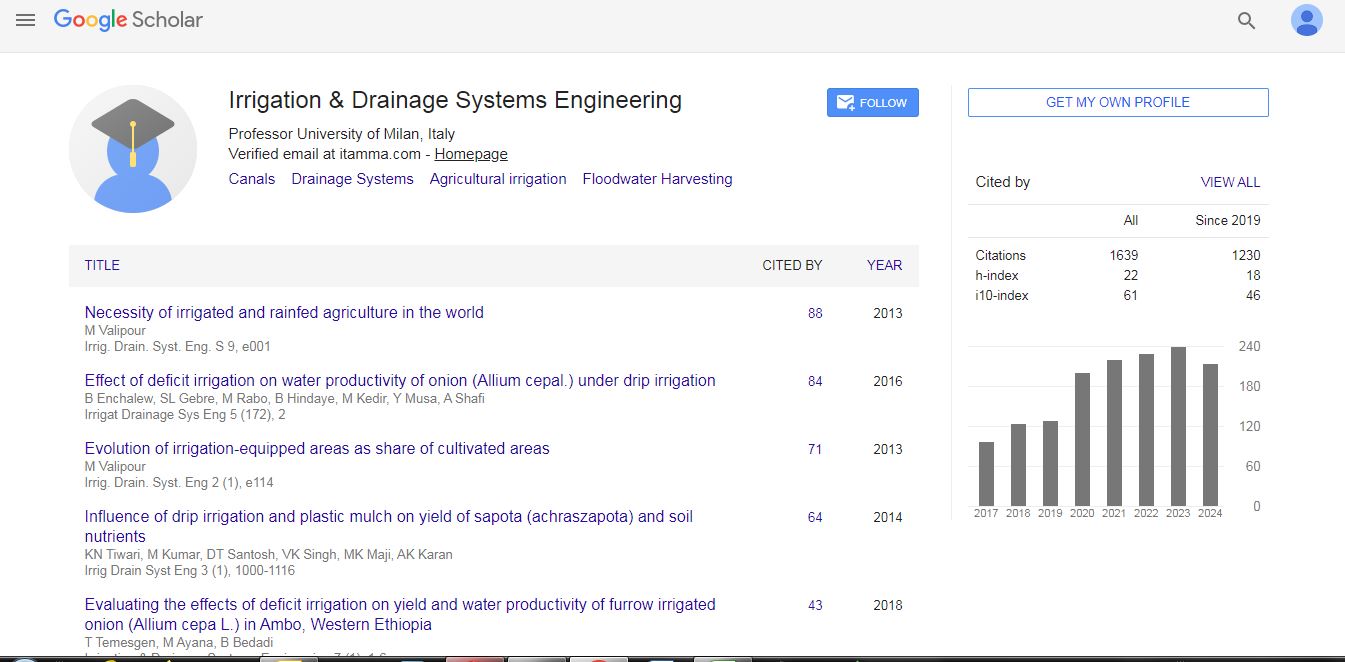
Irrigation & Drainage Systems Engineering received 835 citations as per Google Scholar report