Commentary - (2025) Volume 11, Issue 3
Received: 01-Aug-2025, Manuscript No. jmt-25-175188;
Editor assigned: 04-Aug-2025, Pre QC No. P-175188;
Reviewed: 18-Aug-2025, QC No. Q-175188;
Revised: 22-Aug-2025, Manuscript No. R-175188;
Published:
30-Aug-2025
, DOI: 10.37421/2471-271X.2025.11.351
Citation: Demir, Aysha. ”IPT: Broad Scope, Interpersonal Focus, Accessible.” J Ment Disord Treat 11 (2025):351.
Copyright: © 2025 Demir A. This is an open-access article distributed under the terms of the Creative Commons Attribution License, which permits unrestricted use, distribution and reproduction in any medium, provided the original author and source are credited.
Interpersonal Psychotherapy (IPT) demonstrates significant efficacy in treating depression among adolescents and young adults. This therapeutic approach specifically focuses on improving interpersonal functioning by addressing defined problem areas, such as unresolved grief, active role disputes with others, significant role transitions, or identified interpersonal deficits. By targeting these relational dynamics, IPT effectively helps alleviate depressive symptoms. What's more, this method is particularly valuable because it directly addresses developmental challenges unique to these younger age groups, offering a tailored and potent intervention [1].
Moving beyond depression in youth, IPT is widely recognized as an effective treatment for various eating disorders, including both bulimia nervosa and binge-eating disorder. The therapy adeptly reframes eating disorder symptoms within an interpersonal context. This means it guides individuals to understand precisely how their relationships and social roles profoundly impact their eating behaviors and patterns. By systematically resolving these underlying interpersonal difficulties, clients frequently experience substantial improvements in their eating disorder symptoms, leading to more sustainable recovery [2].
A compelling pilot study has brought to light that IPT can indeed be a promising treatment for generalized anxiety disorder (GAD). While GAD has traditionally been approached with other therapeutic modalities, this groundbreaking research indicates that specifically addressing core interpersonal issuesâ??such as navigating complex role disputes, processing unresolved grief, or overcoming debilitating social isolationâ??can lead to notable reductions in anxiety symptoms. This exciting finding genuinely opens up new avenues for how we might approach GAD treatment in the future, prompting us to consider its often-overlooked social and relational dimensions [3].
In situations where time or resources present limitations, Brief Interpersonal Psychotherapy (IPT-B) emerges as an efficient and highly effective alternative for treating depression. A comprehensive systematic review unequivocally confirms its utility, demonstrating that IPT-B achieves comparable outcomes to standard IPT for specific populations and across various symptom severities. This adaptability makes IPT-B a particularly practical option for significantly expanding access to evidence-based mental health care, reaching more individuals who might otherwise miss out [4].
Crucially, understanding the precise mechanisms through which IPT works is paramount for refining both treatment protocols and training methodologies. A narrative review meticulously highlights how IPT actively facilitates therapeutic change. It does so by fostering improved interpersonal skills, effectively resolving entrenched relational conflicts, and empowering individuals to adapt more resiliently to significant life transitions. These profound shifts in interpersonal functioning are directly and consistently correlated with measurable reductions in psychiatric symptoms, thereby solidly reinforcing the therapy's fundamental theoretical underpinnings and empirical validity [5].
Significantly, IPT is proven to be particularly effective for perinatal depression, an area of critical importance given its profound impact on both mothers and their infants. A rigorous systematic review and meta-analysis provided strong confirmation of its efficacy in reducing depressive symptoms during both pregnancy and the postpartum period. The therapy's inherent focus on managing critical role transitions, such as becoming a new parent, and its emphasis on navigating complex interpersonal relationships make it exceptionally relevant and profoundly beneficial for this especially vulnerable population, offering much-needed support [6].
Furthermore, adaptations of IPT specifically designed for adolescents are showing remarkably promising efficacy across a diverse range of mental health challenges, as detailed in a recent systematic review. These thoughtful adaptations consciously consider the unique developmental stage and distinct interpersonal contexts that characterize teenagers, including the intricate dynamics of peer relationships, complex family interactions, and the vital process of identity formation. By tailoring IPT to this specific age group, its relevance and overall effectiveness in promoting healthy emotional and social development are considerably enhanced [7].
Evidence from a systematic review and meta-analysis clearly indicates that IPT is a viable and highly effective treatment option even within primary care settings. Integrating IPT into primary care can play a vital role in addressing the significant mental health burden often encountered in these environments, especially concerning depression. Its focused, time-limited nature renders it exceptionally well-suited for such busy settings, thereby substantially improving accessibility to specialized mental health care for a broader patient base [8].
For the complex challenge of borderline personality disorder (BPD), IPT holds considerable potential as a valuable therapeutic approach. While BPD is often seen as difficult to treat, it is profoundly characterized by significant and pervasive interpersonal dysfunction. A comprehensive review suggests that by directly targeting these core interpersonal problems, IPT can effectively help individuals with BPD develop healthier relationship patterns and achieve better emotion regulation, thereby offering another valuable evidence-based treatment option for this challenging condition [9].
Finally, it is undeniable that effective training is absolutely essential for the widespread and consistently competent delivery of IPT. A focused review meticulously examines current training practices and offers forward-looking recommendations for future directions. It strongly emphasizes the critical importance of structured curricula, rigorous supervised practice, and ongoing consultation to ensure unwavering fidelity to the therapeutic model. This commitment to high-quality training ultimately translates into demonstrably better patient outcomes and ensures broader, more impactful dissemination of this empirically supported therapy [10].
Interpersonal Psychotherapy (IPT) is a time-limited and focused therapeutic modality that effectively addresses psychiatric symptoms by enhancing interpersonal functioning. It is widely recognized for its significant efficacy in treating depression, particularly among adolescents and young adults. This approach targets developmental challenges unique to these age groups by focusing on problem areas such as unresolved grief, ongoing role disputes, significant life transitions, or identified interpersonal deficits, which helps alleviate depressive symptoms [1]. The core mechanisms of IPT involve facilitating therapeutic change through improving interpersonal skills, resolving relational conflicts, and assisting individuals in adapting more effectively to significant life changes. These positive shifts in interpersonal functioning are directly correlated with measurable reductions in psychiatric symptoms, reinforcing the therapy's fundamental theoretical underpinnings [5].
Beyond its foundational use in depression, IPT has demonstrated considerable effectiveness in treating other complex conditions. It is recognized as an effective intervention for various eating disorders, including bulimia nervosa and binge-eating disorder. The therapy reframes eating disorder symptoms within a clear interpersonal context, helping individuals understand precisely how their relationships and social roles profoundly impact their eating behaviors. Resolution of these interpersonal difficulties often leads to notable improvements in eating disorder symptoms [2]. Furthermore, emerging research suggests that IPT can be a promising treatment for generalized anxiety disorder (GAD). A pilot study indicated that addressing interpersonal issues like role disputes, grief, or social isolation can lead to significant reductions in anxiety symptoms, opening up new avenues for GAD treatment by thoroughly considering its inherent social and relational dimensions [3].
IPT has proven particularly valuable for specialized and often vulnerable populations. For example, it is highly effective for perinatal depression, a critical area given its extensive impact on both mothers and infants. A systematic review and meta-analysis confirmed its efficacy in reducing depressive symptoms during both pregnancy and the postpartum period. This effectiveness stems largely from the therapy's focus on managing critical role transitions, such as becoming a new parent, and navigating complex interpersonal relationships, making it exceptionally relevant and beneficial for this population [6]. Additionally, adaptations of IPT specifically designed for adolescents are showing promising efficacy across a diverse range of mental health challenges. These thoughtful adaptations consciously consider the unique developmental stage and distinct interpersonal contexts of teenagers, including peer relationships, family dynamics, and the vital process of identity formation, thereby enhancing its relevance and effectiveness in promoting healthy emotional and social development in this age group [7].
The practical utility and accessibility of IPT are further enhanced by its adaptable formats and suitability for various settings. Brief Interpersonal Psychotherapy (IPT-B) offers an efficient and highly effective alternative for treating depression, especially in settings where time or resources may be limited. A systematic review confirms its utility, demonstrating comparable outcomes to standard IPT for certain populations and across various symptom severities, making IPT-B a practical option for significantly expanding access to evidence-based mental health care [4]. Moreover, IPT is a viable and effective treatment option within primary care settings. Integrating IPT into primary care can play a crucial role in addressing the significant mental health burden often encountered there, particularly concerning depression, as its focused, time-limited nature makes it exceptionally well-suited for such environments, improving accessibility to specialized care [8].
Even for challenging conditions like borderline personality disorder (BPD), IPT holds considerable potential. While BPD is often complex to treat, it is profoundly characterized by significant and pervasive interpersonal dysfunction. Reviews suggest that by directly targeting these core interpersonal problems, IPT can effectively help individuals with BPD develop healthier relationship patterns and achieve better emotion regulation, offering another valuable evidence-based treatment option [9]. To ensure the widespread and consistently competent delivery of IPT, effective training is absolutely essential. Reviews examine current training practices and offer forward-looking recommendations, emphasizing the critical importance of structured curricula, rigorous supervised practice, and ongoing consultation to ensure unwavering fidelity to the therapeutic model. This commitment to high-quality training ultimately translates into demonstrably better patient outcomes and ensures broader, more impactful dissemination of this empirically supported therapy [10].
Interpersonal Psychotherapy (IPT) is an evidence-based treatment effective across a range of mental health conditions. It significantly helps adolescents and young adults suffering from depression by addressing interpersonal issues like grief, role disputes, and life transitions. IPT is also a recognized treatment for eating disorders, including bulimia nervosa and binge-eating disorder, where it helps individuals understand the interpersonal context of their eating behaviors. Promising pilot studies suggest its utility for generalized anxiety disorder, targeting social and relational dimensions of anxiety. For broader accessibility, Brief Interpersonal Psychotherapy (IPT-B) offers an efficient alternative for depression with comparable outcomes to standard IPT, suitable for resource-limited settings. IPT is particularly effective for perinatal depression, addressing the unique role transitions and relational challenges faced by new mothers. Adaptations of IPT for adolescents also show efficacy by considering their unique developmental and interpersonal contexts. The therapy is a viable option for integration into primary care, improving access to mental health services, especially for depression. Furthermore, IPT shows potential for borderline personality disorder by targeting interpersonal dysfunction and helping develop healthier relationship patterns. Understanding IPT's mechanisms, which involve improving interpersonal skills and resolving conflicts, is crucial for refining treatment. Effective, structured training is essential for competent delivery and widespread dissemination of this empirically supported therapy.
None
None
Laura M, Marjorie RM, Vanesa DG. "Interpersonal Psychotherapy for Depression in Adolescents and Young Adults: A Review of the Evidence and Proposed Mechanisms".Clin Child Fam Psychol Rev 23 (2020):215-231.
Indexed at, Google Scholar, Crossref
Susan PW, Kathleen MP, Rebecca ES. "Interpersonal Psychotherapy for Eating Disorders: An Updated Review".Curr Psychiatry Rep 22 (2020):62.
Indexed at, Google Scholar, Crossref
John CM, Joshua DL, Michael EF. "Interpersonal psychotherapy for generalized anxiety disorder: A pilot study".Depress Anxiety 36 (2019):28-36.
Indexed at, Google Scholar, Crossref
Ana IL, Ana L, Mário PR. "Brief Interpersonal Psychotherapy for Depression: A Systematic Review".Front Psychiatry 12 (2021):640798.
Indexed at, Google Scholar, Crossref
John CM, Myrna MW, Joshua DL. "Understanding mechanisms of change in interpersonal psychotherapy: A narrative review".J Psychother Integr 31 (2021):149-160.
Indexed at, Google Scholar, Crossref
Enya YLN, Kam KMC, Ching-Lan W. "Interpersonal Psychotherapy for Perinatal Depression: A Systematic Review and Meta-Analysis".JAMA Psychiatry 78 (2021):643-652.
Indexed at, Google Scholar, Crossref
Caroline L, Michael BZ, Emily JWZ. "Adaptations and Efficacy of Interpersonal Psychotherapy for Adolescents: A Systematic Review".Child Adolesc Soc Work J 40 (2023):227-248.
Indexed at, Google Scholar, Crossref
Pim C, Marit D, Robert AS. "Interpersonal Psychotherapy in Primary Care: A Systematic Review and Meta-Analysis".Psychol Med 49 (2019):1761-1773.
Indexed at, Google Scholar, Crossref
John CM, Helena AS, Joshua DL. "Interpersonal Psychotherapy for Borderline Personality Disorder: A Review".J Pers Disord 34 (2020):118-132.
Indexed at, Google Scholar, Crossref
Myrna MW, John CM, Joshua DL. "Training in Interpersonal Psychotherapy: A Review of Current Practices and Recommendations for the Future".Psychotherapy 58 (2021):151-160.
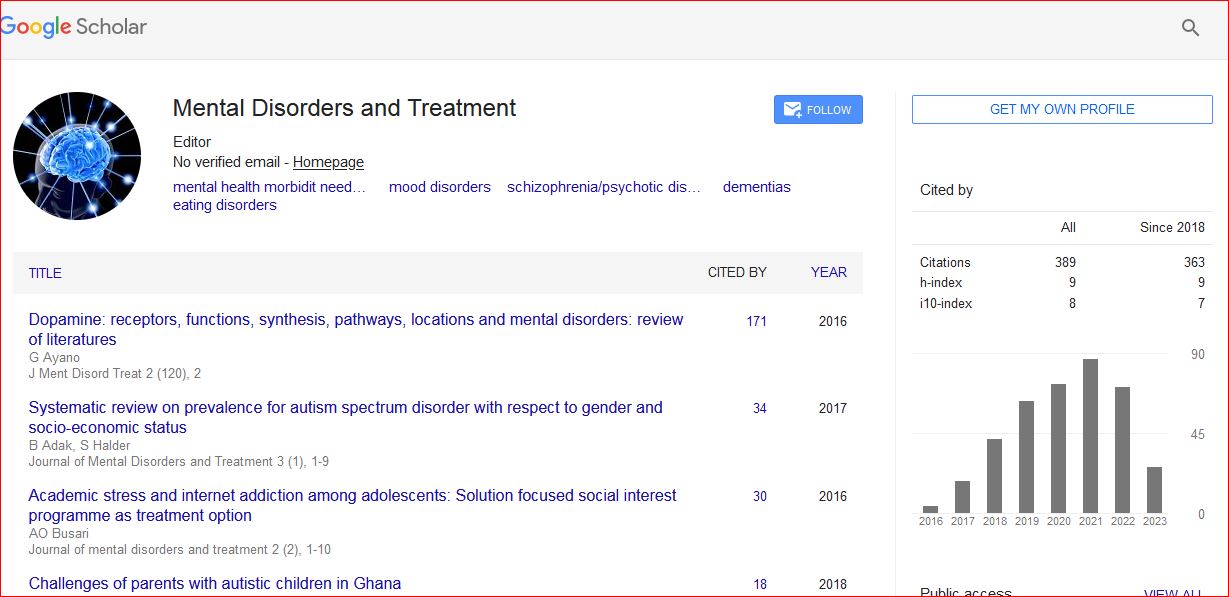
Mental Disorders and Treatment received 556 citations as per Google Scholar report