Perspective - (2025) Volume 11, Issue 4
Received: 01-Aug-2025, Manuscript No. elj-25-174924;
Editor assigned: 04-Aug-2025, Pre QC No. P-174924;
Reviewed: 18-Aug-2025, QC No. Q-174924;
Revised: 22-Aug-2025, Manuscript No. R-174924;
Published:
29-Aug-2025
, DOI: 10.37421/2472-0895.2025.11.329
Citation: Rossi, Emilia. ”Ion Channelopathies: Diverse Disorders and Therapies.” Epilepsy J 11 (2025):329.
Copyright: © 2025 Rossi E. This is an open-access article distributed under the terms of the Creative Commons Attribution License, which permits unrestricted use, distribution and reproduction in any medium, provided the original author and source are credited.
Ion channelopathies are diverse genetic disorders affecting central and peripheral nervous systems, causing conditions like epilepsy, migraines, and movement disorders. They stem from mutations in ion channel genes that disrupt neuronal excitability and signaling. Treatment strategies include symptomatic management, gene therapy, and precision medicine tailored to specific channel defects[1].
Cardiac ion channelopathies are inherited disorders predisposing individuals to life-threatening arrhythmias and sudden cardiac death, encompassing conditions like long QT syndrome and Brugada syndrome. Understanding specific gene mutations impacting cardiac electrical activity is crucial. This leads to personalized medicine, where tailored therapeutic strategies based on individual genetic profiles improve diagnosis, risk stratification, and treatment outcomes[2].
Genetic ion channelopathies are intricately linked to epilepsy, as mutations in voltage-gated or ligand-gated ion channels cause aberrant neuronal excitability and various seizure types. The molecular mechanisms often involve altered channel gating, expression, or localization. Understanding these mechanisms is vital for developing targeted and more effective antiepileptic drugs, moving beyond conventional broad-spectrum treatments[3].
Chronic neuropathic pain often results from ion channel dysfunction, exploring channelopathies as a basis for pain syndromes involving voltage-gated sodium, potassium, and calcium, plus TRP channels in nociceptive signaling. Novel insights into genetic and molecular underpinnings of inherited pain disorders highlight new therapeutic avenues. These include small molecule modulators and gene editing techniques aimed at dysregulated ion channels for more effective pain relief[4].
Muscle ion channelopathies are genetic disorders affecting skeletal muscle, leading to myotonia, periodic paralysis, and myasthenic syndromes. Their pathogenesis involves mutations in sodium, potassium, chloride, and calcium channels disrupting muscle membrane excitability. Accurate genetic diagnosis is crucial for personalized management, guiding current and future treatment approaches for these diverse conditions[5].
Drug discovery for ion channelopathies faces challenges due to channel complexity. Emerging strategies include high-throughput screening, rational drug design based on structural biology, and induced Pluripotent Stem Cell (iPSC) models for personalized drug testing. Targeting specific channel isoforms or interacting proteins promises more selective and effective therapeutics, minimizing off-target effects across various channelopathies[6].
Genetic ion channelopathies underlie a spectrum of neurological disorders, with inherited mutations in ion channel genes causing conditions like familial hemiplegic migraine, episodic ataxia, and early-onset encephalopathy. These genetic defects disrupt neuronal excitability, neurotransmission, and brain development. Genetic testing is increasingly important for diagnosing these complex conditions and guiding appropriate therapeutic choices[7].
Ion channel dysregulation contributes to Autism Spectrum Disorder (ASD) pathophysiology. This review examines genetic and pharmacological aspects of channelopathies in ASD, focusing on mutations in sodium, potassium, calcium, and chloride channels, as well as neurotransmitter receptors. These genetic variations alter neuronal excitability and synaptic plasticity, affecting brain development and ASD symptoms. Pharmacological interventions targeting these channels show potential to ameliorate ASD behaviors[8].
The respiratory system depends heavily on ion channel activity. Respiratory ion channelopathies involve genetic defects impacting breathing control and lung function, covering mechanisms in sleep-ordered breathing, central hypoventilation, and cystic fibrosis. Dysregulation of channels governing neuronal excitability in the brainstem or epithelial fluid transport contributes to respiratory dysfunction, providing insights for potential therapeutic targets[9].
Precision medicine offers significant promise for ion channelopathies, moving beyond general treatments. It emphasizes tailoring therapies to individual patients based on specific genetic mutations and physiological responses. Detailed genetic sequencing, functional assays, and patient-derived cell models are essential for identifying optimal treatments. Leveraging genomics and advanced pharmacology can lead to more effective, personalized interventions and improved outcomes for individuals with these complex genetic disorders[10].
Ion channelopathies are a diverse group of genetic disorders characterized by mutations in genes encoding ion channels, which are fundamental for cellular excitability. These conditions significantly impact physiological function, particularly affecting the central and peripheral nervous systems. Clinically, they present a wide spectrum of neurological manifestations, including epilepsy, migraines, chronic pain, movement disorders, and severe early-onset encephalopathy [1, 7]. Inherited mutations disrupt neuronal excitability, neurotransmission, and brain development, highlighting the critical role of ion channels in neurological health. Genetic testing is increasingly vital for diagnosis and guiding therapeutic choices [1, 7].
Beyond the nervous system, ion channelopathies affect other vital physiological systems. Cardiac ion channelopathies are inherited disorders predisposing individuals to life-threatening arrhythmias and sudden cardiac death, exemplified by long QT syndrome and Brugada syndrome [2]. Muscle ion channelopathies are genetic disorders impairing skeletal muscle function, leading to myotonia, periodic paralysis, and myasthenic syndromes due to mutations in sodium, potassium, chloride, and calcium channels essential for muscle membrane excitability [5]. Chronic neuropathic pain also frequently links to ion channel dysfunction, involving dysregulation of voltage-gated sodium, potassium, calcium, and TRP channels in nociceptive signaling [4].
The intricate link between genetic ion channelopathies and epilepsy is well-documented, with mutations leading to aberrant neuronal excitability and various seizure types [3]. Ion channel dysregulation also contributes to the pathophysiology of Autism Spectrum Disorder (ASD). Genetic variations in channels for sodium, potassium, calcium, chloride, and neurotransmitter receptors alter neuronal excitability and synaptic plasticity, impacting brain development and ASD symptoms [8]. Even the respiratory system, from central pattern generators to airway smooth muscle, relies on ion channel activity. Respiratory ion channelopathies involve genetic defects that impact breathing control and lung function, covering sleep-disordered breathing, central hypoventilation syndromes, and cystic fibrosis [9].
The fundamental molecular mechanisms across these diverse ion channelopathies consistently involve crucial disruptions to ion channel function. These manifest as altered channel gating, changes in channel expression levels, or incorrect localization within the cell membrane. Mutations in ion channel genes profoundly disturb neuronal and cellular excitability and signaling pathways, which directly leads to the specific pathological phenotypes observed across affected tissues and organs, including the brain, heart, muscle, and lungs [1, 3, 5, 7, 8, 9]. Understanding how specific gene mutations impact cellular electrical activity is vital for elucidating pathogenesis and identifying precise intervention points [2].
Current and emerging therapeutic strategies for ion channelopathies are rapidly evolving towards more sophisticated, personalized approaches. Beyond symptomatic management, gene therapy and precision medicine tailor interventions to specific genetic mutations and physiological responses, moving beyond one-size-fits-all treatments [1, 2, 10]. Drug discovery in this challenging field embraces advanced techniques like high-throughput screening, rational drug design based on structural biology, and the use of induced Pluripotent Stem Cell (iPSC) models for personalized drug testing. The goal is to target specific channel isoforms or interacting proteins to develop more selective and effective therapeutics, minimizing off-target effects and improving patient outcomes [6, 10].
Ion channelopathies represent a diverse group of genetic disorders originating from mutations in ion channel genes, which profoundly disrupt neuronal and cellular excitability and signaling. These conditions impact a wide array of physiological systems, leading to varied clinical manifestations. In the central and peripheral nervous systems, they can cause epilepsy, migraines, chronic pain, and various movement disorders. Cardiac ion channelopathies, such as long QT and Brugada syndromes, predispose individuals to severe arrhythmias and sudden cardiac death. Skeletal muscle function is also affected, leading to conditions like myotonia and periodic paralysis. Furthermore, these channel dysfunctions are implicated in other significant neurological disorders, including familial hemiplegic migraine, specific forms of early-onset encephalopathy, and contribute to the pathophysiology of Autism Spectrum Disorder. Even the respiratory system can be affected, with genetic defects in ion channels impacting breathing control and leading to conditions like sleep-disordered breathing. Unraveling the molecular mechanisms, such as altered channel gating, expression, or localization, is paramount for advancing therapeutic development. Existing and novel treatment strategies encompass symptomatic management, gene therapy, and precision medicine approaches that are increasingly tailored to specific genetic defects. Emerging drug discovery techniques, including high-throughput screening, rational design, and induced Pluripotent Stem Cell (iPSC) models, are focused on identifying selective channel modulators. This promises more effective and personalized interventions, ultimately improving diagnostic accuracy, risk stratification, and patient outcomes for individuals living with these complex conditions.
None
None
Indexed at, Google Scholar, Crossref
Indexed at, Google Scholar, Crossref
Indexed at, Google Scholar, Crossref
Indexed at, Google Scholar, Crossref
Indexed at, Google Scholar, Crossref
Indexed at, Google Scholar, Crossref
Indexed at, Google Scholar, Crossref
Indexed at, Google Scholar, Crossref
Indexed at, Google Scholar, Crossref
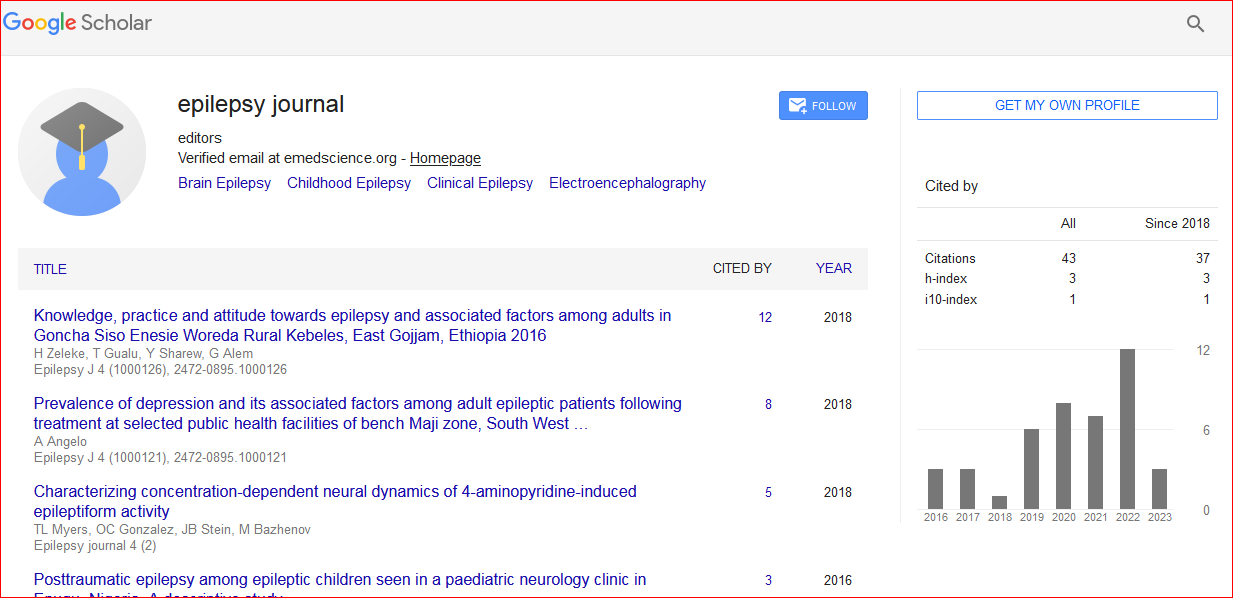
Epilepsy Journal received 41 citations as per Google Scholar report