Brief Report - (2025) Volume 14, Issue 4
Received: 01-May-2025, Manuscript No. jtsm-26-179518;
Editor assigned: 05-May-2025, Pre QC No. P-179518;
Reviewed: 19-May-2025, QC No. Q-179518;
Revised: 22-May-2025, Manuscript No. R-179518;
Published:
29-May-2025
, DOI: 10.37421/2167-0919.2025.14.497
Citation: Berger, Thomas. âIntelligent Wireless Resource Management: Advanced Techniques.â J Telecommun Syst Manage 14 (2025):497.
Copyright: © 2025 Berger T. This is an open-access article distributed under the terms of the Creative Commons Attribution License, which permits unrestricted use, distribution and reproduction in any medium, provided the original author and source are credited.
The landscape of wireless communication is undergoing a profound transformation, driven by an ever-increasing demand for higher data rates, lower latency, and ubiquitous connectivity. This evolution necessitates sophisticated approaches to resource management, a cornerstone of efficient network operation. Deep reinforcement learning has emerged as a powerful paradigm for tackling the complexities of dynamic resource allocation and scheduling in wireless networks, enabling systems to adapt to fluctuating channel conditions and user demands in real-time to optimize performance [1].
Complementing these advancements, federated learning offers a decentralized framework for training resource allocation models, crucial for preserving user privacy while enhancing network intelligence in 5G and beyond architectures [2].
In parallel, the quest for energy efficiency in wireless systems has become paramount, particularly with the proliferation of massive MIMO (Multiple-Input Multiple-Output) technologies. Research in this area focuses on joint optimization of power and resource block allocation to minimize energy consumption without compromising quality of service, striking a critical balance for sustainable network growth [3].
Furthermore, the integration of space and terrestrial networks, often referred to as non-terrestrial networks (NTNs), presents unique resource slicing and scheduling challenges. Addressing dynamic link conditions and the mobility of aerial platforms is essential for ensuring service differentiation and efficient spectrum utilization across diverse applications in these complex infrastructures [4].
Heterogeneous wireless networks, characterized by a mix of different access technologies and user groups, demand intricate resource allocation strategies. Convex optimization techniques are employed to dynamically manage resources like power, bandwidth, and subcarriers, aiming to maximize overall throughput while satisfying individual user needs and mitigating inter-cell interference in these complex architectures [5].
Vehicular communication systems, vital for intelligent transportation, also require specialized resource allocation to guarantee reliability and low latency for safety-critical applications. Dynamic scheduling algorithms that account for vehicle mobility and traffic density are crucial for timely and dependable message delivery [6].
Millimeter-wave (mmWave) wireless networks, with their high bandwidth potential, introduce their own set of resource allocation challenges, including the need for directional antennas and effective management of blockage. Convex optimization plays a key role in optimizing beamforming, power, and bandwidth allocation to maximize spectral efficiency and user throughput in these future high-capacity deployments [7].
The burgeoning Internet of Things (IoT) sector, with its vast number of devices and diverse application requirements, necessitates advanced resource scheduling techniques. Multi-objective optimization frameworks are employed to manage resources for varying latency, reliability, and energy consumption needs, ensuring scalability and efficient network performance [8].
Cognitive radio networks offer a promising avenue for improving spectrum utilization and communication reliability through dynamic spectrum access and intelligent resource allocation. By adapting to changing spectrum availability and minimizing interference, these networks aim to maximize the utility of the radio frequency spectrum for secondary users while protecting primary transmissions [9].
Finally, the advent of aerial base station (ABS) assisted networks introduces complexities in both resource allocation and mobility management. Ensuring seamless connectivity and high throughput for ground users requires optimization frameworks that account for the three-dimensional mobility of ABS and user distributions, minimizing handover failures and maximizing system sum rate [10].
These diverse research directions collectively highlight the critical importance of advanced resource management strategies in shaping the future of wireless communications.
Deep reinforcement learning has emerged as a transformative technology for dynamic resource allocation and scheduling in wireless communication networks. This approach enables systems to autonomously learn optimal allocation policies that adapt to real-time variations in channel conditions and user demands, significantly improving spectral efficiency and quality of service, especially in dense and heterogeneous environments by intelligently managing resources to optimize throughput and minimize interference [1].
Machine learning, in conjunction with federated learning, is revolutionizing resource scheduling for 5G and beyond wireless systems. The proposed federated learning framework facilitates decentralized model training, thereby safeguarding user privacy while enabling adaptive resource assignments based on historical data and real-time feedback, ultimately leading to enhanced network performance and efficient resource utilization, particularly in dynamic traffic scenarios [2].
Energy-efficient resource allocation is a critical concern for massive MIMO systems, where a joint optimization framework for power and resource block allocation is employed. This strategy aims to minimize energy consumption while rigorously satisfying quality of service requirements, effectively balancing spectral and energy efficiency for sustainable operation in high-capacity networks [3].
In the realm of integrated space and terrestrial communications, resource slicing and scheduling for non-terrestrial networks (NTNs) address the unique challenges posed by dynamic link conditions and the mobility of aerial platforms. A novel resource management scheme is introduced to guarantee service differentiation and efficient spectrum utilization across various applications, fostering resilient and flexible communication infrastructures [4].
For heterogeneous wireless networks, joint resource allocation and interference management schemes are essential. Through convex optimization, resources such as power, bandwidth, and subcarriers are dynamically allocated to different user groups and access technologies. The objective is to maximize overall network throughput while ensuring individual user demands are met and inter-cell interference is minimized, offering valuable insights into optimizing resource utilization in complex network architectures [5].
Resource allocation for vehicular communication systems is meticulously designed to enhance reliability and reduce latency for safety-critical applications. Dynamic resource scheduling algorithms take into account vehicle mobility patterns and traffic density, optimizing channel access and power control to ensure timely and reliable message delivery, which is fundamental for advancing intelligent transportation systems [6].
In millimeter-wave (mmWave) wireless networks, convex optimization is leveraged for joint resource allocation, considering the specific characteristics of mmWave, including directional antennas and susceptibility to blockage. An efficient algorithm is proposed for optimizing beamforming, power, and bandwidth allocation to improve spectral efficiency and user throughput, making it relevant for future high-capacity wireless deployments [7].
The increasing demand from Internet of Things (IoT) networks necessitates advanced resource scheduling techniques, particularly for those operating in both licensed and unlicensed spectrum. A multi-objective optimization framework manages resources for diverse IoT applications with varying requirements for latency, reliability, and energy consumption, aiming to maximize network performance and accommodate a massive number of devices efficiently, addressing the critical need for scalable IoT resource management [8].
Cognitive radio networks benefit from resource allocation and scheduling strategies that enhance spectrum utilization and communication reliability. A dynamic spectrum access mechanism is coupled with intelligent resource allocation to adapt to changing spectrum availability and avoid interference. The proposed scheme maximizes the sum rate of secondary users while adhering to interference constraints for primary users, contributing to more efficient radio spectrum usage [9].
Lastly, joint resource allocation and mobility management in aerial base station (ABS) assisted wireless networks tackle the challenges of dynamic resource allocation and handover management. An optimization framework considers the 3D mobility of ABS and user distributions to maximize system sum rate and minimize handover failures, ensuring seamless connectivity and high throughput for ground users, which is crucial for future aerial communication systems [10].
This collection of research explores advanced techniques for resource allocation and scheduling across various wireless communication scenarios. Deep reinforcement learning and federated learning are highlighted for enabling dynamic adaptation and intelligent, privacy-preserving resource management. Energy efficiency in massive MIMO systems is addressed through joint power and resource block optimization. Non-terrestrial networks and heterogeneous wireless systems benefit from sophisticated resource slicing and allocation strategies to ensure service quality and efficient spectrum use. Specific applications like vehicular communications and millimeter-wave networks employ tailored optimization methods for reliability and high capacity. Furthermore, the scalability of Internet of Things networks and the efficient spectrum utilization in cognitive radio networks are investigated. Finally, resource management in aerial base station assisted networks considers mobility for seamless connectivity. Collectively, these studies underscore the critical role of intelligent resource management in advancing wireless communication capabilities.
None
None
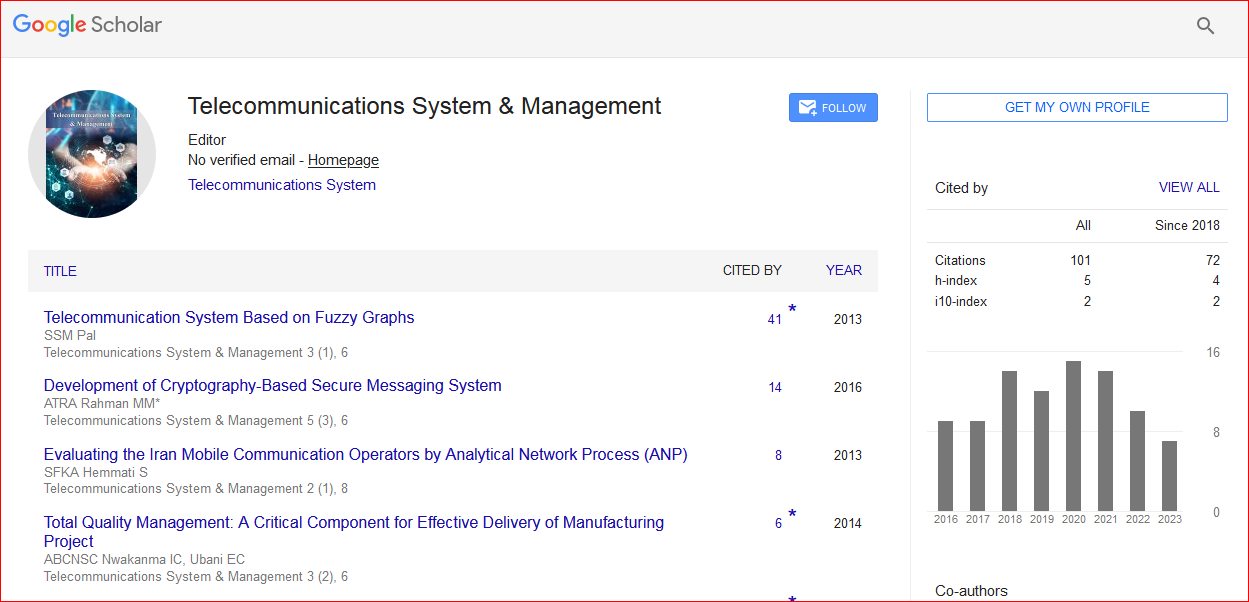
Telecommunications System & Management received 109 citations as per Google Scholar report