Opinion - (2025) Volume 14, Issue 2
Received: 02-Jun-2025, Manuscript No. ara-25-175569;
Editor assigned: 04-Jun-2025, Pre QC No. P-175569;
Reviewed: 18-Jun-2025, QC No. Q-175569;
Revised: 23-Jun-2025, Manuscript No. R-175569;
Published:
30-Jun-2025
, DOI: 10.37421/2168-9695.2025.14.326
Citation: Calderón, Sofia. ”Intelligent Robots: Advancing, Transforming, Ethical Futures.” Adv Robot Autom 14 (2025):326.
Copyright: © 2025 Calderón S. This is an open-access article distributed under the terms of the Creative Commons Attribution License, which permits unrestricted use, distribution and reproduction in any medium, provided the original author and source are credited.
Intelligent robots are quickly changing various aspects of modern life, pushing the boundaries of what machines can do. One important area involves deep reinforcement learning, which is revolutionizing how humanoid robots learn to walk and move. This approach lets them adapt and improve their locomotion skills on their own, bringing us closer to robots that can navigate the real world much more naturally [1].
Deep reinforcement learning also plays a significant role in robot navigation. It teaches robots to move through complex environments, avoid obstacles, and reach goals without needing explicit programming. What this really means is intelligent robots are learning to find their way around the world more effectively and adaptively than ever before [6].
In manufacturing, intelligent robots, especially when integrating Artificial Intelligence (AI) and Human-Robot Collaboration (HRC), are fundamentally changing production. This integration boosts efficiency and flexibility by enhancing robot autonomy, perception, and decision-making on factory floors [4].
Moreover, visual servo control, powered by deep learning, is making robotic arms more precise and adaptive, allowing them to perform complex tasks in manufacturing with greater accuracy by "seeing" what they're doing [8].
Here's the thing about intelligent robots in healthcare. Their role is expanding, with social robots powered by AI offering potential for assistance, companionship, and even therapy. This hints at a future where robots are active participants in patient care, not just tools [5].
However, using intelligent robots in sensitive areas like elder care raises critical ethical questions. These concerns cover everything from privacy and autonomy to the potential for emotional manipulation. It's a critical look at making sure we design and deploy these robots responsibly, keeping human dignity front and center [2].
Privacy and security are paramount in smart healthcare environments, and designing robots to protect patient data is crucial for building trust in these advanced systems [7].
When it comes to more specialized medical applications, the role of intelligent robots in surgery is a big deal. The field is grappling with challenges like precision and real-time adaptation, but it also paints a picture of a future with safer, more efficient operations [3].
Building user trust is a key factor across all applications of intelligent robots. Explainable Artificial Intelligence (XAI) is vital here, as it makes AI's decisions transparent. This transparency helps people understand and accept robot actions, especially in critical applications, which ultimately fosters better Human-Robot Collaboration (HRC) [9].
Intelligent robots are also making their way into education. Through bibliometric analysis, we can see trends and key areas where robots are deployed as learning tools. What this really means is they can personalize education and engage students in new ways, showcasing their potential to reshape learning environments [10].
Overall, these diverse applications highlight the pervasive and evolving influence of intelligent robots, driven by continuous innovation in AI and robotics.
Intelligent robots are changing fundamental aspects of how we live and work, particularly through advancements in learning and interaction. For instance, deep reinforcement learning has been a game-changer for humanoid robots, enabling them to learn complex locomotion skills and adapt to varied real-world environments without extensive traditional programming [1]. This same learning paradigm is crucial for robot navigation, allowing intelligent robots to traverse intricate settings, avoid obstacles, and achieve objectives with remarkable adaptiveness [6]. Let's break down how this capability translates into practical applications, where robots are not just performing predefined tasks but learning and improving their movement autonomously. This autonomy is a cornerstone of next-generation robotics, promising more intuitive and capable machines across industries.
In the realm of manufacturing, the integration of Artificial Intelligence (AI) with robotics is fundamentally reshaping production processes. Here's the thing: effective Human-Robot Collaboration (HRC) is becoming central to factory floors, boosting both efficiency and flexibility. Robots are gaining enhanced autonomy, perception, and decision-making abilities, leading to more dynamic and responsive manufacturing systems [4]. What this really means is complex tasks, once solely human domains, are now being shared with robots. A key part of this improvement comes from visual servo control, where deep learning allows robotic manipulators to "see" and interact with their environment with greater precision, executing intricate tasks with higher accuracy [8]. This advancement moves manufacturing closer to fully adaptive and intelligent automation.
The impact of intelligent robots on healthcare is multifaceted and profound. Social robots, powered by Artificial Intelligence (AI), are emerging as significant aids, offering assistance, companionship, and even therapeutic support. These robots interact meaningfully with patients, suggesting a future where they are active participants in patient care, moving beyond simple tools [5]. However, their deployment, especially in sensitive contexts like elder care, raises significant ethical considerations. Concerns around patient privacy, autonomy, and the potential for emotional manipulation are critical, demanding responsible design and deployment practices that prioritize human dignity [2]. Protecting sensitive patient data is also paramount in smart healthcare environments, necessitating privacy-preserving designs to build and maintain trust in these advanced robotic systems [7]. In more specialized medical applications, surgical robots are experiencing rapid development. While challenges like achieving extreme precision and real-time adaptation persist, the trajectory points towards a future with safer and more efficient surgical operations [3].
Building trust is absolutely critical for the widespread adoption and successful integration of intelligent robots. This is where Explainable Artificial Intelligence (XAI) comes into play. XAI works to make the decision-making processes of AI transparent, which helps users understand and accept robot actions, particularly in high-stakes situations. This transparency is key to fostering better Human-Robot Collaboration (HRC) over time [9].
Beyond industrial and healthcare settings, intelligent robots are also making a significant mark in education. Using bibliometric analysis, researchers are exploring the landscape of Human-Robot Interaction (HRI) within educational robotic systems. This highlights how robots can act as personalized learning tools, engaging students in novel ways and potentially revolutionizing educational methodologies [10]. These diverse applications underscore a broad trend toward increasingly intelligent, adaptive, and integrated robotic systems that are reshaping our interactions with technology and the world around us.
Intelligent robots are rapidly advancing, transforming how we approach complex tasks across many fields. For example, deep reinforcement learning is crucial for teaching humanoid robots to walk and move naturally, helping them adapt to real-world navigation. This kind of learning also drives robot navigation through complex environments, allowing them to avoid obstacles and reach goals without explicit programming. In healthcare, intelligent robots are stepping up in significant ways. Social robots, powered by Artificial Intelligence (AI), assist with tasks, provide companionship, and even help in therapy. However, here's the thing: their use, especially in sensitive areas like elder care, brings up serious ethical considerations regarding privacy, autonomy, and the potential for emotional manipulation. Ensuring patient data protection is paramount, leading to a focus on privacy-preserving designs in smart healthcare environments. Surgical robots are also a big deal, with ongoing efforts to overcome precision and real-time adaptation hurdles to achieve safer, more efficient operations. Let's break down manufacturing, where AI integration with robots is boosting efficiency and flexibility. Human-Robot Collaboration (HRC) is becoming more effective, as robots improve their autonomy, perception, and decision-making capabilities. Visual servo control, enhanced by deep learning, is making robotic manipulators more precise, allowing them to perform complex tasks with greater accuracy. Building trust in these intelligent systems is key. Explainable Artificial Intelligence (XAI) makes robot decisions transparent, which helps users understand and accept their actions, fostering better collaboration. Intelligent robots are also shaping education, acting as learning tools that personalize education and engage students in new ways. Overall, these advancements point towards a future with more adaptive, autonomous, and integrated intelligent robotic systems.
None
None
Yang L, Qiyue Y, Fan Z. "Deep reinforcement learning for humanoid robot locomotion: A review".Front Neurorobot 16 (2022):e1009121.
Indexed at, Google Scholar, Crossref
Annmarie M, Natalie JC, Arbindra R. "Ethical Issues of Autonomous Robot Use in the Care of Older Adults: A Scoping Review".Int J Environ Res Public Health 18 (2021):5410.
Indexed at, Google Scholar, Crossref
Pengxiang L, Xinran Z, Yunming L. "Current challenges and future directions for intelligent surgical robots".World J Clin Cases 11 (2023):5809-5819.
Indexed at, Google Scholar, Crossref
Xiaohui W, Yuan G, Yifei W. "Intelligent Robots: A Review of Artificial Intelligence and Humanâ??Robot Collaboration in Manufacturing".Appl Sci (Basel) 13 (2023):9691.
Indexed at, Google Scholar, Crossref
Eftihia TK, Constantinos PC, Dimitra KD. "The role of artificial intelligence in social robots: an overview".Health Care Manag (Frederick) 42 (2023):E109-E120.
Indexed at, Google Scholar, Crossref
Mengyu L, Jianjun L, Chenyu Y. "Deep Reinforcement Learning for Robot Navigation: A Survey".IEEE Access 9 (2021):110991-111009.
Indexed at, Google Scholar, Crossref
Xiaoyu S, Shiyin N, Yanxiang L. "Privacy-preserving intelligent robots in smart healthcare environments: a literature review".Front Public Health 11 (2023):e1118318.
Indexed at, Google Scholar, Crossref
Xinghao L, Yuanxiang L, Zhongwu Z. "A review of visual servo control based on deep learning for robotic manipulators".J Manuf Syst 69 (2023):118-132.
Indexed at, Google Scholar, Crossref
Laura-Lucia D, Bianca-Mihaela C, RÄ?zvan-Gabriel R. "The impact of explainable AI on users' trust in intelligent systems and robot applications: A systematic review".Front Psychol 14 (2023):e1172827.
Indexed at, Google Scholar, Crossref
Ziyuan L, Yang Y, Junfeng L. "Human-Robot Interaction in Intelligent Educational Robotic Systems: A Bibliometric Analysis and Literature Review".J Intell Robot Syst 107 (2024):11.
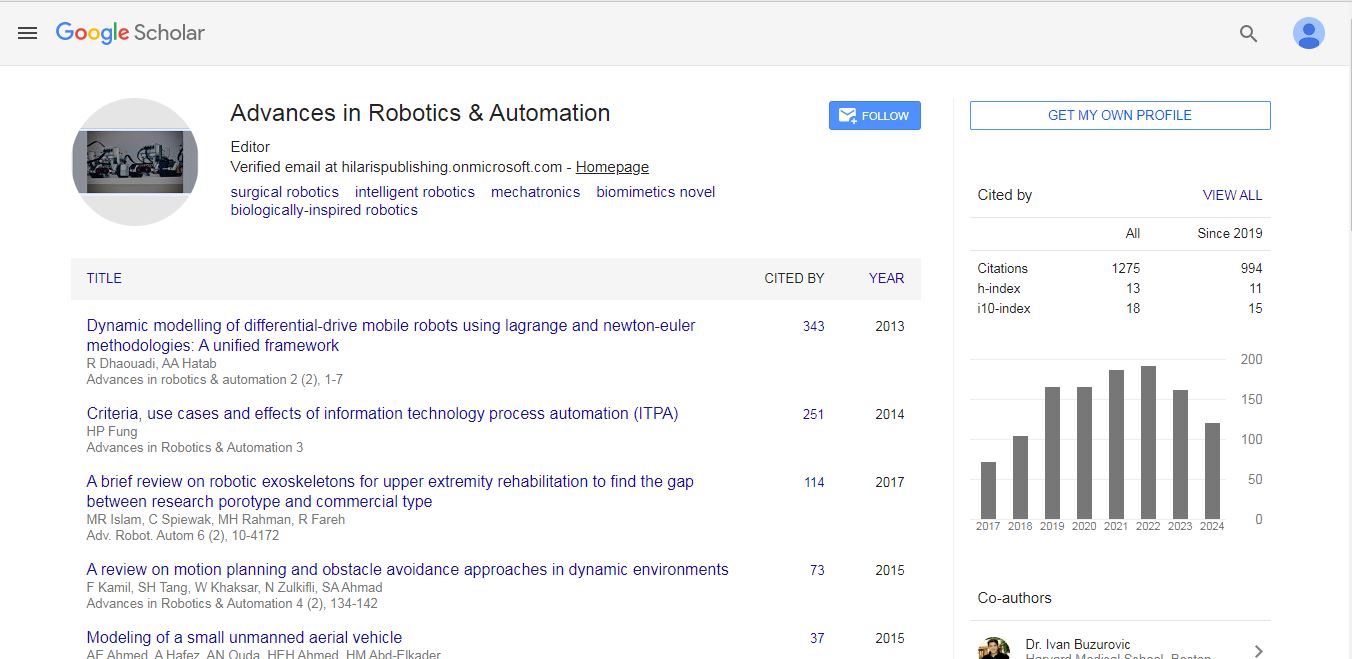
Advances in Robotics & Automation received 1275 citations as per Google Scholar report