Brief Report - (2025) Volume 14, Issue 2
Received: 01-Mar-2025, Manuscript No. jtsm-26-179499;
Editor assigned: 03-Mar-2025, Pre QC No. P-179499;
Reviewed: 17-Mar-2025, QC No. Q-179499;
Revised: 24-Mar-2025, Manuscript No. R-179499;
Published:
31-Mar-2025
, DOI: 10.37421/2167-0919.2025.14.484
Citation: Kovács, Elena. ”Intelligent Networks: Adaptive Architectures, AI, and Security.” J Telecommun Syst Manage 14 (2025):484.
Copyright: © 2025 Kovács E. This is an open-access article distributed under the terms of the Creative Commons Attribution License, which permits unrestricted use, distribution and reproduction in any medium, provided the original author and source are credited.
The evolution of communication networks into the next generation is marked by a profound emphasis on advanced design principles and strategic management approaches to meet escalating demands. These networks are envisioned to be highly adaptive, intelligent, and robust, capable of supporting a multitude of diverse applications ranging from the Internet of Things (IoT) to the advanced capabilities of 5G/6G and AI-driven services. The integration of proactive management strategies, incorporating real-time monitoring and predictive analytics, is deemed essential for ensuring resilience, optimizing performance, and maintaining user satisfaction in these complex systems. The overarching goal is to develop communication infrastructures that are not only faster and more efficient but also inherently more flexible and secure to navigate the intricate future communication landscapes. The transition towards 6G networks, in particular, necessitates a fundamental paradigm shift, moving towards intelligent automation and distributed control mechanisms. This evolution requires a deep examination of architectural changes and management strategies to effectively handle the anticipated massive connectivity, ultra-low latency requirements, and the pervasive integration of intelligence throughout the network. Key insights for this transition involve leveraging artificial intelligence and machine learning for proactive network optimization, utilizing blockchain technology to bolster security and trust, and implementing software-defined networking (SDN) and network function virtualization (NFV) for agile resource orchestration. Effective management of the Internet of Things (IoT) within these next-generation networks is paramount to unlocking its full potential. This necessitates focused investigation into resource allocation and Quality of Service (QoS) management techniques specifically tailored for massive IoT deployments. The inherent challenges posed by a vast number of heterogeneous devices, diverse traffic patterns, and limited resources demand intelligent algorithms for dynamic resource provisioning and efficient spectrum sharing to enhance network efficiency and ensure reliable service delivery. The objective is to formulate scalable management frameworks capable of accommodating billions of connected devices while upholding acceptable performance benchmarks. The integration of Artificial Intelligence (AI) and Machine Learning (ML) into the management of communication networks is being actively explored to achieve enhanced automation and operational efficiency. Novel AI-driven approaches are being presented for intelligent traffic engineering and anomaly detection within complex network environments. The fundamental concept involves using ML models to predict network congestion, optimize routing paths, and identify security threats in real-time, thereby enabling proactive management crucial for maintaining the performance and reliability of dynamic and increasingly complex next-generation networks. The rapidly evolving landscape of communication networks, especially with the advent of 5G and its subsequent iterations, underscores the critical need for sophisticated security management. Developing resilient and adaptive security architectures is a primary focus. This includes the implementation of zero-trust security models, advanced intrusion detection systems, and robust cryptographic solutions designed to protect against emerging cyber threats. A unified management framework that seamlessly integrates security operations with core network management functions is advocated to ensure rapid response to security incidents and maintain the integrity and confidentiality of network data. Network slicing emerges as a critical technology for the management of next-generation communication networks, particularly in the context of 5G and future mobile systems. The design principles and management strategies for creating and operating virtual network slices, each customized for specific service requirements, are being outlined. Key management aspects include resource isolation, dynamic orchestration, and end-to-end service assurance, with the inherent flexibility of network slicing being a crucial element for efficiently delivering a wide array of services, from enhanced mobile broadband to mission-critical communications. The management of distributed ledger technologies (DLT) and blockchain within next-generation communication networks is being investigated for its potential to enhance security, trust, and data integrity. These decentralized technologies offer architectural advantages for secure identity management, decentralized data storage, and transparent transaction logging. The exploration of management frameworks necessary to effectively integrate blockchain into communication network operations is essential for enabling new services and improving existing ones through enhanced trust and security. The application of edge computing is being studied for its role in achieving efficient management of next-generation communication networks. By pushing computation and data storage closer to the network edge, significant reductions in latency and improvements in bandwidth utilization and real-time processing capabilities can be realized. The design of edge-enabled network management systems, encompassing resource orchestration, service deployment, and data analytics at the edge, is crucial for leveraging edge intelligence to foster more responsive and efficient network infrastructures for advanced applications. The drive towards intelligent and autonomous network management is a central theme in the development of next-generation communication networks. The use of reinforcement learning (RL) techniques is being examined for dynamic resource allocation and network optimization. An RL-based framework allows network management systems to learn optimal policies through interaction with the network environment, enabling adaptation to changing conditions and user demands, ultimately aiming to enhance network efficiency, reduce operational costs, and improve user experience through self-optimizing functionalities. Challenges related to energy efficiency in next-generation communication networks are being addressed through various management strategies. With the exponential increase in connected devices and data rates, energy consumption is a significant concern. Exploring strategies such as intelligent sleep modes, dynamic power management, and energy-aware resource allocation is crucial. The focus is on developing management techniques that can effectively balance performance requirements with energy conservation, thereby contributing to the overall sustainability of future communication infrastructures.
Next-generation communication networks are being designed with a strong emphasis on fundamental principles and strategic management to accommodate the surging demands of modern applications like IoT, 5G/6G, and AI-driven services. These systems require adaptive architectures, intelligent resource allocation, and robust security frameworks. Proactive management, integrating real-time monitoring and predictive analytics, is considered vital for ensuring network resilience, optimal performance, and high user satisfaction. The aim is to create networks that are not only faster and more efficient but also more flexible and secure, capable of handling the complexities of future communication environments [1].
The ongoing evolution towards 6G networks necessitates a significant shift towards intelligent automation and distributed control in network management. This involves a thorough examination of architectural advancements and management strategies to cope with anticipated massive connectivity, ultra-low latency, and the widespread integration of intelligence. Key aspects include the use of AI/ML for proactive optimization, blockchain for enhanced security and trust, and SDN/NFV for flexible resource orchestration. The development of scalable and adaptable management systems is critical to dynamically respond to evolving network conditions and service requirements [2].
Effective management of the Internet of Things (IoT) within next-generation networks is crucial for realizing its full potential. This involves dedicated research into resource allocation and Quality of Service (QoS) management techniques suitable for massive IoT deployments. The challenges presented by heterogeneous devices, diverse traffic, and limited resources require intelligent algorithms for dynamic resource provisioning and spectrum sharing to improve network efficiency and ensure dependable service delivery. The goal is to develop management frameworks that can scale to accommodate billions of devices while maintaining acceptable performance levels [3].
The integration of Artificial Intelligence (AI) and Machine Learning (ML) into communication network management is a key trend for enhancing automation and efficiency. Novel AI-driven approaches are being developed for intelligent traffic engineering and anomaly detection in complex network environments. The core principle is to leverage ML models for real-time prediction of network congestion, optimization of routing paths, and identification of security threats, thereby enabling proactive management essential for the performance and reliability of next-generation networks characterized by dynamic traffic and increasing complexity [4].
As communication networks evolve, particularly with the advancements in 5G and beyond, sophisticated security management becomes indispensable. This necessitates the development of resilient and adaptive security architectures. Implementation of zero-trust security models, advanced intrusion detection systems, and cryptographic solutions are central to safeguarding against emerging cyber threats. A unified management framework that merges security operations with network management functions is advocated to facilitate rapid responses to security incidents and guarantee the integrity and confidentiality of network data [5].
Network slicing plays a pivotal role in the management of next-generation communication networks, especially within the framework of 5G and future mobile systems. The design and management strategies for creating and operating virtual network slices, each customized for specific service requirements, are crucial. Key management considerations include resource isolation, dynamic orchestration, and end-to-end service assurance. The inherent flexibility of network slicing is vital for the efficient delivery of diverse services, ranging from enhanced mobile broadband to critical communications [6].
The integration of distributed ledger technologies (DLT) and blockchain into next-generation communication network management is being explored for its potential to enhance security, trust, and data integrity within intricate network ecosystems. Key features include secure identity management, decentralized data storage, and transparent transaction logging. The development of appropriate architectural considerations and management frameworks is necessary to effectively integrate blockchain into communication network operations, thereby enabling new services and improving existing ones through augmented trust and security [7].
The application of edge computing is being studied for its contribution to the efficient management of next-generation communication networks. By relocating computation and data storage closer to the network edge, significant reductions in latency, improvements in bandwidth utilization, and enhanced real-time processing capabilities can be achieved. The design of edge-enabled network management systems, including resource orchestration, service deployment, and data analytics at the edge, is focused on utilizing edge intelligence to create more responsive and efficient network infrastructures for applications such as autonomous systems and augmented reality [8].
Intelligent and autonomous network management represents a central theme in the evolution of next-generation communication networks. This research examines the application of reinforcement learning (RL) techniques for dynamic resource allocation and network optimization. An RL-based framework empowers network management systems to learn optimal operational policies through interaction with the network environment, enabling adaptation to changing conditions and user demands. The objective is to boost network efficiency, decrease operational costs, and elevate the user experience by facilitating self-optimizing network functionalities [9].
Energy efficiency management in next-generation communication networks presents significant challenges due to the increasing number of connected devices and higher data rates, leading to substantial energy consumption. Various strategies are being explored, including intelligent sleep modes, dynamic power management, and energy-aware resource allocation. The focus is on developing management techniques that can effectively balance performance requirements with energy conservation, thereby contributing to the sustainability of future communication infrastructures [10].
Next-generation communication networks are characterized by a need for adaptive architectures, intelligent resource allocation, and robust security to handle escalating demands from diverse applications like IoT and 5G/6G. Proactive management, leveraging real-time monitoring and predictive analytics, is essential for network resilience and performance. The transition to 6G emphasizes intelligent automation, distributed control, and the integration of AI/ML, blockchain, SDN, and NFV for optimized resource orchestration and enhanced security. Effective management of massive IoT deployments requires sophisticated resource allocation and QoS techniques to handle heterogeneous devices and varied traffic. AI/ML-driven approaches are crucial for intelligent traffic engineering and anomaly detection, enabling proactive network management. Security management focuses on resilient architectures, zero-trust models, and intrusion detection systems, with unified frameworks for rapid incident response. Network slicing is key for tailored service delivery through virtual network segments. Blockchain and DLT integration aims to enhance security, trust, and data integrity. Edge computing offers efficient management by reducing latency and improving real-time processing. Reinforcement learning is being explored for autonomous network optimization and resource allocation. Energy efficiency is a significant concern, addressed through strategies like intelligent sleep modes and dynamic power management to balance performance with sustainability.
None
None
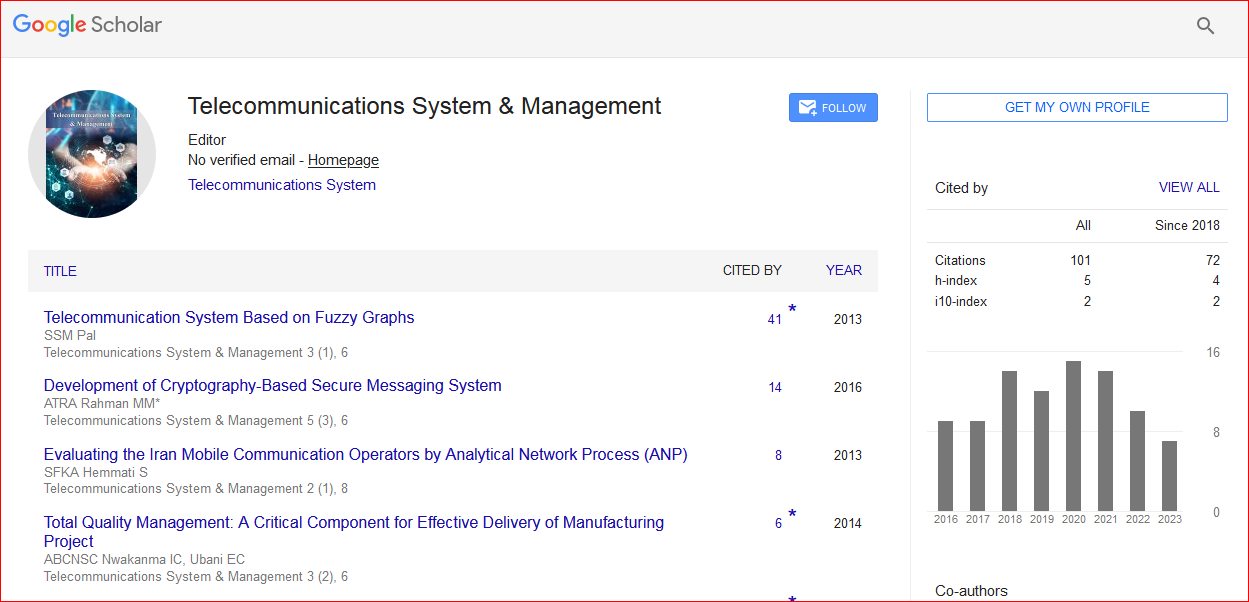
Telecommunications System & Management received 109 citations as per Google Scholar report