Perspective - (2025) Volume 16, Issue 2
Received: 28-Mar-2025, Manuscript No. gjto-25-175383;
Editor assigned: 31-Mar-2025, Pre QC No. P-175383;
Reviewed: 14-Apr-2025, QC No. QC-175383;
Revised: 21-Apr-2025, Manuscript No. R-175383;
Published:
28-Apr-2025
, DOI: 10.37421/2229-8711.2025.16.438
Citation: Markovic, Elena. ”Intelligent Algorithms: Revolutionizing Industries, Overcoming Hurdles.” Global J Technol Optim 16 (2025):438.
Copyright: © 2025 Markovic E. This is an open-access article distributed under the terms of the Creative Commons Attribution License, which permits unrestricted use,
distribution and reproduction in any medium, provided the original author and source are credited.
The rapid evolution of intelligent algorithms is reshaping numerous sectors, offering advanced solutions to complex problems and driving innovation across industries. These algorithms, encompassing deep learning, machine learning, and natural language processing, are proving indispensable in enhancing diagnostic accuracy and operational efficiency. In the critical field of medical diagnosis, for instance, intelligent algorithms are at the forefront, particularly in areas like image analysis and the precise prediction of diseases. They leverage sophisticated computational methods to process vast amounts of medical data, assisting healthcare professionals in making more informed decisions. Despite their promising capabilities, the deployment of such systems in clinical settings faces considerable hurdles, primarily concerning the stringent requirements for data privacy and the urgent need for more explainable Artificial Intelligence (AI) models that clinicians can trust and understand [1].
Beyond healthcare, intelligent algorithms are similarly transforming the manufacturing landscape, ushering in a new era for industrial automation. Here, machine learning and advanced optimization techniques are not just incrementally improving processes; they are fundamentally reshaping manufacturing efficiency, elevating quality control standards, and enabling predictive maintenance capabilities that significantly reduce downtime. These advancements are central to realizing the full potential of Industry 4.0 environments, fostering greater adaptability and responsiveness within complex production cycles. However, the successful integration of these algorithms depends on overcoming significant challenges related to seamless data integration across disparate systems and meeting the demanding requirements for real-time processing [2].
The domain of cybersecurity also benefits immensely from these algorithmic advancements. Intelligent algorithms, particularly those rooted in machine learning and deep learning, are instrumental in actively identifying and mitigating malicious activities, detecting intrusions, and pinpointing anomalies within vast streams of network traffic and system behaviors. Their strength lies in their ability to process and analyze massive datasets rapidly, adapting to the continuously evolving patterns of cyber threats. Yet, the persistent issues of managing false positives, addressing data scarcity for newly emerging or rare attack vectors, and fulfilling substantial computational demands remain critical areas for ongoing research and development in creating truly robust cybersecurity solutions [3].
Our urban environments are becoming smarter through the application of intelligent algorithms in various smart city initiatives. These algorithms ingeniously utilize data streamed from countless Internet of Things (IoT) devices and sensors to enable real-time decision-making across applications such as traffic management, energy optimization, waste collection, and enhancing public safety. Specific algorithmic approaches like genetic algorithms, neural networks, and swarm intelligence play vital roles in fostering more sustainable and livable urban centers. However, the widespread deployment of smart city technologies necessitates careful navigation of obstacles like safeguarding data privacy, ensuring interoperability between diverse systems, and establishing robust ethical frameworks [4].
In the highly dynamic world of finance, intelligent algorithms are becoming indispensable tools for forecasting financial markets. A wide array of algorithmic approaches, including advanced machine learning models, neural networks, and fuzzy logic systems, are employed to predict intricate movements in stock prices, broader market trends, and currency fluctuations. These sophisticated tools have the potential to confer significant competitive advantages in trading and investment strategies. Nevertheless, their application is fraught with inherent difficulties, particularly confronting the volatile nature of financial markets, the pervasive presence of data noise, and the profound challenge of accurately capturing complex, non-linear market dynamics [5].
The quest for fully autonomous driving systems is intrinsically linked to the development and refinement of intelligent algorithms. These algorithms are crucial components within the perception, planning, and control modules of self-driving vehicles. Advanced deep learning techniques power object detection and semantic segmentation, reinforcement learning guides complex decision-making, and model predictive control optimizes trajectory planning for safe and efficient autonomous navigation. Integrating vast streams of sensor data from cameras, LiDAR, and radar creates comprehensive environmental models. Still, significant hurdles persist, including the need to reliably handle unpredictable real-world scenarios, ensure system robustness against adversarial attacks, and rigorously achieve verifiable safety standards [6].
Environmental monitoring and the prediction of pollution levels are also increasingly relying on intelligent algorithms. Machine learning, deep learning, and swarm intelligence are deployed to analyze extensive environmental datasets, enabling accurate predictions of air and water quality and facilitating effective management of natural resources. These algorithms prove effective in pinpointing pollution sources, forecasting ecological changes, and supporting evidence-based policymaking for sustainable development. Key challenges in this domain include managing the inherent heterogeneity of environmental data, meeting the demands for real-time processing capabilities, and seamlessly integrating diverse sensor networks [7].
In the realm of online education, intelligent algorithms are pivotal in crafting personalized learning experiences. Recommendation systems, adaptive testing, and intelligent tutoring platforms are designed to customize educational content and pacing to align with individual student needs and diverse learning styles. These algorithms analyze student performance, engagement metrics, and preferences to optimize learning paths and deliver highly targeted feedback. Yet, developing these systems responsibly requires addressing concerns about data privacy, ensuring the availability of diverse and unbiased training data, and overcoming the inherent complexity of accurately modeling human learning processes [8].
The acceleration of materials discovery and design represents another frontier where intelligent algorithms are making a profound impact. Machine learning, deep learning, and various optimization algorithms are actively utilized to predict novel material properties, identify new compounds, and streamline synthetic pathways. The adoption of these algorithms promises to significantly reduce experimental costs and time, enabling the rapid exploration of vast chemical spaces and the design of materials with precisely tailored functionalities. However, researchers continually face challenges related to the scarcity of high-quality experimental data, the interpretability of increasingly complex models, and the effective integration of computational insights with experimental workflows [9].
Lastly, intelligent algorithms are integral to the advancement of smart agriculture, driving improvements in both efficiency and sustainability. Machine learning, image processing, and optimization algorithms are applied across a spectrum of agricultural tasks, including precise crop monitoring, early disease detection, optimized irrigation, and accurate yield prediction. These algorithms play a vital role in processing data from various sources, such as ground sensors, Unmanned Aerial Vehicles (UAVs), and satellites, to equip farmers with actionable insights. Overcoming the challenges posed by the variability of agricultural environments and developing explainable models to foster farmer trust remains crucial for future progress [10].
Intelligent algorithms are proving indispensable across an expansive array of modern applications, fundamentally enhancing capabilities from complex data analysis to predictive modeling. These algorithms, spanning various Artificial Intelligence (AI) subfields like deep learning, machine learning, and natural language processing, offer unprecedented opportunities for efficiency, accuracy, and innovation. They are adept at processing vast datasets, identifying intricate patterns, and making informed decisions, thus pushing the boundaries of what is technologically feasible. Their core strength lies in their adaptability and capacity to learn from data, leading to solutions that were once beyond reach for traditional computational methods.
One major area of impact is in critical human-centric fields. In medical diagnosis, intelligent algorithms are transforming healthcare by enhancing diagnostic accuracy and streamlining operations, particularly through advanced image analysis and robust disease prediction models [1]. Similarly, in personalized learning, these algorithms develop tailored educational content and adaptive learning paths by analyzing student performance and engagement, ensuring a more effective and individualized learning experience [8]. These applications highlight the profound potential of AI to directly improve human well-being and development.
The industrial and urban landscapes are also significantly benefiting from these advancements. Intelligent algorithms are integral to industrial automation, where they optimize manufacturing processes, refine quality control, and enable predictive maintenance, thereby driving increased efficiency within Industry 4.0 environments [2]. Urban centers are becoming smarter with algorithms managing traffic, energy systems, waste, and public safety by leveraging data from Internet of Things (IoT) devices for real-time decision-making [4]. Furthermore, in autonomous driving, intelligent algorithms are critical for complex tasks such as perception, planning, and control, allowing vehicles to navigate safely and efficiently by integrating diverse sensor data [6].
Beyond these, intelligent algorithms are crucial in safeguarding our digital and natural worlds, and optimizing complex financial and material processes. Cybersecurity heavily relies on these algorithms for real-time threat detection, identifying malicious activities and anomalies across networks [3]. For environmental monitoring, they analyze vast datasets to predict pollution levels and manage natural resources, supporting sustainable development initiatives [7]. In financial markets, algorithms provide sophisticated forecasting capabilities for stock prices and market trends, offering competitive advantages to traders and investors [5]. They also accelerate materials discovery and design by predicting properties and optimizing synthetic pathways, significantly reducing experimental costs and time [9]. Even agriculture is becoming more intelligent, with algorithms enhancing crop monitoring, disease detection, and yield prediction, providing actionable insights for farmers [10].
Despite these widespread benefits, the implementation of intelligent algorithms is not without its significant challenges. Across all sectors, common hurdles include addressing stringent data privacy concerns, ensuring the need for robust validation protocols, and tackling the complexity of interpretability, especially in sensitive clinical or financial settings [1, 5, 8]. Data-related issues like the scarcity of high-quality training data for rare events or novel materials, the presence of data noise, and the heterogeneity of data sources also pose considerable difficulties [3, 5, 7, 9]. Furthermore, demands for real-time processing, ensuring system robustness against adversarial attacks, and establishing clear ethical frameworks are paramount for the successful and responsible deployment of these advanced technologies [2, 4, 6, 8, 10]. Future research will likely focus on developing more explainable AI models, integrating multi-modal data, and creating hybrid AI-physics models to overcome these persistent obstacles and fully realize the potential of intelligent algorithms.
Intelligent algorithms are fundamentally transforming a wide array of critical sectors, significantly enhancing efficiency, accuracy, and predictive capabilities across diverse applications. These sophisticated computational methods, including deep learning, machine learning, and natural language processing, are proving indispensable in advancing fields from medical diagnosis, where they improve diagnostic precision and operational efficiency, to industrial automation, where they optimize manufacturing processes and facilitate predictive maintenance for Industry 4.0. They are also vital for robust cybersecurity threat detection, enabling real-time identification of anomalies, and for effective smart city management, utilizing Internet of Things (IoT) data to streamline urban services like traffic and energy. Moreover, intelligent algorithms are crucial in financial market forecasting, offering competitive advantages in predicting trends, and in the development of autonomous driving systems, where they manage perception, planning, and control for safe navigation.
Their utility extends to environmental monitoring for pollution prediction, personalized learning experiences in online education, and accelerating materials discovery and design by predicting properties. They also play a key role in smart agriculture, enhancing crop monitoring and yield prediction. While these algorithms offer profound benefits, their widespread adoption faces substantial challenges. These include ensuring stringent data privacy, demanding robust validation, addressing interpretability in sensitive domains, and managing issues like data scarcity, noise, and computational demands. Future efforts will likely focus on integrating multi-modal data and developing more explainable Artificial Intelligence (AI) models to build greater trust and overcome current limitations, ensuring their continued responsible and effective deployment.
None
None
Fenhong Y, Quan L, Zhaoxia Z. "Intelligent algorithms in medical diagnosis: Current status, challenges, and future directions".J. Biomed. Inform. 145 (2023):104473.
Indexed at, Google Scholar, Crossref
Bo J, Ming L, Jin W. "Intelligent Algorithms in Industrial Automation: A Review on Recent Advances and Challenges".IEEE Trans. Ind. Inform. 19 (2023):1-13.
Indexed at, Google Scholar, Crossref
Pankaj K, Rajesh K, Ajay S. "Intelligent Algorithms for Cybersecurity Threat Detection: A Survey".J. Netw. Comput. Appl. 232 (2024):103778.
Indexed at, Google Scholar, Crossref
Muhammad ZA, Shamroz A, Muhammad R. "Intelligent Algorithms for Smart City Applications: A Review".Sustain. Cities Soc. 83 (2022):103986.
Indexed at, Google Scholar, Crossref
Mohammad LA, Adnan RA, Samir AG. "Intelligent Algorithms for Financial Market Forecasting: A Systematic Review".J. Financ. Data Sci. 7 (2021):5-27.
Indexed at, Google Scholar, Crossref
Weijie L, Yu C, Song M. "Intelligent Algorithms for Autonomous Driving: Perception, Planning, and Control".Robot. Auton. Syst. 166 (2023):104445.
Indexed at, Google Scholar, Crossref
Husain SA, Riyadh AA, Huda MA. "Intelligent Algorithms for Environmental Monitoring and Pollution Prediction: A Review".Environ. Sci. Pollut. Res. 29 (2022):24967-24985.
Indexed at, Google Scholar, Crossref
Chandan KS, Ashish KS, Virendra KS. "Intelligent Algorithms for Personalized Learning in Online Education".Educ. Inf. Technol. 25 (2020):2549-2571.
Indexed at, Google Scholar, Crossref
Yang W, Xiaolong L, Yang Z. "Intelligent Algorithms for Accelerating Materials Discovery and Design: A Review".npj Comput. Mater. 10 (2024):25.
Indexed at, Google Scholar, Crossref
Xin Z, Yun W, Wei Y. "Intelligent Algorithms for Smart Agriculture: A Review".J. Sensors 2019 (2019):6843479.
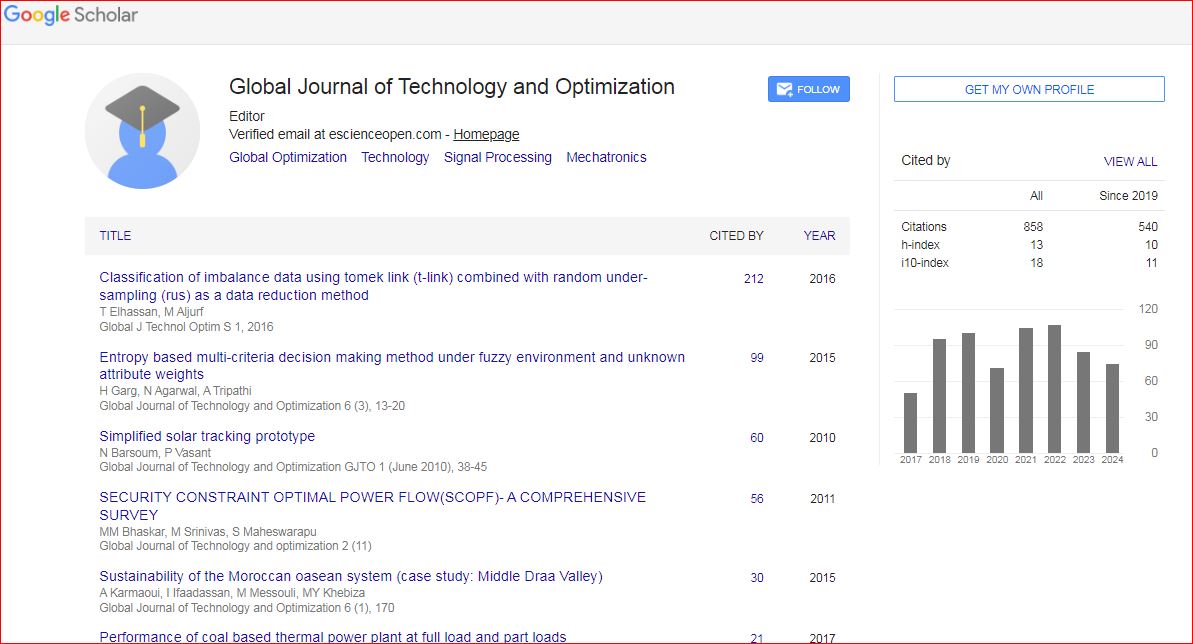
Global Journal of Technology and Optimization received 847 citations as per Google Scholar report