Perspective - (2025) Volume 14, Issue 3
Received: 02-May-2025, Manuscript No. aim-25-177352;
Editor assigned: 05-May-2025, Pre QC No. P-177352;
Reviewed: 19-May-2025, QC No. Q-177352;
Revised: 23-May-2025, Manuscript No. R-177352;
Published:
30-May-2025
, DOI: 10.37421/2427-5162.2025.14.573
Citation: Mendes, Carolina. ”Integrative Oncology: Evidence, Needs and Patient Care.” Alt Integr Med 14 (2025):573.
Copyright: © 2025 Mendes C. This is an open-access article distributed under the terms of the Creative Commons Attribution License, which permits unrestricted use, distribution and reproduction in any medium, provided the original author and source are credited.
A recent study in Germany surveyed physicians and allied health professionals on their perspectives regarding integrative oncology. The findings highlighted challenges and opportunities for better integrating complementary therapies into mainstream cancer care. This work pointed to a clear need for more education and evidence-based guidelines among healthcare providers to enhance practical application [1].
This research explored patient perspectives on integrating complementary therapies into standard cancer care. It uncovered crucial insights into communication patterns and the information needs of patients, emphasizing the importance of clear, empathetic dialogue between patients and healthcare providers about these therapies for informed decision-making [2].
A scoping review provided an overview of integrative oncology practices specifically within Latin America. It mapped the current landscape, identifying prevalent complementary therapies, research trends, and existing gaps. This helps define a clearer path for future integrative oncology development in the region, supporting targeted efforts [3].
The paper examined integrative oncology's role within palliative care for advanced cancer patients. It highlighted how complementary therapies significantly improve quality of life, symptom management, and psychological well-being. This offers a holistic approach to care during critical stages of illness, providing comprehensive support beyond conventional methods [4].
This study investigated the use of complementary and integrative medicine among oncology patients in Malaysia. It revealed the prevalence, patterns of use, and perceived effectiveness of various therapies. The findings shed light on patient motivations and needs, crucial for developing culturally sensitive and effective integrative care models tailored to the local context [5].
Through a systematic review and meta-analysis, this article evaluated the efficacy of integrative oncology interventions in enhancing cancer patients' well-being. The review consolidated evidence, showing promising outcomes for various complementary therapies in improving patient-reported quality of life and symptom management, thus reinforcing their therapeutic value [6].
This qualitative study explored patient perspectives on integrative oncology, detailing their needs, expectations, and experiences with complementary therapies. The insights gained are crucial for tailoring patient-centered integrative care programs and improving communication in oncology settings, ensuring a more responsive and empathetic approach [7].
The article focused on applying complementary therapies within integrative oncology, specifically in cancer survivorship care. It outlined how these therapies support long-term well-being, manage late effects of treatment, and enhance quality of life for cancer survivors. This highlights a critical component of post-treatment support for enduring health [8].
This systematic review critically assessed the efficacy and underlying mechanisms of mind-body interventions in integrative oncology. It synthesized evidence on practices like meditation, yoga, and tai chi, demonstrating their benefits for psychological distress, fatigue, and pain management in cancer patients, offering valuable non-pharmacological options [9].
This systematic review investigated dietary interventions as part of integrative oncology, reviewing current evidence and offering practical considerations. It explored how specific diets and nutritional strategies can complement conventional cancer treatments, potentially improving outcomes and mitigating side effects, thereby optimizing overall patient care [10].
The German survey of healthcare professionals regarding integrative oncology revealed complementary therapies are present but often lack standardized implementation. Inadequate knowledge and absence of clear guidelines were identified as primary barriers. Addressing these through targeted education could improve patient access and quality of integrated cancer support [1]. Patient-centered research highlighted communication as a cornerstone for integrating complementary therapies into cancer care. Findings revealed patients desire open, empathetic conversations with medical teams about information needs. Successful integration requires a robust framework for patient-provider interaction, fostering informed decision-making and patient empowerment [2]. The scoping review on integrative oncology in Latin America understood regional nuances. It cataloged therapies and observed research patterns. By identifying gaps, the review provides a strategic foundation for policymakers and researchers to focus efforts, ensuring future advancements are regionally appropriate and impactful for patients [3]. For advanced cancer patients, integrative oncology within palliative care offers significant promise. Research emphasized that complementary therapies move beyond symptom palliation, contributing to better overall quality of life. This holistic strategy acknowledges multifaceted needs, addressing physical discomfort, emotional, and psychological well-being during critical stages [4]. The Malaysian study on complementary and integrative medicine among oncology patients revealed significant therapy uptake. Beyond prevalence, it explored reasons patients seek interventions and perceived efficacy. This nuanced understanding is paramount for designing integrative care pathways that resonate with cultural values and address diverse health-seeking behaviors effectively [5]. A systematic review and meta-analysis provided strong empirical backing for integrative oncology interventions. By synthesizing studies, the review confirmed complementary therapies demonstrate measurable benefits. Improvements in patient-reported quality of life and symptom control were consistently observed, strengthening the evidence base for integrated approaches in cancer care [6]. Gathering patient perspectives on integrative oncology through a qualitative lens offered deep insights into care. The study documented patient expectations, experiences, and unmet needs. This information is invaluable for creating individualized, patient-responsive integrative care programs, enhancing the therapeutic journey and improving dialogue in oncology settings [7]. For cancer survivors, integrative oncology offers a vital continuum of care, particularly through complementary therapies. The article underscored their utility in fostering sustained well-being, mitigating chronic side effects, and improving life quality after treatment. This dedicated focus ensures that the benefits of integrative approaches extend beyond the acute treatment phase [8]. Mind-body interventions, a cornerstone of integrative oncology, were rigorously evaluated in a systematic review. The study elucidated their demonstrable efficacy and explored mechanisms through which practices like yoga or meditation exert effects. This scientific scrutiny provides understanding of how these therapies reduce anxiety, exhaustion, and chronic pain, supporting their inclusion [9]. Dietary interventions form a critical aspect of integrative oncology, as highlighted by a systematic review. This research detailed evidence supporting various nutritional strategies designed to work synergistically with conventional cancer therapies. The review provided practical guidance, emphasizing how tailored dietary plans could enhance treatment effectiveness, optimizing patient recovery and well-being [10].
The collective research highlights the multifaceted nature of integrative oncology, encompassing healthcare provider perspectives, patient needs, regional practices, and specific therapeutic modalities. Studies reveal a demand for better education and evidence-based guidelines among professionals, while patient perspectives emphasize the critical role of clear communication and information regarding complementary therapies. Regional analyses map existing practices and identify development gaps. Investigations into palliative care and survivorship underscore the significant role of integrative approaches in enhancing quality of life and managing treatment side effects for advanced cancer patients and survivors. Furthermore, systematic reviews confirm the efficacy of interventions like mind-body practices and dietary strategies in improving patient well-being, psychological distress, and symptom management. The ongoing exploration of prevalence and perceived effectiveness aids in developing culturally sensitive care models. Overall, the evidence collectively advocates for robust, patient-centered, and culturally appropriate integration of complementary therapies within comprehensive cancer care to optimize outcomes across various stages of the disease.
None
None
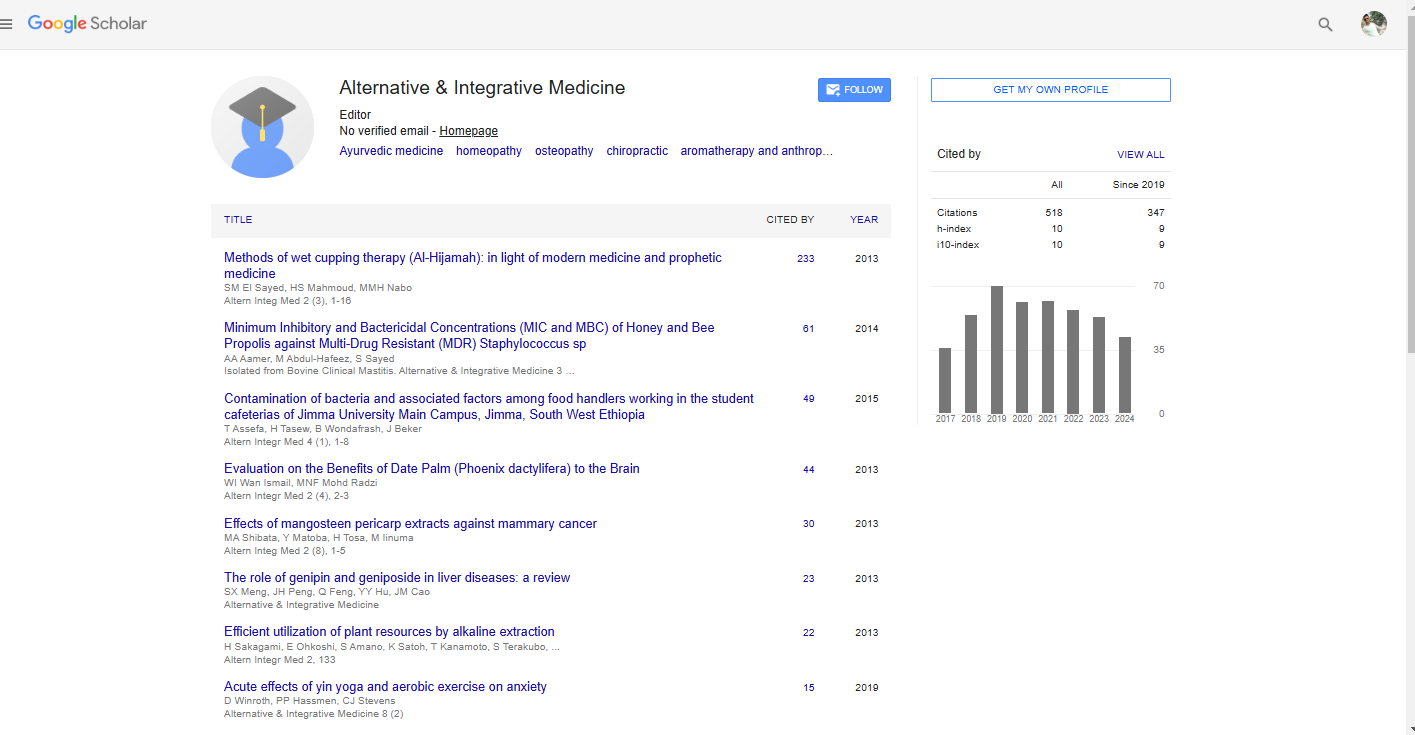
Alternative & Integrative Medicine received 476 citations as per Google Scholar report