Opinion - (2025) Volume 14, Issue 3
Received: 02-May-2025, Manuscript No. aim-25-177350;
Editor assigned: 05-May-2025, Pre QC No. P-177350;
Reviewed: 19-May-2025, QC No. Q-177350;
Revised: 23-May-2025, Manuscript No. R-177350;
Published:
30-May-2025
, DOI: 10.37421/2427-5162.2025.14.571
Citation: Al-Zahra, Fatima. ”Integrative Mental Health: A Holistic Path to Well-being.” Alt Integr Med 14 (2025):571.
Copyright: © 2025 Al-Zahra F. This is an open-access article distributed under the terms of the Creative Commons Attribution License, which permits unrestricted use, distribution and reproduction in any medium, provided the original author and source are credited.
This comprehensive review offers a broad overview of integrative mental health approaches, emphasizing personalized and evidenceinformed care. It details current evidence for various modalities like nutritional interventions, herbal medicines, mindbody practices, and lifestyle modifications in addressing common mental health conditions. These strategies are crucial in addressing common mental health conditions when integrated alongside conventional treatments. Such an approach aims to optimize patient outcomes by considering a wider range of therapeutic options. This integration represents a significant shift towards more holistic mental health care models [1].
An systematic review and metaanalysis evaluated the effectiveness of diverse mindbody interventions for anxiety and depression. Practices such as mindfulness, yoga, and tai chi were synthesized, revealing significant therapeutic benefits. These interventions serve effectively as adjunctive treatments within integrative mental healthcare models. Their inclusion can enhance overall treatment efficacy and patient wellbeing by addressing psychological and physiological aspects simultaneously. This supports a broader understanding of mental health care [2].
An umbrella review synthesized findings from numerous systematic reviews and metaanalyses focusing on nutritional psychiatry. Strong evidence supports dietary interventions and specific nutrients as crucial components in preventing and treating various mental health disorders. This research underscores their integral role within a holistic mental health strategy. Recognizing the profound impact of nutrition on brain function and mental wellbeing is essential for comprehensive patient care. These findings advocate for dietary considerations as foundational elements [3].
This review explores the application of complementary and alternative medicine CAM in treating mental health conditions specific to children and adolescents. It thoroughly discusses the existing evidence base, safety profiles, and critical clinical considerations for various CAM therapies within this sensitive population. The review advocates for an informed and carefully integrated approach to CAM within pediatric mental healthcare. This ensures that interventions are both effective and safe for younger patients [4].
A systematic review and metaanalysis investigated the efficacy of acupuncture in alleviating anxiety disorders. The findings indicate that acupuncture can significantly reduce anxiety symptoms. This benefit is observed whether acupuncture is employed as a standalone treatment or in conjunction with conventional therapies. Its demonstrated effectiveness supports its potential inclusion in integrative mental health protocols. This offers a valuable nonpharmacological option for anxiety management, enhancing patient choice and treatment diversity [5].
This systematic review and metaanalysis assessed the effectiveness of various phytotherapeutic agents in treating depression. The study provides compelling evidence for the therapeutic potential of certain herbal medicines. These agents can function effectively as either monotherapy or adjunctive treatments for depressive disorders. Their valuable role within an integrative mental health framework is highlighted. This underscores the importance of natural compounds as viable options in managing depression, expanding treatment modalities [6].
A scoping review examined existing models for successfully integrating complementary and alternative medicine CAM into conventional mental healthcare settings. It identified diverse approaches to implementation, highlighting key factors that either facilitate or hinder successful integration. This provides crucial insights for developing more effective and sustainable integrative care systems. Understanding these implementation models is vital for bridging the gap between conventional and alternative therapies, ensuring cohesive patient management [7].
This systematic review delved into the proposed mechanisms through which mindfulnessbased interventions MBIs exert their therapeutic effects on mental health. It explored various neurobiological, psychological, and behavioral pathways involved in MBIs. This research significantly enhances the understanding of how MBIs can be effectively incorporated into comprehensive integrative mental health strategies. Recognizing these mechanisms allows for more targeted and evidenceinformed application of mindfulness practices in clinical settings [8].
This review explored interventional studies investigating the crucial role of the gut microbiome in overall mental health. It synthesized findings regarding probiotics, prebiotics, and specific dietary interventions. The studies highlight their remarkable potential to modulate the gutbrain axis and positively influence psychiatric outcomes. This offers valuable insights for developing future integrative mental health strategies. Targeting the gut microbiome represents an innovative avenue for mental health treatment and prevention [9].
This systematic review examined the effectiveness of various lifestyle medicine interventions for improving mental health outcomes. It included factors such as diet, physical activity, sleep quality, and stress management techniques. The review underscores the profound impact of these modifiable lifestyle factors on mental wellbeing. It advocates strongly for their systematic integration into comprehensive mental health care plans, emphasizing prevention and holistic health promotion. Lifestyle medicine is thus a cornerstone of integrative care [10].
This article C001 provides a broad overview of integrative mental health approaches. It details current evidence for modalities like nutritional interventions, herbal medicines, mindbody practices, and lifestyle modifications in addressing mental health conditions. It emphasizes personalized and evidenceinformed care, integrating these strategies alongside conventional treatments [1]. C002 presents a systematic review and metaanalysis on mindbody interventions for anxiety and depression. It synthesizes evidence on practices such as mindfulness, yoga, and tai chi. Findings suggest significant therapeutic benefits as adjunctive treatments, highlighting their role in integrative mental healthcare models [2]. An umbrella review C003 synthesizes findings on nutritional psychiatry. It outlines strong evidence supporting dietary interventions and specific nutrients as crucial components in preventing and treating various mental health disorders. This underscores their integral role in a holistic mental health strategy [3]. C004 reviews complementary and alternative medicine CAM in child and adolescent psychiatry. It discusses the evidence base, safety profiles, and clinical considerations for various CAM therapies. It advocates for an informed and integrated approach within pediatric mental healthcare, prioritizing patient wellbeing [4]. A systematic review and metaanalysis C005 investigates acupuncture efficacy in treating anxiety disorders. Findings suggest acupuncture significantly reduces anxiety symptoms. This applies whether used as standalone treatment or with conventional therapies. It supports acupuncture inclusion in integrative mental health protocols [5]. C006 details a systematic review and metaanalysis assessing phytotherapeutic agents for depression. It provides evidence for certain herbal medicines therapeutic potential. These function as monotherapy or adjunctive treatments, suggesting their valuable role within an integrative mental health framework [6]. This scoping review C007 examines existing models for integrating complementary and alternative medicine CAM into conventional mental healthcare settings. It identifies different implementation approaches. Factors facilitating or hindering successful integration are highlighted, providing insights for developing effective integrative care systems [7]. C008 provides a systematic review on mechanisms of mindfulnessbased interventions MBIs. It explores neurobiological, psychological, and behavioral pathways through which MBIs exert therapeutic effects. This enhances understanding of how MBIs can be effectively incorporated into integrative mental health strategies [8]. The review C009 explores interventional studies on the gut microbiome role in mental health. It synthesizes findings on probiotics, prebiotics, and dietary interventions. These highlight their potential to modulate the gutbrain axis and influence psychiatric outcomes, offering insights for integrative mental health strategies [9]. C010 presents a systematic review on lifestyle medicine interventions for mental health. It covers diet, physical activity, sleep, and stress management. It underscores the profound impact of modifiable lifestyle factors and advocates for their systematic integration into comprehensive mental health care plans [10].
Integrative mental health represents a multifaceted approach that combines conventional treatments with evidenceinformed complementary and alternative medicine CAM modalities. This comprehensive perspective highlights the significant roles of nutritional interventions, herbal medicines, and various mindbody practices such as mindfulness, yoga, and tai chi in addressing diverse mental health conditions. Research consistently demonstrates the therapeutic benefits of these approaches for anxiety, depression, and other psychiatric disorders, either as standalone or adjunctive treatments. Furthermore the profound importance of lifestyle modifications including diet, physical activity, sleep, and stress management is underscored as foundational to overall mental wellbeing. The gut microbiome is also identified as a critical modulator of the gutbrain axis influencing psychiatric outcomes and offering innovative therapeutic avenues. Successful integration of these diverse strategies into existing healthcare models necessitates an understanding of their mechanisms and implementation challenges, particularly in vulnerable populations like children and adolescents. This holistic framework advocates for personalized care, recognizing the interconnectedness of physical and mental health to optimize treatment efficacy and promote lasting recovery and resilience.
None
None
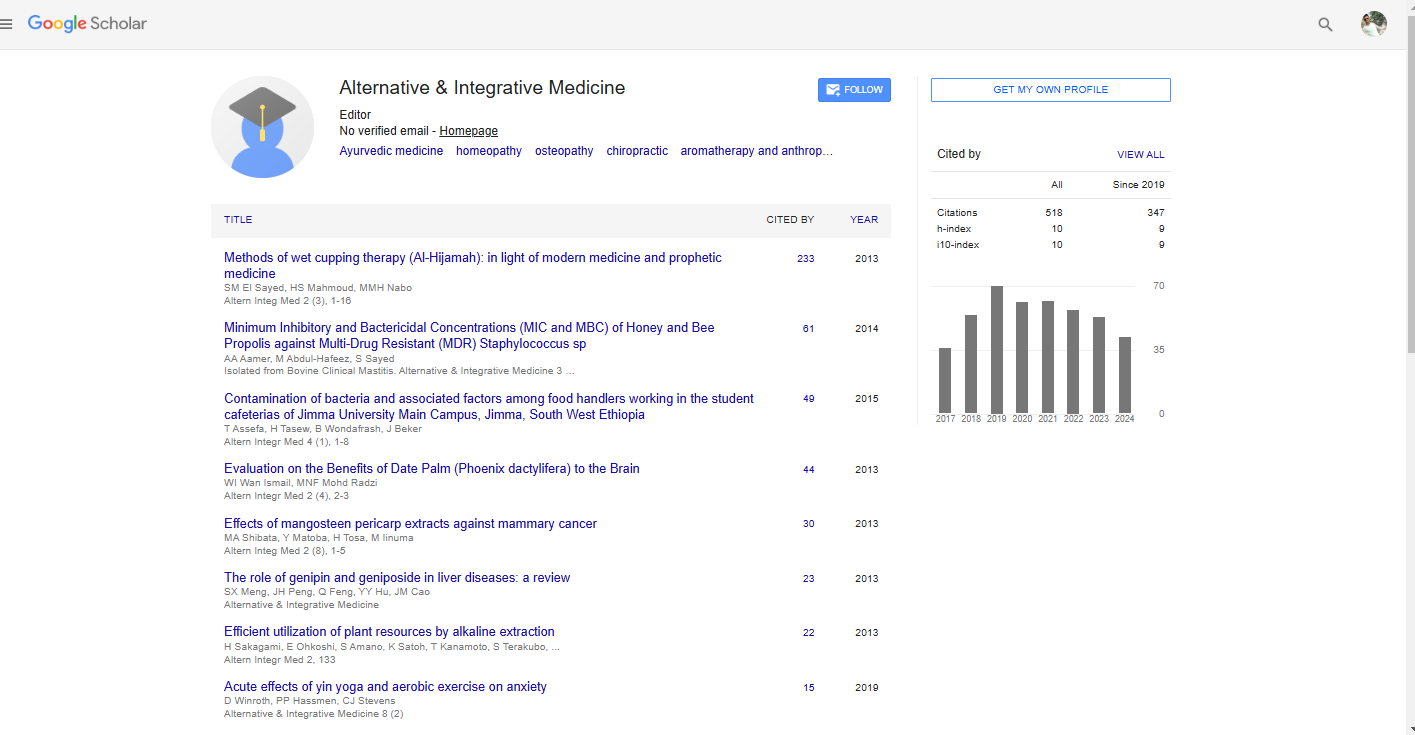
Alternative & Integrative Medicine received 476 citations as per Google Scholar report