Commentary - (2025) Volume 14, Issue 3
Received: 02-May-2025
Editor assigned: 05-May-2025
Reviewed: 19-May-2025
Revised: 23-May-2025
Published:
30-May-2025
, DOI: 10.37421/2427-5162.2025.14.568
Citation: Okafor, Samuel. ”Integrative Health: Mechanisms, Therapies and Evidence.” Alt Integr Med 14 (2025):568.
Copyright: © 2025 Okafor S. This is an open-access article distributed under the terms of the Creative Commons Attribution License, which permits unrestricted use, distribution and reproduction in any medium, provided the original author and source are credited.
Aromatherapy presents a promising complementary approach to mental health care, with recent systematic reviews highlighting its potential efficacy in managing anxiety and depression. Investigations into its physiological and psychological effects suggest that specific essential oils can positively influence mood states and stress responses. This field continues to gather evidence supporting its integration into broader mental wellness strategies, offering accessible and non-invasive options for individuals seeking relief from psychological distress [1].
Traditional Chinese Medicine (TCM) offers a rich tradition of therapeutic interventions, with contemporary research increasingly elucidating its complex biological mechanisms. A notable area of recent focus involves TCM's profound ability to modulate the gut microbiota. Studies reveal a sophisticated interplay between various TCM practices and the host's gut ecosystem, demonstrating how these ancient methodologies can effectively rebalance microbial communities to promote overall health and well-being [2].
Acupuncture, a cornerstone of traditional East Asian medicine, has garnered substantial scientific interest for its effectiveness in chronic pain management. Comprehensive overviews, synthesizing numerous systematic reviews, consistently affirm acupuncture's role as a viable and beneficial treatment modality across a spectrum of persistent pain conditions. Furthermore, contemporary research continues to unravel the intricate neurobiological mechanisms underpinning its analgesic effects, providing a deeper understanding of its therapeutic actions [3].
The therapeutic potential of medicinal mushrooms has been extensively explored, particularly concerning their significant immunomodulatory properties. Research indicates that these natural agents contain a diverse array of bioactive compounds capable of enhancing or precisely regulating immune responses. This makes medicinal mushrooms valuable adjuncts in supportive therapies, contributing to improved host defense mechanisms and overall immune homeostasis [4].
Mind-body interventions, encompassing practices such as meditation and yoga, have gained considerable recognition for their effectiveness in alleviating stress. Systematic reviews and meta-analyses consistently demonstrate that these practices lead to measurable reductions in stress, impacting both physiological markers and psychological outcomes. The underlying mechanisms involve alterations in brain activity and a modulation of stress hormone levels, underscoring their profound influence on well-being [5].
Omega-3 fatty acids represent crucial nutritional components with far-reaching physiological implications, particularly in the context of inflammation. Recent work has advanced our understanding beyond their simple anti-inflammatory role, revealing their active participation in the resolution phase of inflammation. This involves specific molecular mechanisms that actively contribute to the cessation of inflammatory processes, offering significant clinical implications for managing inflammatory diseases [6].
The intricate connection between the gut and the brain, known as the gut-brain axis, has emerged as a critical determinant of mental health. Investigations in this area have pinpointed prebiotics and probiotics as key modulators of this axis, influencing brain function and mood. These findings suggest that targeted dietary interventions, leveraging beneficial gut microbiota, can play a supportive role in enhancing neurological and psychological well-being [7].
Curcumin, a prominent compound derived from turmeric, has been the subject of extensive scientific scrutiny due to its remarkably diverse health benefits. Comprehensive reviews detail the multifaceted molecular pathways through which curcumin exerts its potent anti-inflammatory, antioxidant, and anti-cancer effects. This extensive body of evidence underscores curcumin's substantial therapeutic potential across a wide range of health conditions [8].
The therapeutic landscape for pain relief continues to evolve, with cannabinoids presenting new and compelling insights. Drawing from both preclinical and clinical data, research illuminates the sophisticated mechanisms by which cannabinoids interact with the endocannabinoid system. This interaction modulates pain perception, thereby opening promising avenues for the development of novel and effective pain management strategies [9].
Yoga practice has long been recognized for its holistic health benefits, and recent systematic reviews and meta-analyses have begun to quantify its specific physiological impacts. Notably, findings indicate that regular engagement in yoga can positively influence the autonomic nervous system (ANS) functions, including heart rate variability. This suggests a profound impact on stress regulation and the establishment of overall physiological balance within the body [10].
A systematic review focusing on aromatherapy underscores its significant potential in addressing anxiety and depression. The review meticulously examines the physiological and psychological responses elicited by various essential oils, revealing how these substances can effectively influence emotional states and stress reactions. This comprehensive analysis positions aromatherapy as a valuable and evidence-based complementary approach within the realm of mental health care, providing insights into its practical applications for patient well-being [1]. A detailed article explores the mechanisms by which Traditional Chinese Medicine (TCM) exerts its influence on the gut microbiota. This research unveils the complex and dynamic interactions between TCM interventions and the microbial ecosystem residing within the gut. By outlining specific pathways and demonstrating how these ancient practices contribute to the rebalancing of the gut microbiome, the article highlights TCM's capacity to positively impact host health through internal systemic modulation [2]. An overview of systematic reviews provides a compelling synthesis of evidence for acupuncture's efficacy in managing chronic pain. This work consolidates a broad spectrum of research, consistently affirming acupuncture's utility as a robust treatment for various long-standing pain conditions. Furthermore, it delves into the intricate neurobiological underpinnings of acupuncture, offering a clearer understanding of how needling techniques modulate pain perception and relief through the nervous system [3]. A systematic review illuminates the potent immunomodulatory properties inherent in medicinal mushrooms. This investigation meticulously examines the bioactive compounds present in these fungi and delineates the mechanisms through which they either enhance or finely regulate immune responses. Consequently, the review positions medicinal mushrooms as significant therapeutic agents, particularly valuable in supportive care where immune system optimization is a primary objective [4]. A systematic review and meta-analysis thoroughly investigates the impact of mind-body interventions on stress levels. The study meticulously details both the physiological markers, such as hormone levels and brain activity, and the psychological outcomes, like reported stress reduction. It unequivocally confirms that practices like meditation and yoga can substantially diminish stress by favorably altering internal biological and mental processes, validating their role in holistic health [5]. Focused research on omega-3 fatty acids elucidates their critical role not merely in suppressing inflammation, but actively in its resolution. This work precisely outlines the specific molecular mechanisms by which omega-3s facilitate the cessation of inflammatory processes, moving beyond passive inhibition to active physiological restoration. These findings provide clear and actionable clinical implications for nutritional strategies aimed at managing and resolving inflammatory conditions effectively [6]. A pivotal paper examines the crucial role of the gut-brain axis, identifying prebiotics and probiotics as key modulators pertinent to mental health. The article meticulously explains how alterations in the gut microbiota can directly influence brain function, emotional regulation, and overall mood. This research strongly suggests that targeted dietary interventions incorporating these beneficial microbial components can significantly support neurological and psychological well-being, paving the way for novel therapeutic approaches [7]. A comprehensive review synthesizes the extensive scientific literature surrounding curcumin, detailing its wide array of health benefits. It systematically describes the molecular pathways through which curcumin exerts its well-documented anti-inflammatory, antioxidant, and anti-cancer properties. This in-depth analysis underscores the compound's broad therapeutic potential, validating its traditional use and informing its modern application in various health contexts [8]. Insights into the application of cannabinoids for pain relief are significantly advanced by a recent article drawing from both preclinical and clinical studies. This research elucidates the intricate mechanisms by which cannabinoids interact with the endogenous endocannabinoid system, thereby modulating the perception of pain. These findings are instrumental in opening new therapeutic avenues and guiding the development of innovative strategies for managing chronic and acute pain conditions [9]. A systematic review and meta-analysis rigorously explores the effects of yoga practice on the autonomic nervous system (ANS) functions. The evidence presented indicates that consistent yoga engagement can induce positive changes in parameters such as heart rate variability. This suggests a profound and beneficial impact on the body's stress regulation mechanisms and overall physiological equilibrium, reinforcing yoga's utility as a health-promoting intervention [10].
The provided content highlights a diverse range of complementary and integrative health approaches, detailing their mechanisms and therapeutic applications. Aromatherapy is shown to influence mood and stress, offering support for anxiety and depression. Traditional Chinese Medicine is recognized for modulating gut microbiota, impacting overall host health. Acupuncture demonstrates efficacy in chronic pain management through neurobiological pathways. Medicinal mushrooms are noted for their significant immunomodulatory effects, enhancing immune responses. Mind-body interventions like meditation and yoga are confirmed to reduce stress by altering physiological markers and brain activity, with yoga specifically benefiting the autonomic nervous system. Furthermore, specific natural compounds and dietary components are explored: omega-3 fatty acids actively resolve inflammation, curcumin exhibits anti-inflammatory, antioxidant, and anti-cancer properties, and cannabinoids offer new strategies for pain relief by interacting with the endocannabinoid system. The gut-brain axis is emphasized as a critical link, with prebiotics and probiotics identified as key modulators for mental health. Collectively, these studies underscore the growing evidence base for holistic and natural interventions across various health domains.
None
None
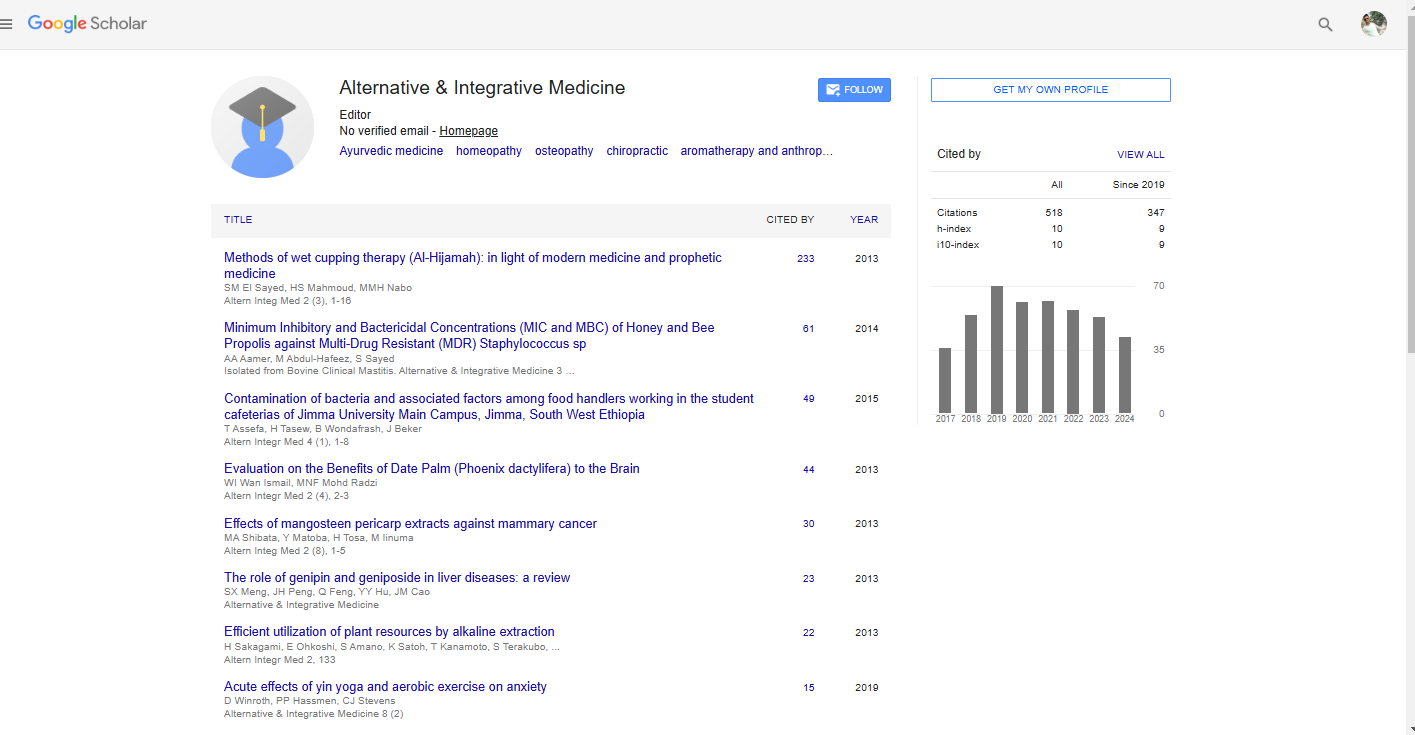
Alternative & Integrative Medicine received 476 citations as per Google Scholar report