Short Communication - (2025) Volume 14, Issue 6
Received: 03-Nov-2025, Manuscript No. aim-25-178063;
Editor assigned: 05-Nov-2025, Pre QC No. P-178063;
Reviewed: 19-Nov-2025, QC No. Q-178063;
Revised: 24-Nov-2025, Manuscript No. R-178063;
Published:
29-Nov-2025
, DOI: 10.37421/2427-5162.2025.14.606
Citation: Klein, Sophia. ”Integrative Chronic Pain Management: A Holistic Approach.” Alt Integr Med 14 (2025):606.
Copyright: © 2025 Klein S. This is an open-access article distributed under the terms of the Creative Commons Attribution License, which permits unrestricted use, distribution and reproduction in any medium, provided the original author and source are credited.
The management of chronic pain represents a significant challenge in modern healthcare, necessitating a comprehensive and often multimodal approach to address its complex nature. Integrative pain management strategies, which combine conventional medical treatments with complementary therapies, are gaining increasing attention for their potential to improve patient outcomes. This approach recognizes that chronic pain is not solely a physical phenomenon but also involves psychological and social dimensions that require simultaneous attention. By blending evidence-based conventional therapies with practices like acupuncture, mindfulness, and yoga, clinicians aim to reduce pain intensity, enhance functional capacity, and ultimately improve the overall quality of life for individuals suffering from persistent pain conditions [1].
The neurological underpinnings of chronic pain are intricate, involving alterations in brain activity and connectivity. Mindfulness-based interventions have emerged as a promising avenue for modulating pain perception and emotional responses. Research in this area demonstrates how consistent practice of mindfulness can lead to changes in brain regions associated with pain processing and attention, offering a non-pharmacological means of pain management. The efficacy of these interventions is supported by evidence showing reductions in pain intensity, improvements in mood, and the fostering of self-management skills among patients with diverse chronic pain conditions [2].
Acupuncture, an ancient therapeutic practice, has garnered considerable attention as an adjunctive therapy for a variety of chronic pain conditions, including low back pain, osteoarthritis, and fibromyalgia. The proposed mechanisms of action are diverse, involving the release of endogenous opioids and the modulation of various neurotransmitter systems, all contributing to pain relief. Findings from systematic reviews suggest that acupuncture can be a valuable component of an integrated pain management strategy, providing significant pain reduction and functional improvement with a favorable safety profile and minimal side effects [3].
Exercise therapy plays a crucial role in the management of chronic pain, impacting physical function, pain modulation, and psychological well-being. A synthesis of evidence from various exercise modalities, such as aerobic training, strength training, and flexibility exercises, demonstrates their effectiveness in not only reducing pain but also improving mobility. Furthermore, exercise can combat the prevalent psychological comorbidities of chronic pain, including depression and anxiety, thereby contributing to a more holistic recovery [4].
Nutritional approaches are increasingly being recognized for their potential contribution to chronic pain management strategies. Specific nutrients and dietary patterns can exert influence on critical biological pathways involved in inflammation, nerve function, and pain signaling. Personalized nutritional guidance, therefore, can serve as a valuable complement to conventional treatments, supporting overall health and potentially mitigating pain in individuals with chronic pain conditions [5].
Psychological therapies, particularly cognitive behavioral therapy (CBT) and acceptance and commitment therapy (ACT), are cornerstones in managing the complex psycho-social aspects of chronic pain. These therapeutic modalities equip patients with essential coping mechanisms to effectively manage pain-related distress, enhance emotional regulation, and improve functional capacity. By addressing the psychological burden of chronic pain, these therapies can reduce reliance on pharmacological interventions and improve overall patient well-being [6].
Yoga has emerged as a potent complementary therapy for chronic pain management, offering a unique blend of physical postures, breathing exercises, and meditation. The practice of yoga can lead to significant improvements in flexibility, strength, pain reduction, and psychological well-being for individuals experiencing conditions such as back pain and arthritis. Its holistic approach contributes to reducing the reliance on pain medication and enhancing the overall quality of life [7].
Manual therapies, including massage and chiropractic care, are being investigated for their role in managing chronic musculoskeletal pain. These interventions show potential benefits for pain relief, improved physical function, and reduced disability. However, their effective application necessitates an evidence-based approach, careful patient selection, and integration within a broader multidisciplinary pain management strategy to maximize positive outcomes [8].
Therapeutic music interventions offer a non-pharmacological adjunct for chronic pain management, impacting pain perception, mood, and anxiety. Studies have demonstrated that music can effectively modulate physiological responses and psychological states, providing relief for conditions such as fibromyalgia and cancer pain. This approach offers a complementary strategy to enhance the effectiveness of conventional treatments [9].
Herbal medicine and supplements are being explored for their potential as complementary therapies in chronic pain management. Commonly used agents like turmeric, ginger, and devil's claw possess anti-inflammatory properties and have shown pain-relieving effects. However, their utilization requires a critical review of evidence, careful consideration of safety, and seamless integration with conventional care to optimize patient outcomes and minimize risks [10].
The integration of conventional medical treatments with complementary therapies offers a synergistic approach to managing chronic pain, a condition characterized by its multifaceted nature and profound impact on an individual's life. This multimodal strategy aims to address the physical, psychological, and social dimensions of pain concurrently. By combining evidence-based conventional treatments with practices such as acupuncture, mindfulness, and yoga, the objective is to not only alleviate pain intensity but also to restore function and enhance the overall quality of life for patients [1].
Understanding the neurological basis of chronic pain is critical for developing effective interventions. Mindfulness-based practices have shown significant promise in modulating pain perception and emotional responses by influencing brain activity in key areas. This research indicates that mindfulness can be a valuable tool for reducing pain, improving mood, and empowering patients with chronic pain conditions to better manage their symptoms through self-awareness and self-regulation [2].
Acupuncture stands out as a valuable adjunctive therapy for a range of chronic pain conditions, including low back pain, osteoarthritis, and fibromyalgia. Its proposed mechanisms involve endogenous opioid release and modulation of neurotransmitter systems, contributing to analgesia. Evidence suggests that acupuncture can be effectively incorporated into integrated pain management plans, offering substantial relief and functional gains with a low incidence of adverse effects [3].
Exercise therapy is a fundamental component of chronic pain management, contributing to improvements in physical function, pain modulation, and psychological well-being. A broad spectrum of exercise modalities, encompassing aerobic, strength, and flexibility training, has demonstrated efficacy in reducing pain levels and enhancing mobility. Moreover, exercise plays a crucial role in mitigating the psychological distress, such as depression and anxiety, that often accompanies chronic pain [4].
Nutritional interventions are increasingly recognized for their role in supporting chronic pain management. The influence of specific nutrients and dietary patterns on inflammatory processes, nerve function, and pain signaling pathways is an area of growing interest. Personalized nutritional guidance can complement conventional treatments, fostering better health outcomes and potentially alleviating pain symptoms in individuals with chronic pain [5].
Psychological therapies, specifically cognitive behavioral therapy (CBT) and acceptance and commitment therapy (ACT), are essential for addressing the psychological burden of chronic pain. These therapies equip patients with effective coping strategies for pain-related distress, improve their ability to regulate emotions, and enhance their functional capacity. This approach can lead to a reduced reliance on pharmacological interventions for pain management [6].
Yoga offers a comprehensive approach to chronic pain management through its combination of physical postures, breathing exercises, and meditation. Its benefits extend to improved flexibility, increased strength, reduced pain, and enhanced psychological well-being, particularly for conditions like back pain and arthritis. The practice of yoga can significantly decrease the need for pain medication and improve an individual's overall quality of life [7].
Manual therapies, such as massage and chiropractic adjustments, are being explored for their efficacy in managing chronic musculoskeletal pain. These techniques show potential for pain relief, functional improvement, and disability reduction. However, their successful implementation requires adherence to evidence-based practices, careful patient selection, and integration within a comprehensive, multidisciplinary pain management framework [8].
Therapeutic music interventions provide a non-pharmacological option for managing chronic pain by influencing pain perception, mood, and anxiety. Research indicates that music can modulate physiological and psychological states, serving as an effective adjunct to conventional treatments for conditions like fibromyalgia and cancer-related pain [9].
Herbal medicines and supplements are being investigated as complementary therapies for chronic pain. Agents such as turmeric, ginger, and devil's claw have demonstrated anti-inflammatory and pain-relieving properties. Nevertheless, it is imperative to emphasize evidence-based usage, safety considerations, and integration with conventional care to achieve optimal results for patients managing chronic pain [10].
Chronic pain management is increasingly adopting integrative approaches that combine conventional treatments with complementary therapies. These strategies aim to address the physical, psychological, and social aspects of pain, improving patient outcomes. Practices like mindfulness, acupuncture, exercise, psychological therapies, yoga, manual therapies, music therapy, and nutritional interventions are being explored for their efficacy. Herbal medicines and supplements are also considered, with an emphasis on evidence-based use and safety. The goal is to reduce pain intensity, enhance function, and improve the overall quality of life for individuals with chronic pain, often reducing the reliance on pharmacological interventions.
None
None
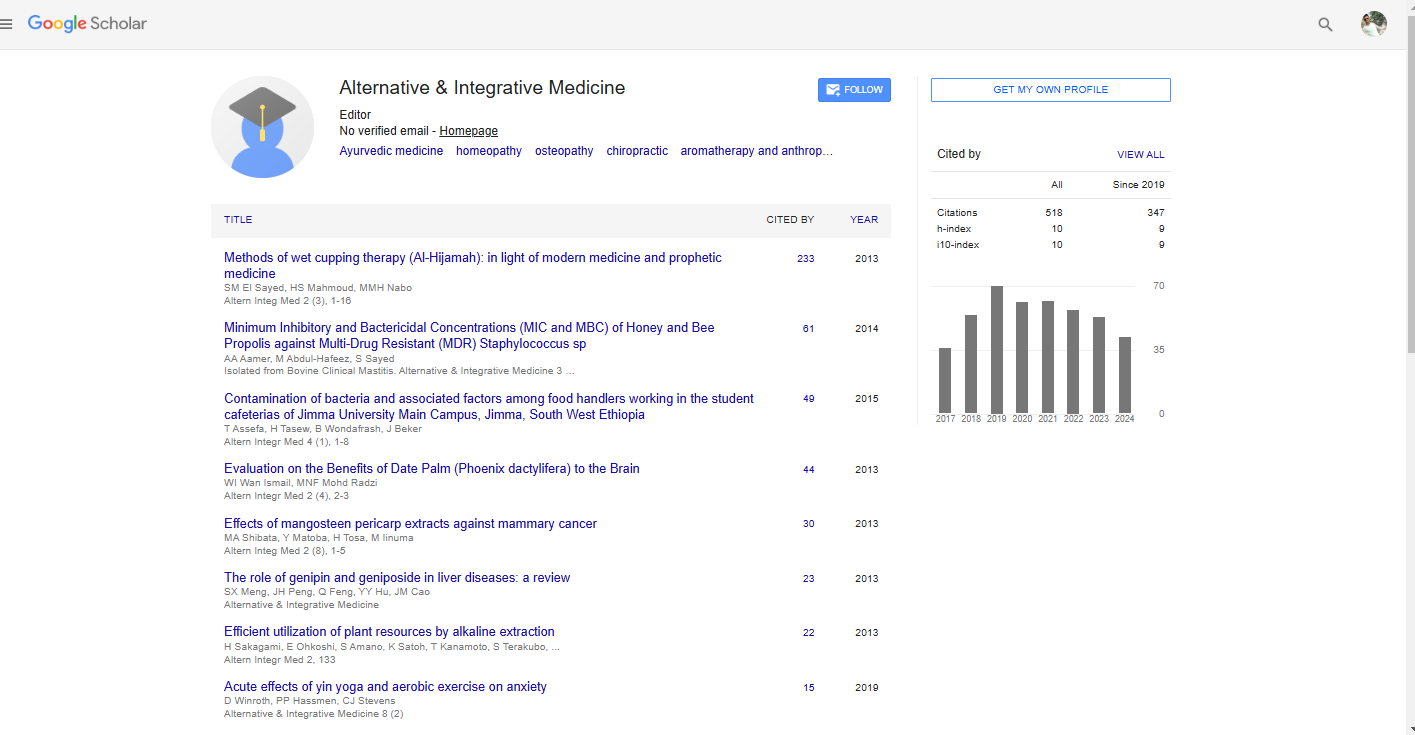
Alternative & Integrative Medicine received 476 citations as per Google Scholar report