Perspective - (2025) Volume 9, Issue 6
Received: 13-Sep-2024, Manuscript No. JGGE-24-147941;
Editor assigned: 16-Sep-2024, Pre QC No. JGGE-24-147941 (PQ);
Reviewed: 01-Oct-2024, QC No. JGGE-24-147941;
Revised: 14-Dec-2025, Manuscript No. JGGE-24-147941;
Published:
29-Dec-2025
, DOI: 10.37421/2684-4567.2025.9.203
Citation: Ross, Theodora. "Integrating Genomic Data with Artificial Intelligence: Innovations and Challenges." J Genet Genom 9 (2025): 203.
Copyright: © 2025 Ross T. This is an open-access article distributed under the terms of the creative commons attribution license which permits unrestricted
use, distribution and reproduction in any medium, provided the original author and source are credited.
In the ever-evolving landscape of modern science and technology, the convergence of genomic data and Artificial Intelligence (AI) represents a transformative frontier with the potential to revolutionize fields ranging from personalized medicine to biological research. Integrating genomic data with artificial intelligence: Innovations and challenges explores this dynamic intersection, highlighting how advanced computational techniques are being harnessed to unlock new insights from the vast and complex world of genomics.
Genomic data, characterized by its sheer volume and complexity, has become a cornerstone of contemporary biological research and medical practice. The ability to sequence and analyze entire genomes provides a wealth of information about genetic variations, gene functions, and their roles in health and disease. However, the analysis and interpretation of this data pose significant challenges due to its high dimensionality and the intricate patterns it encompasses.
Artificial intelligence, particularly machine learning and deep learning, offers powerful tools for addressing these challenges. By leveraging sophisticated algorithms and computational models, AI can identify patterns, predict outcomes, and generate insights from genomic data that might be beyond human capacity to discern. From enhancing Genome-Wide Association Studies (GWAS) to optimizing drug discovery and personalizing treatment plans, the integration of AI with genomic data is opening new avenues for scientific and medical breakthroughs.
This article provides a comprehensive overview of how AI techniques are being applied to genomic research, detailing the innovations that are driving progress and the challenges that must be addressed. Topics include the development of predictive models for disease risk, the use of AI in genomics-driven drug development, and the ethical considerations surrounding data privacy and algorithmic bias. Through a blend of theoretical exploration and practical case studies, Integrating Genomic Data with Artificial Intelligence offers valuable insights into how these technologies are shaping the future of genomics and healthcare.
As we navigate this exciting frontier, it is essential to understand both the potential and limitations of integrating AI with genomic data. This article serves as a critical resource for researchers, data scientists, clinicians, and students, providing a thorough examination of the innovations at the cutting edge of this interdisciplinary field and the challenges that need to be addressed to fully realize its promise.
Integrating genomic data with artificial intelligence: Innovations and Challenges
Integrating genomic data with artificial intelligence and innovations and challenges provides a detailed exploration of the transformative intersection between genomics and Artificial Intelligence (AI). This article delves into how AI technologies are revolutionizing the analysis and application of genomic data, offering innovative solutions to some of the most pressing challenges in modern biology and medicine.
As the field of genomics continues to generate increasingly large and complex datasets, traditional methods of data analysis have struggled to keep pace. AI, particularly machine learning and deep learning, has emerged as a powerful tool to address these challenges. By applying advanced algorithms and computational models, AI can uncover hidden patterns, predict genetic risk factors, and personalize treatment strategies with unprecedented accuracy and efficiency.
The article covers a range of topics, including:
• Innovations in AI for genomics: Detailed discussions on how AI is enhancing Genome-Wide Association Studies (GWAS), facilitating more accurate genetic variant discovery, and optimizing drug development processes.
• Applications of AI in personalized medicine: Insights into how AI-driven models are being used to tailor medical treatments to individual genetic profiles, improving patient outcomes and advancing precision medicine.
• Challenges and considerations: An exploration of the ethical and technical challenges associated with integrating AI and genomics, including issues related to data privacy, algorithmic bias, and the need for transparency and reproducibility.
Through a blend of theoretical insights and practical case studies, this article offers a comprehensive overview of the current state and future directions of AI in genomics. It is an essential resource for researchers, data scientists, clinicians, and students interested in understanding how AI is reshaping the landscape of genomic research and its implications for healthcare.
Integrating genomic data with artificial intelligence provides a valuable framework for appreciating the innovative potential of these technologies while also highlighting the challenges that must be addressed to fully realize their benefits. As we continue to advance in this exciting field, this article serves as a crucial guide to navigating the evolving synergy between genomic data and artificial intelligence.
In concluding integrating genomic data with artificial intelligence innovations and Challenges, it is evident that the fusion of genomic data and Artificial Intelligence (AI) is ushering in a new era of discovery and innovation in both science and medicine. The integration of AI technologies with the vast and complex realm of genomic data is proving to be a powerful catalyst for advancing our understanding of genetics, enhancing diagnostic accuracy, and personalizing treatment strategies
The article has highlighted several key achievements facilitated by this integration. AI's ability to process and analyze large-scale genomic datasets with high precision has enabled the identification of novel genetic variants associated with diseases, optimized drug discovery processes, and supported the development of personalized medicine approaches. These innovations are transforming our approach to healthcare by providing more tailored and effective interventions, ultimately improving patient outcomes. However, the journey is not without its challenges. As we have explored, issues related to data privacy, algorithmic bias, and the need for robust, transparent methodologies are critical considerations that must be addressed to fully harness the potential of AI in genomics. The complexity of genomic data demands sophisticated AI tools, yet the efficacy and fairness of these tools depend on ongoing refinement and ethical oversight. Looking ahead, the continued evolution of both genomic technologies and AI methodologies promises to further enhance our ability to decode the intricacies of the human genome and apply this knowledge in clinical practice. Future advancements will likely bring even more powerful tools for predictive analytics, personalized treatment, and disease prevention, making it essential for researchers and practitioners to stay abreast of these developments and their implications.
In summary, integrating genomic data with artificial intelligence underscores the transformative impact of merging these two fields. By addressing the challenges and embracing the innovations at the intersection of AI and genomics, we can unlock new possibilities for understanding human health and advancing medical science. This article provides a comprehensive foundation for appreciating how these technologies are shaping the future and offers guidance on navigating the complex landscape where genomic data meets artificial intelligence.
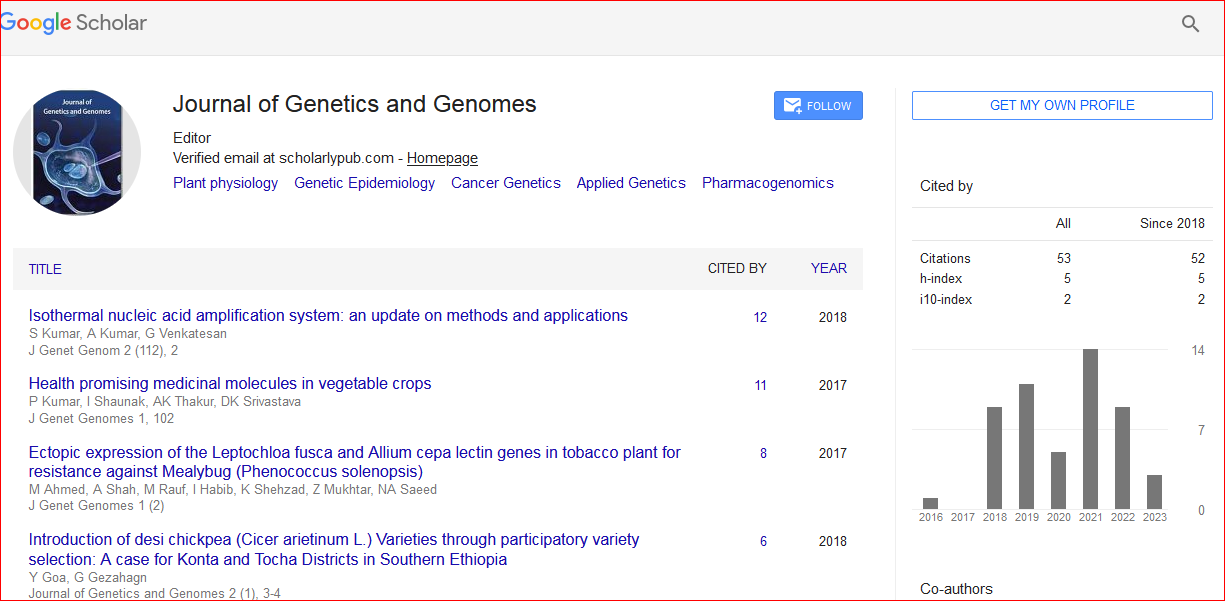
Journal of Genetics and Genomes received 65 citations as per Google Scholar report