Brief Report - (2025) Volume 14, Issue 3
Received: 01-May-2025, Manuscript No. mcce-26-190166;
Editor assigned: 05-May-2025, Pre QC No. P-190166;
Reviewed: 19-May-2025, QC No. Q-190166;
Revised: 22-May-2025, Manuscript No. R-190166;
Published:
29-May-2025
, DOI: 10.37421/2470-6965.2025.14.402
Citation: Sorensen, Amelia. ”Integrated Malaria Control Towards Elimination.” Malar Contr Elimination 14 (2025):402.
Copyright: © 2025 Sorensen A. This is an open-access article distributed under the terms of the Creative Commons Attribution License, which permits unrestricted use, distribution and reproduction in any medium, provided the original author and source are credited.
Significant advancements in malaria control are driving progress towards its elimination, utilizing integrated strategies that encompass improved vector control, widespread diagnostics, effective case management with artemisinin-based combination therapies, and the emerging role of vaccines [1].
Sustained political will, increased funding, and robust community engagement are recognized as essential pillars for surmounting persistent challenges such as insecticide resistance and the complexities of mobile populations, paving the way for a malaria-free world [1].
The advent of malaria vaccines, exemplified by RTS,S/AS01, marks a transformative moment in public health, offering a new dimension to malaria prevention, particularly for vulnerable children in endemic regions [2].
While vaccines are not a panacea, their strategic integration with established control measures can substantially reduce malaria incidence and mortality, underscoring the importance of continued research into next-generation vaccines and optimized deployment [2].
A critical impediment to effective malaria vector control is the escalating issue of insecticide resistance in Anopheles mosquitoes [3].
A comprehensive understanding of the molecular underpinnings of this resistance, coupled with the implementation of integrated vector management strategies that include novel insecticides and alternative control methods, is paramount to preserving the efficacy of ongoing control programs [3].
The accurate diagnosis of malaria, including the detection of asymptomatic infections, is fundamental for both effective treatment and robust surveillance initiatives [4].
Innovations in rapid diagnostic tests and molecular detection techniques, in conjunction with enhanced microscopy, are significantly improving the capacity for case detection, thereby enabling targeted interventions to interrupt transmission [4].
Genomic surveillance of malaria parasites provides an unprecedented lens through which to scrutinize population structures, the emergence of drug resistance, and the intricate dynamics of disease transmission [5].
Grasping the nuances of genetic diversity and the evolutionary pathways of resistance is indispensable for formulating adaptive control strategies and predicting the future impact of public health interventions [5].
The long-term sustainability of malaria control programs is inextricably linked to unwavering political commitment and the provision of adequate, predictable financial resources [6].
Investing in resilient national health systems, cultivating local research and healthcare workforce capacity, and fostering collaborative partnerships are vital steps towards consolidating progress and achieving ambitious elimination goals, especially in resource-constrained environments [6].
Community engagement is an indispensable element for the successful eradication of malaria, empowering local populations with knowledge and resources to foster adherence to interventions and promote timely reporting of cases [7].
This grassroots approach is crucial for dismantling socio-cultural barriers and cultivating a sense of collective responsibility for malaria control efforts [7].
Antimalarial drug resistance continues to represent a significant and persistent threat, underscoring the need for continuous monitoring and the urgent development of novel therapeutic agents [8].
Understanding the mechanisms driving resistance and enforcing judicious drug use policies are critical for safeguarding the efficacy of current treatments and guiding the development of future interventions [8].
Achieving malaria elimination in sub-Saharan Africa, the region disproportionately affected by the disease, necessitates the implementation of intensified and context-specific approaches [9].
Addressing multifaceted challenges, including insecticide resistance, the prevalence of asymptomatic carriers, and complex population movements, requires innovative tools and strategies, underpinned by strong political will and sustained financial investment [9].
The integration of multiple interventions, such as comprehensive vector control measures and prompt diagnostic and treatment protocols, forms the bedrock of current malaria control strategies [10].
The judicious deployment of these tools, informed by local epidemiological patterns and the evolving landscape of resistance, is critical for maximizing their impact and advancing the global agenda for malaria elimination [10].
Malaria control efforts are making substantial headway towards elimination through the strategic integration of various interventions, including enhanced vector control measures, widespread diagnostic capabilities, effective treatment regimens with artemisinin-based combination therapies, and the promising introduction of vaccines [1].
The continuation of these efforts hinges on sustained political support, increased financial investment, and active community involvement to surmount obstacles such as insecticide resistance and the mobility of populations, with the ultimate aim of a malaria-free world [1].
The development and deployment of malaria vaccines, such as RTS,S/AS01, represent a paradigm shift in the prevention landscape, particularly benefiting children in high-burden regions [2].
While not a singular solution, the synergistic integration of these vaccines with existing control strategies can significantly diminish malaria cases and reduce mortality, emphasizing the importance of ongoing research into advanced vaccine technologies and optimal implementation [2].
Insecticide resistance in Anopheles mosquitoes presents a formidable challenge to the efficacy of vector control programs [3].
A thorough investigation into the molecular mechanisms driving this resistance, coupled with the adoption of integrated vector management approaches that incorporate novel insecticides and alternative control technologies, is imperative for maintaining the effectiveness of malaria control initiatives [3].
The accurate diagnosis of malaria, especially asymptomatic infections, is a critical component for both successful treatment and effective epidemiological surveillance [4].
Advances in rapid diagnostic tests and molecular detection methods, complemented by improved microscopy, are enhancing the ability to identify cases, thereby facilitating targeted interventions to interrupt disease transmission [4].
Genomic epidemiology of malaria parasites offers profound insights into the genetic makeup of parasite populations, the evolution of drug resistance, and the patterns of disease transmission [5].
Understanding the genetic diversity within parasite populations and the mechanisms by which resistance emerges is vital for developing responsive control strategies and predicting the impact of interventions, thus supporting malaria elimination efforts [5].
The long-term viability of malaria control programs depends heavily on steadfast political commitment and consistent, predictable financial support [6].
Investing in the strengthening of national health systems, building local expertise among researchers and health professionals, and fostering robust partnerships are essential for sustaining progress and achieving malaria elimination goals, particularly in regions with limited resources [6].
Engaging communities is an indispensable factor in the successful eradication of malaria, empowering local populations with knowledge and resources to ensure compliance with control measures and promote prompt reporting of malaria cases [7].
This community-centered approach is crucial for overcoming cultural and social barriers and fostering local ownership of malaria control initiatives [7].
Antimalarial drug resistance remains a persistent and significant threat to global efforts to eliminate malaria, necessitating continuous surveillance and the development of new therapeutic options [8].
Understanding the mechanisms of drug resistance and implementing appropriate policies for antimalarial use are crucial for preserving the effectiveness of current treatments and guiding the development of future therapies [8].
The aspiration to eliminate malaria from sub-Saharan Africa, the region most heavily impacted by the disease, requires the implementation of tailored and intensified strategies [9].
Overcoming the complex challenges posed by insecticide resistance, widespread asymptomatic infections, and population mobility demands innovative tools and approaches, supported by strong political will and sustained financial investment [9].
The cornerstone of contemporary malaria control strategies lies in the integrated application of multiple interventions, including vector control methods such as long-lasting insecticidal nets and indoor residual spraying, alongside prompt diagnosis and treatment [10].
Optimizing the deployment of these tools based on local epidemiological data and emerging resistance trends is essential for maximizing their impact and advancing the goal of malaria elimination [10].
Malaria control is advancing towards elimination through integrated strategies including vector control, diagnostics, effective treatments, and vaccines. Sustained political will, funding, and community engagement are crucial to overcome challenges like insecticide resistance and mobile populations. Malaria vaccines offer a new prevention tool, especially for children, complementing existing interventions. Insecticide resistance in mosquitoes is a major threat, requiring integrated vector management. Accurate diagnosis, including for asymptomatic cases, is vital for treatment and surveillance. Genomic surveillance provides insights into parasite populations and resistance. Sustainable control relies on political commitment, funding, and strong health systems. Community engagement empowers local populations and fosters ownership. Antimalarial drug resistance necessitates ongoing monitoring and new therapies. Eliminating malaria in sub-Saharan Africa requires intensified, tailored approaches. Integrated strategies, optimizing tool deployment based on local data, are key to maximizing impact and achieving elimination.
None
None
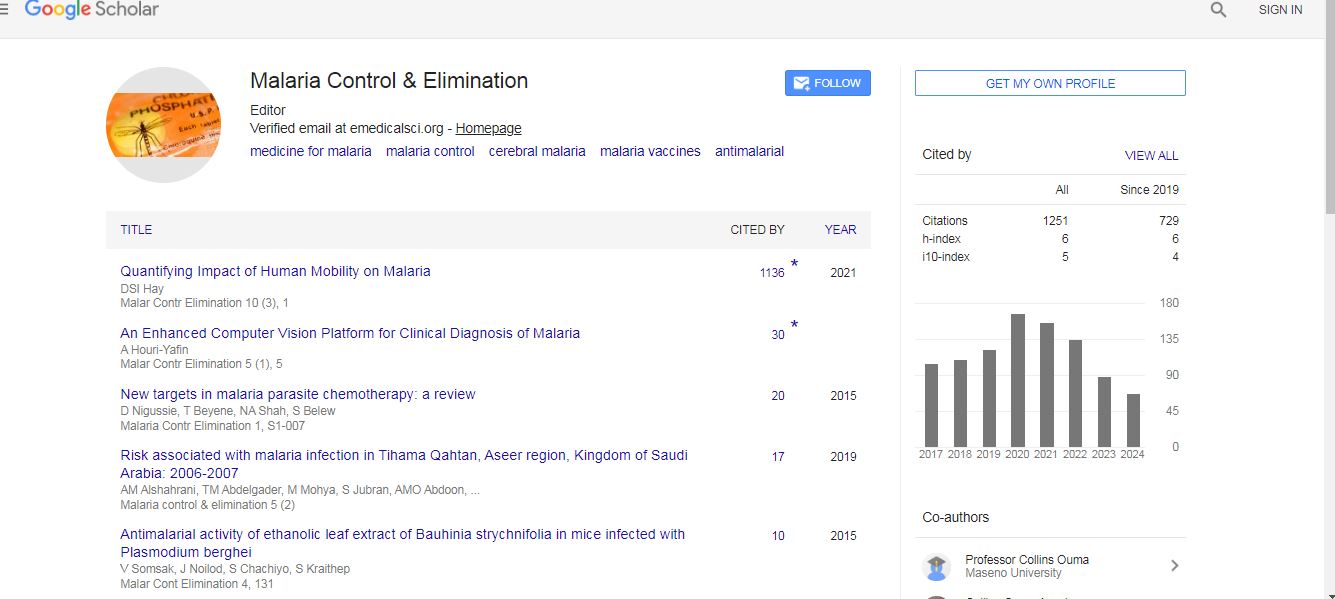
Malaria Control & Elimination received 1187 citations as per Google Scholar report