Commentary - (2025) Volume 14, Issue 6
Received: 01-Dec-2025, Manuscript No. idse-26-183633;
Editor assigned: 03-Dec-2025, Pre QC No. P-183633;
Reviewed: 17-Dec-2025, QC No. Q-183633;
Revised: 22-Dec-2025, Manuscript No. R-183633;
Published:
29-Dec-2025
, DOI: 10.37421/2168-9768.2025.14.520
Citation: Njoroge, Victor. ”Integrated Irrigation Drainage: Sustainable
Water Management.” Irrigat Drainage Sys Eng 14 (2025):520.
Copyright: © 2025 Njoroge V. This is an open-access article distributed under the terms of the Creative Commons Attribution License, which permits unrestricted use,
distribution and reproduction in any medium, provided the original author and source are credited.
The design and planning of irrigation and drainage systems are fundamental to achieving sustainable agriculture and ensuring food security in a world facing increasing water scarcity and environmental challenges. An integrated approach is crucial, recognizing the interconnectedness of water application for crops and the efficient removal of excess water to prevent detrimental conditions like waterlogging and salinity. This holistic perspective aims to optimize resource utilization, enhance agricultural productivity, and safeguard environmental health. Key considerations in this integrated design process include site-specific hydrological analysis, precise estimation of crop water requirements, thorough understanding of soil characteristics, and the judicious selection of appropriate irrigation and drainage technologies [1].
Modern hydrological modeling techniques offer powerful tools for the planning and design of sophisticated irrigation and drainage infrastructure. These advanced methods enable detailed simulations of water flow, accurate prediction of potential flooding events, and the optimization of network layouts for maximum efficiency. The application of computational fluid dynamics (CFD) and Geographic Information Systems (GIS) allows for more precise estimations of system performance and a significant reduction in design uncertainties. This leads to the development of more efficient and cost-effective engineering solutions for water management [2].
Designing effective drainage systems, particularly for regions susceptible to both water scarcity and excessive rainfall, presents unique challenges. Innovations in this area often focus on developing conjunctive use systems that seamlessly integrate irrigation and drainage to achieve optimal water resource management. These approaches are increasingly emphasizing the critical importance of considering climate variability and designing adaptable infrastructure capable of withstanding extreme weather events. Such adaptability is paramount for long-term resilience and effectiveness [3].
Subsurface drainage systems play a vital role in improving agricultural land by enhancing soil aeration and preventing saturation of the root zone, which can severely inhibit crop growth. A comprehensive review of design methodologies for these systems is essential. This includes understanding the application of transient flow models and established graphical methods. The impact of various soil properties, such as hydraulic conductivity, and critical design parameters like drainage spacing, significantly influences the overall efficiency of the system and its resulting agricultural outcomes [4].
Optimizing surface drainage design is equally important for agricultural lands, with a primary focus on reducing surface runoff volumes and effectively controlling soil erosion. This is often achieved through the implementation of a decision-support framework that intelligently integrates hydrological data, detailed topographical information, and comprehensive land use data. The benefits of combining best management practices with engineered drainage solutions are substantial, leading to improved water quality and enhanced soil conservation efforts [5].
The performance evaluation and design considerations for on-farm irrigation systems are critical for maximizing water-use efficiency and conserving energy. This involves a thorough examination of different irrigation methods, including drip, sprinkler, and furrow irrigation, assessing their suitability for diverse cropping systems and soil types. Effective planning for on-farm water management is essential to maximize crop yields while simultaneously minimizing water losses, thereby contributing to overall agricultural sustainability [6].
Designing and planning irrigation and drainage works in arid and semi-arid regions present distinct challenges due to the inherent scarcity of water resources. Strategies for water harvesting, highly efficient water application, and robust salinity management are paramount. These regions often benefit from integrating traditional knowledge with modern engineering practices to develop sustainable and contextually appropriate water management solutions that address local needs and environmental constraints [7].
The environmental impacts associated with irrigation and drainage engineering works warrant careful analysis and proactive mitigation. Issues such as waterlogging, soil salinization, alterations in groundwater levels, and the potential for agricultural runoff to cause pollution must be thoroughly examined. Incorporating comprehensive environmental impact assessments and well-defined mitigation measures into the planning and design phases is crucial for ensuring the long-term ecological sustainability of these projects [8].
An economic assessment of irrigation and drainage projects is essential for ensuring their viability and sustainability. This typically involves rigorous cost-benefit analysis and evaluation of the return on investment. Assessing the financial feasibility of different engineering designs and management strategies requires careful consideration of construction costs, ongoing operational expenses, and the projected gains in agricultural productivity. Decision-makers need robust tools to select the most economically efficient and environmentally sound water infrastructure projects [9].
The application of remote sensing and GIS technologies has significantly advanced the planning and monitoring capabilities for irrigation and drainage networks. Satellite imagery and spatial analysis tools enable precise mapping of soil moisture levels, accurate delineation of drainage basins, and effective assessment of the impact of implemented water management practices. This technological integration leads to enhanced accuracy and efficiency in design and planning, facilitating better resource allocation and optimized system performance [10].
The integrated design and planning of irrigation and drainage systems represent a cornerstone of modern sustainable agriculture, aiming to optimize water use while mitigating negative environmental impacts. This approach emphasizes the critical balance between providing adequate water for crops and efficiently removing excess water to prevent issues like waterlogging and soil salinization. Success hinges on detailed site-specific hydrological analysis, accurate crop water needs assessment, understanding soil properties, and selecting appropriate technologies for both irrigation and drainage [1].
Advanced hydrological modeling techniques are transforming the planning and design of irrigation and drainage infrastructure. The use of computational fluid dynamics (CFD) and Geographic Information Systems (GIS) allows for sophisticated simulations of water flow, prediction of flood risks, and optimization of network configurations. This enables engineers to achieve more accurate performance estimates and reduce design uncertainties, resulting in more efficient and cost-effective projects [2].
Designing drainage systems for challenging environments, such as those experiencing both water scarcity and heavy rainfall, necessitates innovative solutions. The development of conjunctive use systems that effectively integrate irrigation and drainage functions is a key strategy. These systems must be designed with climate variability in mind, ensuring adaptability to extreme weather events for sustained functionality and water resource management [3].
Subsurface drainage is crucial for improving soil conditions by enhancing aeration and preventing root zone saturation. The design of these systems relies on established methodologies, including transient flow models and graphical techniques. Crucially, the effectiveness of subsurface drainage is directly influenced by soil properties, particularly hydraulic conductivity, and design parameters like drainage spacing, which dictate system efficiency and agricultural benefits [4].
Optimizing surface drainage is paramount for agricultural watersheds to minimize runoff volume and control erosion. A systematic approach, often employing a decision-support framework, integrates hydrological data, topography, and land use information to guide design. The synergy between engineered drainage solutions and best management practices is vital for achieving improved water quality and effective soil conservation [5].
On-farm irrigation systems require careful evaluation and design to maximize water-use efficiency and minimize energy consumption. This involves selecting appropriate irrigation methods, such as drip, sprinkler, or furrow systems, based on specific crop requirements and soil conditions. Strategic planning for on-farm water management is essential for boosting crop yields and reducing water wastage [6].
Addressing the complexities of irrigation and drainage in arid and semi-arid regions demands specialized strategies due to severe water scarcity. Water harvesting, highly efficient application techniques, and robust salinity management are key considerations. Integrating traditional water management knowledge with contemporary engineering practices is often essential for developing sustainable solutions tailored to these environments [7].
The environmental consequences of irrigation and drainage projects, including waterlogging, salinization, and altered groundwater dynamics, must be rigorously assessed. Potential pollution from agricultural runoff is also a significant concern. Proactive integration of environmental impact assessments and mitigation strategies into the design and planning phases is imperative for long-term ecological health [8].
Economic viability is a critical factor in the success of irrigation and drainage projects. Comprehensive cost-benefit analyses and return on investment calculations are necessary. This involves evaluating construction and operational expenses against anticipated agricultural productivity gains to ensure the selection of financially sound and sustainable water infrastructure solutions [9].
Modern planning and monitoring of irrigation and drainage networks are significantly enhanced by remote sensing and GIS technologies. These tools facilitate accurate mapping of soil moisture, delineation of drainage basins, and assessment of water management impacts. This technological integration improves the precision and efficiency of design and planning processes, leading to better resource allocation and improved system performance [10].
This collection of research explores various facets of irrigation and drainage system design and planning. It highlights the importance of integrated approaches, advanced hydrological modeling, and adaptive designs for sustainable agriculture. Specific focus is placed on optimizing surface and subsurface drainage, enhancing on-farm irrigation efficiency, and addressing the unique challenges of arid regions. The economic and environmental impacts of these projects are also critically examined, with an emphasis on cost-benefit analysis and mitigation strategies. Furthermore, the integration of remote sensing and GIS technologies is presented as a means to improve planning, monitoring, and overall system performance for better water resource management and agricultural productivity.
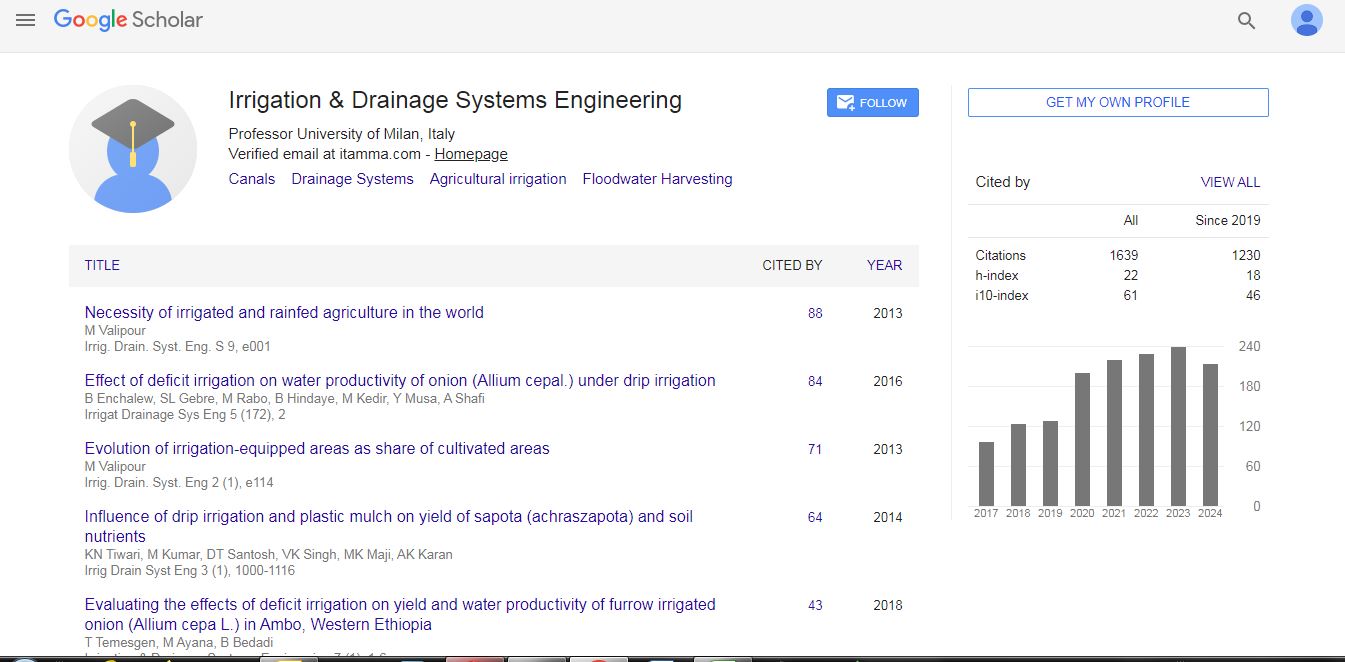
Irrigation & Drainage Systems Engineering received 835 citations as per Google Scholar report