Brief Report - (2025) Volume 14, Issue 2
Received: 01-Apr-2025, Manuscript No. idse-26-182761;
Editor assigned: 03-Apr-2025, Pre QC No. P-182761;
Reviewed: 17-Apr-2025, QC No. Q-182761;
Revised: 22-Apr-2025, Manuscript No. R-182761;
Published:
29-Apr-2025
, DOI: 10.37421/2168-9768.2025.14.478
Citation: López, María Fernanda. ”Integrated Irrigation and
Drainage for Sustainable Agriculture.” Irrigat Drainage Sys Eng 14 (2025):478.
Copyright: © 2025 López F. María This is an open-access article distributed under the terms of the Creative Commons Attribution License, which permits unrestricted use,
distribution and reproduction in any medium, provided the original author and source are credited.
The effective planning, design, and management of irrigation and drainage systems are paramount for achieving sustainable agriculture, particularly in arid and semi-arid regions where water scarcity is a prevalent challenge. These integrated approaches must meticulously consider vital factors such as water availability, the specific water requirements of various crops, soil characteristics, and the potential environmental impacts of agricultural practices. Advances in remote sensing and Geographic Information Systems (GIS) technologies are revolutionizing the precision with which these systems can be monitored and managed, ultimately leading to significant improvements in water-use efficiency and a reduction in environmental degradation. The research underscores the critical need for adaptive management strategies that are capable of responding dynamically to evolving climatic conditions and ever-changing socio-economic landscapes [1].
Optimizing irrigation scheduling represents a cornerstone of efficient water management in modern agriculture. This involves the strategic utilization of real-time data, diligently collected from sources such as soil moisture sensors and local weather stations, to formulate and implement dynamic irrigation strategies. The findings from such investigations consistently demonstrate that by precisely adjusting irrigation schedules based on the actual needs of crops and prevailing environmental conditions, substantial water savings can be realized without compromising, and often even enhancing, crop yields. Furthermore, these studies frequently highlight the considerable economic advantages associated with the adoption of precision irrigation techniques [2].
The meticulous design of drainage systems is of critical importance for the prevention of waterlogging and soil salinization, both of which can severely impair agricultural productivity and lead to substantial crop losses. This paper delves into an in-depth investigation of the performance characteristics of subsurface drainage systems, analyzing their efficacy under a variety of soil types and diverse rainfall patterns. A key emphasis is placed on the indispensable role of proper hydraulic design, which necessitates careful consideration of crucial factors including drain spacing, depth, and the selection of appropriate drainage materials. Additionally, the research extends to an examination of the broader environmental implications associated with the discharge of drainage water, advocating strongly for the implementation of best practices that effectively minimize the loss of vital nutrients and sediments into receiving water bodies [3].
As water scarcity emerges as an increasingly urgent global concern, the imperative for innovative approaches to irrigation management becomes ever more pronounced. This particular research rigorously evaluates the efficacy of deficit irrigation strategies, a set of techniques designed to conserve water resources while simultaneously striving to maintain optimal crop yields for specific agricultural purposes. The study provides valuable insights into the strategic application of controlled water stress at various critical growth stages of crops, with the overarching goal of maximizing overall water productivity. Moreover, the research extends to a discussion of the economic viability and environmental sustainability of adopting such advanced practices within agricultural systems that are characterized by significant water limitations [4].
The integration of cutting-edge technologies is fundamentally transforming the landscape of irrigation and drainage management, ushering in an era of unprecedented efficiency and precision. This paper specifically explores the practical applications of remote sensing technologies and Artificial Intelligence (AI) in achieving highly precise irrigation water management. It convincingly demonstrates how sophisticated satellite imagery analysis, coupled with advanced AI algorithms, can be effectively employed to accurately estimate the precise water needs of crops, to identify specific areas within fields experiencing water stress, and to optimize the delivery of irrigation water. The tangible benefits derived from such technological integration include markedly improved water use efficiency, substantial reductions in labor costs, and a notable enhancement in overall crop health and vigor [5].
The quality of agricultural drainage water presents a significant and ongoing environmental challenge that demands careful attention and effective solutions. This study undertakes a comprehensive investigation into the efficacy of constructed wetlands as a method for treating agricultural drainage water. The primary objective is to remove excess nutrients and substantially reduce pollutant loads before such water is discharged into natural ecosystems. The research meticulously quantifies the removal efficiencies achieved for key pollutants such as nitrogen and phosphorus, thereby highlighting the substantial ecological benefits that can be derived from strategically incorporating wetlands into existing drainage systems. It ultimately provides invaluable insights for the optimal design and effective management of these nature-based systems to achieve superior water quality improvement outcomes [6].
The comprehensive planning of agricultural irrigation systems must inherently consider the long-term sustainability of precious water resources, a factor that is increasingly influenced by global environmental changes. This paper undertakes a detailed examination of the multifaceted socio-economic and environmental factors that exert a significant influence on the successful planning and design of essential irrigation infrastructure. It emphatically stresses the indispensable importance of robust stakeholder participation throughout the planning process and the adoption of adaptive planning methodologies to ensure the equitable distribution of water resources and to proactively minimize potential conflicts. Furthermore, the study critically considers the profound impact of ongoing climate change on the availability of water resources and underscores the critical necessity for designing resilient and adaptable irrigation system infrastructures capable of withstanding future uncertainties [7].
Efficient management of extensive irrigation networks is an absolutely crucial undertaking for ensuring the effective and equitable delivery of water resources to agricultural end-users, namely farmers. This article meticulously presents a robust framework specifically designed for the effective management of large-scale irrigation systems. The framework places a strong emphasis on key operational aspects, including continuous performance monitoring, strategic water allocation, and proactive maintenance protocols. It further discusses the innovative application of advanced hydraulic modeling techniques and the deployment of extensive sensor networks to accurately identify operational inefficiencies and to systematically optimize overall system operations. A central tenet of the study is the emphasized role of well-defined institutional arrangements and active farmer engagement in achieving successful and sustainable irrigation system management [8].
The design of on-farm irrigation systems plays a pivotal and direct role in determining both water use efficiency and overall crop productivity. This particular research critically evaluates the performance characteristics of several different on-farm irrigation methods, encompassing widely adopted techniques such as drip irrigation, sprinkler irrigation, and furrow irrigation. It meticulously provides detailed quantitative data pertaining to water application uniformity, the extent of water savings achieved, and their resultant effects on crop yield across a diverse range of crop types. The study ultimately aims to offer practical guidance for selecting the most appropriate and effective irrigation system, tailored to specific local conditions and informed by sound economic considerations [9].
The design of agricultural drainage systems must increasingly account for the growing unpredictability and erratic nature of rainfall patterns, which are significantly influenced by ongoing climate change. This paper undertakes a thorough analysis of the resilience of existing agricultural drainage systems when subjected to extreme rainfall events. It meticulously employs advanced hydrological modeling techniques to rigorously assess the capacity of current drainage networks to effectively handle substantially increased runoff volumes and to prevent widespread flooding. The research critically emphasizes the urgent need for the adoption of climate-resilient design principles and the implementation of proactive adaptive management strategies to ensure the long-term functionality and reliability of vital drainage infrastructure in the face of future climate uncertainties [10].
Effective irrigation and drainage systems are fundamental to sustainable agriculture, especially in regions facing water scarcity. Integrated approaches that consider water availability, crop needs, soil conditions, and environmental impacts are crucial. Modern technologies like remote sensing and GIS offer advanced tools for precise monitoring and management, enhancing water-use efficiency and minimizing environmental damage. Adaptive management strategies are essential to navigate changing climates and socio-economic factors [1].
Optimizing irrigation scheduling is a key to efficient water management. Utilizing real-time data from soil moisture sensors and weather stations allows for dynamic irrigation strategies. Adjusting irrigation based on actual crop needs and environmental conditions leads to significant water savings without compromising crop yield. The economic benefits of precision irrigation are also a considerable advantage [2].
The design of drainage systems is vital for preventing waterlogging and salinity, which negatively affect agricultural productivity. This study analyzes subsurface drainage systems under various soil and rainfall conditions. Proper hydraulic design, considering factors like drain spacing and depth, is emphasized. The environmental implications of drainage water discharge are also examined, promoting practices that reduce nutrient and sediment loss [3].
Water scarcity necessitates innovative irrigation management. This research assesses deficit irrigation strategies, which conserve water while maintaining crop yields. Controlled water stress applied at different growth stages maximizes water productivity. The economic and environmental sustainability of these practices in water-limited systems is also discussed [4].
Advanced technologies are transforming irrigation and drainage management. Remote sensing and Artificial Intelligence (AI) are applied for precise irrigation water management. Satellite imagery and AI algorithms help estimate crop water needs, identify water stress areas, and optimize irrigation delivery, leading to improved water use efficiency, reduced costs, and enhanced crop health [5].
Managing the quality of agricultural drainage water is a significant environmental concern. Constructed wetlands are investigated for their effectiveness in treating drainage water, removing excess nutrients, and reducing pollutant loads before discharge. The research quantifies nutrient removal efficiencies, highlighting the ecological benefits of incorporating wetlands into drainage systems for water quality improvement [6].
Planning irrigation systems requires a focus on long-term water resource sustainability. This paper explores socio-economic and environmental factors influencing irrigation infrastructure planning and design. Stakeholder participation and adaptive planning are stressed for equitable water distribution and conflict minimization. The impact of climate change on water availability and the need for resilient designs are also considered [7].
Efficient management of irrigation networks is crucial for effective water delivery to farmers. This article presents a framework for managing large-scale irrigation systems, focusing on performance monitoring, water allocation, and maintenance. Hydraulic modeling and sensor networks are used to identify inefficiencies and optimize operations. Institutional arrangements and farmer engagement are highlighted as key to successful management [8].
The design of on-farm irrigation systems greatly influences water use efficiency and crop productivity. This research evaluates different on-farm irrigation methods, such as drip, sprinkler, and furrow irrigation. It provides data on water application uniformity, water savings, and their impact on crop yield, offering guidance for selecting appropriate systems based on local conditions and economic factors [9].
Drainage system design must adapt to increasingly erratic rainfall due to climate change. This paper assesses the resilience of agricultural drainage systems to extreme rainfall events using hydrological modeling. It emphasizes the need for climate-resilient design principles and adaptive management to ensure the long-term functionality of drainage infrastructure [10].
This collection of research highlights the critical importance of integrated and adaptive approaches to managing irrigation and drainage systems for sustainable agriculture. Key themes include optimizing irrigation scheduling through real-time data and precision techniques, the vital role of proper drainage system design to prevent waterlogging and salinity, and the adoption of deficit irrigation strategies to conserve water while maintaining crop yields. The integration of advanced technologies like remote sensing and AI is revolutionizing water management precision. Furthermore, research addresses the environmental quality of drainage water, advocating for solutions like constructed wetlands, and emphasizes the need for socio-economic and environmental considerations in irrigation system planning. The resilience of drainage systems to extreme weather events and efficient management frameworks for large-scale irrigation networks are also crucial areas of focus. Ultimately, these studies underscore the necessity of informed design, adaptive strategies, and technological integration to address water scarcity and climate change impacts in agriculture.
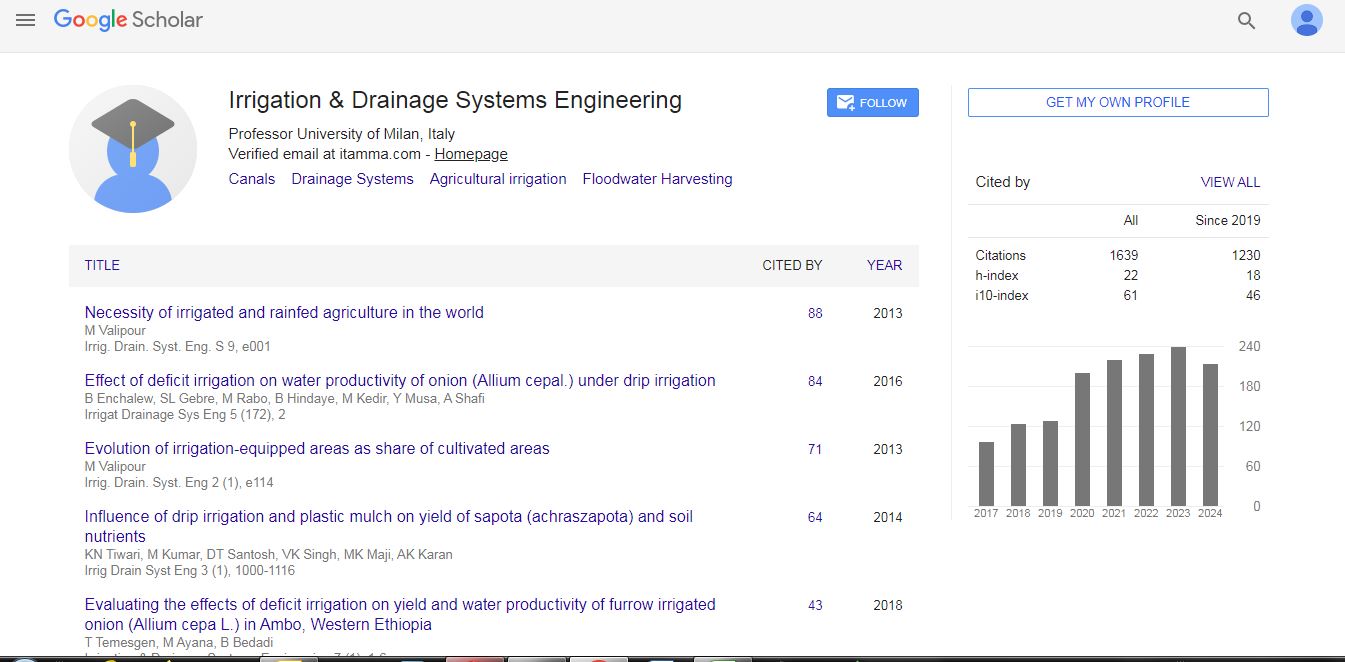
Irrigation & Drainage Systems Engineering received 835 citations as per Google Scholar report