Perspective - (2025) Volume 11, Issue 4
Received: 02-Nov-2025, Manuscript No. jmt-25-175214;
Editor assigned: 04-Nov-2025, Pre QC No. P-175214;
Reviewed: 18-Nov-2025, QC No. Q-175214;
Revised: 24-Nov-2025, Manuscript No. R-175214;
Published:
29-Nov-2025
, DOI: 10.37421/2471-271X.2025.11.363
Citation: Adeyemi, Samuel. ”Insomnia: Nature, Treatments and Health Implications.” J Ment Disord Treat 11 (2025):363.
Copyright: © 2025 Adeyemi S. This is an open-access article distributed under the terms of the Creative Commons Attribution License, which permits unrestricted use, distribution and reproduction in any medium, provided the original author and source are credited.
This systematic review explores the efficacy of Cognitive Behavioral Therapy for Insomnia (CBT-I) specifically for patients experiencing chronic pain alongside their insomnia. The findings suggest that CBT-I holds significant promise as an effective treatment, offering improvements in both sleep quality and pain symptoms, highlighting its utility in complex comorbid conditions [1].
This narrative review focuses on insomnia in older adults, examining its underlying physiological mechanisms and various treatment approaches. It emphasizes that insomnia in this population often involves distinct challenges and comorbidities, necessitating tailored interventions that consider age-related changes and potential medication interactions [2].
A systematic review and meta-analysis investigated the critical link between insomnia and cardiovascular disease. The research highlights a significant association, indicating that chronic insomnia is not just a symptom but a potential risk factor for various cardiovascular conditions, underscoring the importance of early intervention for sleep disturbances [3].
This guideline from the American Academy of Sleep Medicine provides comprehensive recommendations for the pharmacological management of chronic insomnia in adults. It critically evaluates various medications, offering evidence-based advice on their efficacy, safety, and appropriate use in clinical practice [4].
This systematic review and meta-analysis evaluates the effectiveness of digital Cognitive Behavioral Therapy for Insomnia (dCBT-I) specifically for adolescents. The findings suggest that dCBT-I is a promising and accessible intervention, demonstrating significant improvements in sleep outcomes for this younger population, addressing a critical need in adolescent mental health [5].
This review delves into the significant role of insomnia in both the onset and persistence of various mental disorders. It underscores that insomnia is frequently a precursor or maintaining factor for conditions like depression and anxiety, highlighting the critical need to address sleep disturbances as part of comprehensive mental health care [6].
This scoping review examines insomnia and its treatment in individuals diagnosed with mood disorders. It provides an overview of current research, emphasizing the high comorbidity between insomnia and mood disorders like depression and bipolar disorder, and explores various therapeutic strategies tailored to this complex patient group [7].
A systematic review and meta-analysis investigate the impact of various sleep interventions on both insomnia and depression in adults. The findings suggest that effectively treating insomnia can lead to significant improvements in depressive symptoms, underscoring the interconnectedness of sleep health and mental well-being [8].
This systematic review and meta-analysis examines the bidirectional relationship between chronic insomnia and generalized anxiety disorder. It reveals that these two conditions frequently influence each other, with insomnia often exacerbating anxiety and vice-versa, suggesting that integrated treatment approaches are most effective [9].
This systematic review and meta-analysis investigate the prevalence and characteristics of sleep disturbances, particularly insomnia, among patients affected by COVID-19. The findings highlight a significant increase in insomnia symptoms during and after COVID-19 infection, pointing to the need for attention to sleep health in post-pandemic recovery [10].
Research extensively covers the efficacy and application of Cognitive Behavioral Therapy for Insomnia (CBT-I) across diverse populations. A systematic review confirms CBT-I's significant promise for patients experiencing chronic pain alongside insomnia, demonstrating improvements in both sleep quality and pain symptoms [1]. Additionally, digital Cognitive Behavioral Therapy for Insomnia (dCBT-I) is identified as an accessible and effective intervention for adolescents, providing crucial improvements in sleep outcomes and addressing mental health needs within this younger demographic [5].
Beyond general applications, specific challenges and comorbidities associated with insomnia are explored. A narrative review on insomnia in older adults highlights the distinct physiological mechanisms and the need for tailored interventions, considering age-related changes and potential medication interactions [2]. Furthermore, a systematic review and meta-analysis establish a critical link between chronic insomnia and cardiovascular disease, indicating that poor sleep is a significant risk factor for various cardiovascular conditions, emphasizing the importance of early intervention for sleep disturbances [3].
Insomnia's profound connection to mental health disorders is a recurring theme. One review delves into its significant role in both the onset and persistence of conditions such as depression and anxiety, underscoring the necessity of addressing sleep disturbances as part of comprehensive mental health care [6]. A scoping review further examines insomnia and its treatment in individuals with mood disorders, emphasizing the high comorbidity with conditions like depression and bipolar disorder and exploring tailored therapeutic strategies [7]. The bidirectional relationship between chronic insomnia and generalized anxiety disorder is also noted, where each condition can exacerbate the other, reinforcing the need for integrated treatment approaches [9].
Treatment and emerging contexts of insomnia are also detailed. Comprehensive guidelines from the American Academy of Sleep Medicine provide evidence-based recommendations for the pharmacological management of chronic insomnia in adults, critically evaluating various medications for efficacy and safety [4]. Another systematic review and meta-analysis demonstrate that effective sleep interventions for insomnia can lead to significant improvements in depressive symptoms, highlighting the interconnectedness of sleep health and mental well-being [8].
Lastly, contemporary research investigates the impact of global health crises on sleep. A systematic review and meta-analysis reveal a significant increase in insomnia symptoms among patients affected by COVID-19 during and after infection, underscoring the vital need for attention to sleep health in post-pandemic recovery efforts [10].
This body of research offers a comprehensive overview of insomnia, exploring its multifaceted nature, comorbidities, and various treatment modalities. Studies consistently highlight the efficacy of Cognitive Behavioral Therapy for Insomnia (CBT-I), and its digital counterpart, dCBT-I, across different populations, including patients with chronic pain and adolescents, demonstrating improvements in sleep quality and associated symptoms. The research also delves into the specific challenges of insomnia in older adults, emphasizing the necessity for tailored interventions that account for age-related factors and potential medication interactions. A significant theme is the strong link between chronic insomnia and broader health implications. It is identified as a potential risk factor for cardiovascular disease, underscoring the importance of early intervention. Moreover, insomnia is frequently implicated in the onset and persistence of mental disorders, such as depression and anxiety, often exhibiting a bidirectional relationship that necessitates integrated treatment approaches. Effective sleep interventions are shown to alleviate depressive symptoms, reinforcing the interconnectedness of sleep and mental health. The literature also addresses pharmacological management strategies for chronic insomnia in adults, providing evidence-based guidelines for clinical practice. Finally, a contemporary concern involves the heightened prevalence of sleep disturbances, particularly insomnia, among individuals affected by COVID-19, pointing to an ongoing need for attention to sleep health in the context of pandemic recovery.
None
None
Amanda GB, Christopher MF, Michael JS. "Cognitive Behavioral Therapy for Insomnia (CBT-I) in Patients with Comorbid Chronic Pain: A Systematic Review.".Sleep Med Rev 67 (2023):101736.
Indexed at, Google Scholar, Crossref
Andrew WK, Maurice MO, Sonia A. "Insomnia in Older Adults: A Narrative Review of Pathophysiology and Treatment Approaches.".Drugs Aging 40 (2023):25-41.
Indexed at, Google Scholar, Crossref
Hanxi Z, Ming S, Xiaomin S. "The Association Between Insomnia and Cardiovascular Disease: A Systematic Review and Meta-Analysis.".Sleep Med 97 (2022):8-15.
Indexed at, Google Scholar, Crossref
Neil BKF, Kathleen LP, Rochelle G. "Pharmacological Management of Chronic Insomnia in Adults: An American Academy of Sleep Medicine Clinical Practice Guideline.".J Clin Sleep Med 18 (2022):1699-1708.
Indexed at, Google Scholar, Crossref
Sarah CI, Charlotte MC, Eleanor ST. "Digital Cognitive Behavioral Therapy for Insomnia (dCBT-I) for Adolescents: A Systematic Review and Meta-Analysis.".Sleep Med Rev 66 (2022):101719.
Indexed at, Google Scholar, Crossref
Allison GH, Colin AE, Charles MM. "The Role of Insomnia in the Development and Maintenance of Mental Disorders.".Clin Psychol Rev 91 (2022):102102.
Indexed at, Google Scholar, Crossref
Daniel JS, Heather LR, Andrew MK. "Insomnia and Its Treatment in Patients with Mood Disorders: A Scoping Review.".CNS Drugs 35 (2021):45-63.
Indexed at, Google Scholar, Crossref
Helen JK, Laura KBY, Chloe AG. "Sleep Interventions for Insomnia and Depression in Adults: A Systematic Review and Meta-analysis.".Lancet Psychiatry 8 (2021):421-432.
Indexed at, Google Scholar, Crossref
Yan H, Min W, Yi L. "The bidirectional relationship between chronic insomnia and generalized anxiety disorder: A systematic review and meta-analysis.".Sleep Med 74 (2020):151-160.
Indexed at, Google Scholar, Crossref
Bing-Chuan H, Shu-Chun C, Ching-Liang Y. "Sleep and Insomnia in COVID-19 Patients: A Systematic Review and Meta-Analysis.".Sleep Med 74 (2020):1-9.
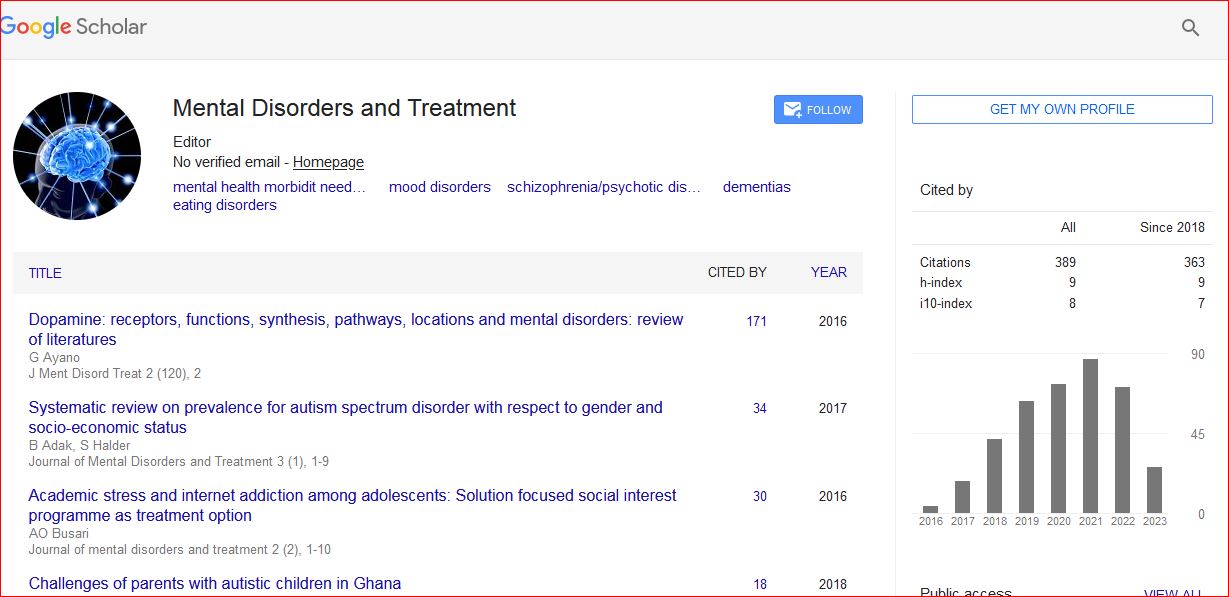
Mental Disorders and Treatment received 556 citations as per Google Scholar report