Commentary - (2025) Volume 13, Issue 3
Received: 01-May-2025, Manuscript No. economics-26-186047;
Editor assigned: 05-May-2025, Pre QC No. P-186047;
Reviewed: 19-May-2025, QC No. Q-186047;
Revised: 22-May-2025, Manuscript No. R-186047;
Published:
29-May-2025
, DOI: 10.37421/2375-4389.2025.13.523
Citation: Torres, Rafael Ignacio. ”Multifaceted Drivers of Inflation
in Developed Economies.” J Glob Econ 13 (2025):523.
Copyright: © 2025 Torres I. Rafael This is an open-access article distributed under the terms of the Creative Commons Attribution License, which permits unrestricted use,
distribution and reproduction in any medium, provided the original author and source are credited.
The economic landscape of developed nations over the past half-decade has been significantly shaped by a complex interplay of inflationary forces, necessitating a thorough examination of the underlying drivers and policy responses. The recent surge in inflation has underscored the interconnectedness of global supply chains, the volatility of commodity markets, and the dynamic nature of consumer behavior, all of which have presented considerable challenges to policymakers striving for price stability. One critical aspect of this inflationary environment has been the role of supply chain disruptions, which, coupled with shifts in consumer demand, have pushed inflation to elevated levels in many developed economies. The intricate web of global trade and production has proven vulnerable to unforeseen shocks, leading to shortages and price increases across a wide spectrum of goods and services. Complementing these supply-side pressures have been substantial fiscal and monetary policy interventions undertaken to mitigate the economic fallout from global events. These policies, while aimed at supporting economic activity, have also been scrutinized for their potential contributions to inflationary pressures, creating a delicate balancing act for central banks and governments. The challenges faced by policymakers in navigating these multifaceted inflationary pressures are substantial. Maintaining price stability requires a nuanced understanding of the various contributing factors and the effectiveness of different policy tools in the current economic climate, which differs significantly from historical norms. Furthermore, the persistence of inflation is heavily influenced by the formation and anchoring of inflation expectations. Central bank communication and credibility play a pivotal role in managing these expectations, as unanchored expectations can create self-fulfilling prophecies that make inflation control more difficult. Global commodity prices, particularly for energy and food, have also exerted a significant influence on domestic inflation in developed countries. The pass-through effect of these price volatilities, exacerbated by global market dynamics, has added another layer of complexity to inflation management. The effectiveness of unconventional monetary policies, such as quantitative easing, in managing inflation during periods of supply-side shocks has been a subject of considerable debate. While these policies can support economic recovery, their direct impact on immediate inflation pressures stemming from supply constraints appears to be limited, with potential long-term implications to consider. Labor market dynamics, characterized by tightness and rising wage pressures, have contributed to underlying inflation trends. The potential for a wage-price spiral poses a challenge for central banks, as they must manage wage growth without stifling employment, a key objective for economic stability. The impact of fiscal stimulus measures, especially in the post-pandemic era, has also been analyzed for its contribution to inflation. While crucial for economic recovery, substantial fiscal support has been linked to demand-pull inflation, highlighting the trade-offs between growth support and price stability. Finally, the broader forces of globalization and deglobalization, alongside the evolving landscape of climate change policies and digitalization, are increasingly recognized as factors influencing inflation. These macro-trends, encompassing trade patterns, geopolitical shifts, environmental regulations, and technological advancements, collectively shape the inflationary environment in developed economies.
The inflationary dynamics observed in developed economies over the past five years are characterized by a complex interplay of factors, including disruptions to global supply chains, significant shifts in consumer demand patterns, and the broad implementation of fiscal and monetary policy responses. These elements have collectively contributed to elevated inflation rates, posing considerable challenges for policymakers aiming to maintain price stability. The study emphasizes the critical need for a nuanced understanding of these pressures and the effectiveness of various monetary policy tools in the current economic context [1].
A crucial element in understanding inflation persistence lies in the management of inflation expectations. Research suggests that central banks' communication strategies and their perceived credibility are paramount in anchoring these expectations within developed markets. When expectations become unanchodoxed, the risk of a self-fulfilling prophecy emerges, complicating efforts to bring inflation back to target levels. The analysis of different communication approaches is vital in this regard [2].
Global commodity price volatility has emerged as another significant determinant of inflation in developed countries. A notable pass-through effect, particularly from energy and food markets, has been observed to exacerbate domestic inflationary pressures. The research further explores how the structure of import bills and the specific mechanisms through which these price shocks are transmitted influence the speed and magnitude of their impact on domestic inflation [3].
The effectiveness of unconventional monetary policies, such as quantitative easing, in combating inflation during periods marked by supply-side shocks has been a subject of intense scrutiny. While these measures can provide support for economic activity, their direct influence on mitigating immediate inflationary pressures originating from supply constraints appears limited. The potential side effects and long-term implications of these policies warrant careful consideration [4].
Labor market conditions, specifically the degree of tightness and the associated wage pressures, play a significant role in driving underlying inflation trends in developed economies. The potential for a wage-price spiral necessitates careful management by central banks, balancing the imperative to control inflation with the objective of maintaining robust employment levels and avoiding stifled job growth [5].
Fiscal stimulus measures implemented in the wake of global events, such as the COVID-19 pandemic, have been analyzed for their inflationary impact. While essential for economic recovery, substantial fiscal support has been identified as a contributor to demand-pull inflation in developed markets, highlighting the inherent trade-offs between stimulating growth and preserving price stability [6].
Broader trends in globalization and deglobalization are increasingly influencing inflation dynamics within developed nations. Shifts in global trade patterns, the restructuring of international supply chains, and evolving geopolitical factors collectively impact price levels. There is an indication that intensifying deglobalization trends could contribute to rising inflationary pressures [7].
The design and implementation of central bank mandates are critical for achieving price stability in developed markets. Comparative analyses reveal how different inflation-targeting frameworks perform under various economic shocks. The challenge of balancing inflation control with other policy objectives, such as financial stability and full employment, remains a central theme in this discussion [8].
The interaction between climate change policies and inflation is a growing area of research in developed economies. The transition towards a greener economy, driven by measures like carbon pricing and investments in renewable energy, can introduce both inflationary and deflationary pressures. Quantifying these impacts on consumer prices and navigating the challenges of achieving climate goals without compromising price stability are key considerations [9].
Finally, the pervasive influence of digitalization and automation on productivity and inflation is being explored. Technological advancements can lead to increased efficiency and potentially lower production costs, exerting downward pressure on inflation. Conversely, increased demand for digital infrastructure and services may introduce inflationary effects, creating a dual impact that requires careful analysis [10].
This collection of research examines the multifaceted drivers of inflation in developed economies over the past five years. Key contributing factors include supply chain disruptions, shifts in consumer demand, and significant fiscal and monetary policy interventions. The role of inflation expectations, global commodity price volatility, and labor market tightness are highlighted as critical influences. Studies also investigate the impact of unconventional monetary policies, fiscal stimulus, globalization trends, central bank mandates, climate change policies, and digitalization on price stability. The research underscores the complex challenges faced by policymakers in balancing economic growth with inflation control, emphasizing the need for a comprehensive understanding of these interconnected economic forces.
None
None
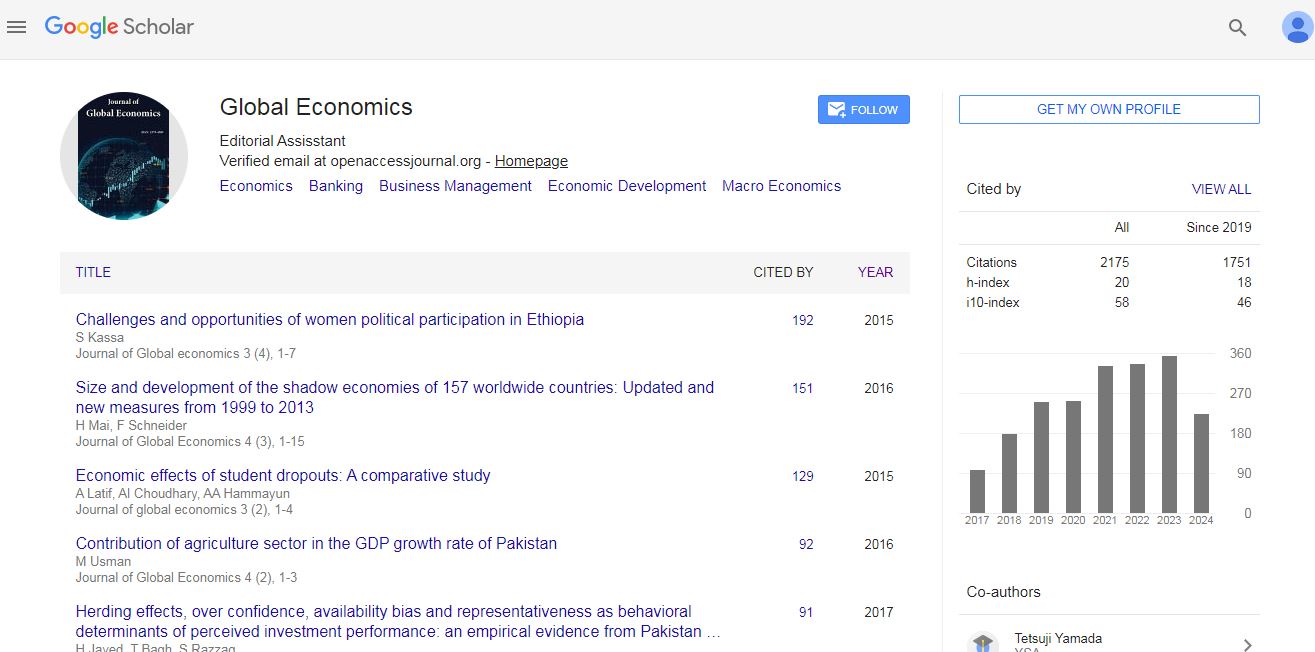
Journal of Global Economics received 2175 citations as per Google Scholar report