Perspective - (2025) Volume 9, Issue 4
Received: 02-Jul-2025, Manuscript No. jcao-26-187151;
Editor assigned: 04-Jul-2025, Pre QC No. P-187151;
Reviewed: 18-Jul-2025, QC No. Q-187151;
Revised: 23-Jul-2025, Manuscript No. R-187151;
Published:
30-Jul-2025
, DOI: 10.37421/2684-6004.2025.9.307
Citation: Viktor Novak. ”Advancements in Perioperative And Intensive Care Medicine.” J Clin Anesthesiol 09 (2025):307.
Copyright: © 2025 viktor.novak@cuni.cz N. Viktor This is an open-access article distributed under the terms of the Creative Commons Attribution License, which permits unrestricted use, distribution and reproduction in any medium, provided the original author and source are credited.
The advancement of surgical procedures, particularly major abdominal interventions, necessitates a meticulous approach to perioperative care, with fluid management being a cornerstone of patient recovery and safety. Individualized fluid therapy, guided by sophisticated monitoring techniques, has demonstrated a significant capacity to mitigate postoperative complications such as ileus and infections, thereby enhancing patient convalescence [1].
Complementing surgical techniques, the role of regional anesthesia in post-operative pain control and the reduction of opioid reliance has become increasingly prominent. Ultrasound-guided regional blocks offer superior analgesia, diminish opioid-related adverse effects, and promote earlier patient mobilization following orthopedic procedures [2].
In the aging surgical population, the impact of anesthetic agents on neurological outcomes, specifically neuroinflammation and cognitive function, warrants careful consideration. While generally safe, prolonged exposure to volatile anesthetics may be linked to subtle postoperative neurocognitive alterations, highlighting the need for continued research into anesthetic choices for vulnerable elderly patients [3].
Beyond elective surgery, the critical care setting presents distinct challenges, notably in the management of severe sepsis and septic shock. Early recognition, rapid antibiotic administration, and aggressive fluid resuscitation are paramount, with ongoing exploration of novel therapeutic strategies aimed at improving survival rates [4].
Following cardiac arrest, targeted temperature management (TTM) has emerged as a critical intervention to improve neurological outcomes. Research into optimal temperature ranges and duration, coupled with strategies to manage potential complications, continues to refine this life-saving protocol [5].
Acute respiratory distress syndrome (ARDS) presents a significant challenge in intensive care, demanding sophisticated mechanical ventilation strategies. Lung-protective ventilation protocols and innovative techniques are continuously being developed to optimize gas exchange and minimize ventilator-induced lung injury [6].
Non-invasive monitoring, particularly point-of-care ultrasound (POCUS), is revolutionizing the assessment of hemodynamic status in critically ill patients. POCUS facilitates quicker diagnoses and guides therapeutic interventions, ultimately leading to improved patient outcomes in the ICU [7].
The complexities of pain management for patients with chronic pain undergoing surgery require tailored approaches. Multimodal analgesia, incorporating regional anesthesia, opioid-sparing methods, and adjuvant therapies, is crucial for effective pain relief while minimizing the risk of opioid dependence [8].
Perioperative myocardial dysfunction remains a significant concern, necessitating comprehensive diagnostic and management strategies. Invasive monitoring and targeted pharmacological interventions play vital roles in optimizing cardiac function during the perioperative period [9].
Finally, the recent COVID-19 pandemic has profoundly impacted anesthesia and intensive care services, prompting significant adaptations in clinical practices and underscoring the importance of preparedness for future health crises within these critical fields [10].
The meticulous management of fluid balance during major abdominal surgery is crucial for optimizing patient outcomes. Evidence suggests that individualized fluid therapy, informed by advanced monitoring systems, can significantly reduce the incidence of postoperative complications such as paralytic ileus and surgical site infections, contributing to a smoother and faster patient recovery [1].
Regional anesthesia techniques play a pivotal role in enhancing postoperative analgesia and minimizing the need for systemic opioids. Specifically, ultrasound-guided regional nerve blocks have been shown to provide superior pain relief, reduce opioid-related side effects like nausea and respiratory depression, and facilitate earlier patient ambulation, which is vital for recovery after orthopedic procedures [2].
In elderly patients undergoing surgery, the potential impact of anesthetic agents on neuroinflammation and cognitive function is a subject of ongoing investigation. While current volatile anesthetic agents are generally considered safe, there is a recognized need to further explore whether prolonged exposure might contribute to subtle postoperative neurocognitive deficits, especially in this vulnerable demographic [3].
The management of severe sepsis and septic shock in the intensive care unit is a time-sensitive endeavor. The established principles of early recognition, prompt administration of broad-spectrum antibiotics, and aggressive intravenous fluid resuscitation remain critical. Furthermore, research continues to explore novel therapeutic avenues to enhance survival rates for these critically ill patients [4].
Targeted temperature management (TTM) is a key intervention for patients who have experienced cardiac arrest, aimed at improving neurological recovery. Systematic reviews and meta-analyses are vital in defining the optimal temperature targets and duration of TTM, as well as identifying strategies to prevent and manage potential complications associated with hypothermia or rewarming [5].
Mechanical ventilation strategies for patients with acute respiratory distress syndrome (ARDS) are continually evolving. Current practices emphasize lung-protective ventilation, employing low tidal volumes and appropriate positive end-expiratory pressure (PEEP) to minimize ventilator-induced lung injury (VILI). Future directions involve exploring advanced ventilator modes and adjunctive therapies to further optimize gas exchange and patient outcomes [6].
Point-of-care ultrasound (POCUS) has emerged as an invaluable tool for non-invasive hemodynamic assessment in the intensive care setting. Its ability to provide rapid, bedside evaluation of cardiac function, fluid status, and vascular tone allows for quicker diagnoses and more targeted therapeutic interventions, ultimately improving patient management and outcomes [7].
For surgical patients with pre-existing chronic pain, anesthetic and analgesic management presents unique challenges. A multimodal approach is recommended, integrating regional anesthesia, opioid-sparing pharmacotherapies, and adjuvant analgesics to achieve effective pain control while mitigating the risks of opioid dependence and tolerance [8].
Perioperative myocardial dysfunction, characterized by impaired cardiac contractility, is a significant concern that can lead to adverse cardiovascular events. Comprehensive evaluation using diagnostic imaging, invasive hemodynamic monitoring, and judicious use of pharmacological agents is essential for managing these patients effectively throughout the perioperative period [9].
The global impact of the COVID-19 pandemic on anesthesia and intensive care services has been profound. This experience has necessitated rapid adaptation of clinical protocols, highlighted the resilience of healthcare professionals, and provided critical lessons for enhancing preparedness and response capabilities in anticipation of future public health emergencies [10].
This collection of research highlights critical advancements in perioperative and intensive care medicine. Studies cover optimized fluid management in major abdominal surgery, the benefits of regional anesthesia for pain control, and the neurological implications of anesthetic agents in elderly patients. Critically ill patients benefit from updated protocols for sepsis management, targeted temperature management after cardiac arrest, and lung-protective mechanical ventilation for ARDS. Non-invasive monitoring techniques like POCUS improve hemodynamic assessments. Pain management for chronic pain patients undergoing surgery requires multimodal approaches. Perioperative myocardial dysfunction necessitates careful diagnosis and management. Finally, lessons learned from the COVID-19 pandemic are shaping future preparedness in anesthesia and intensive care.
None
None
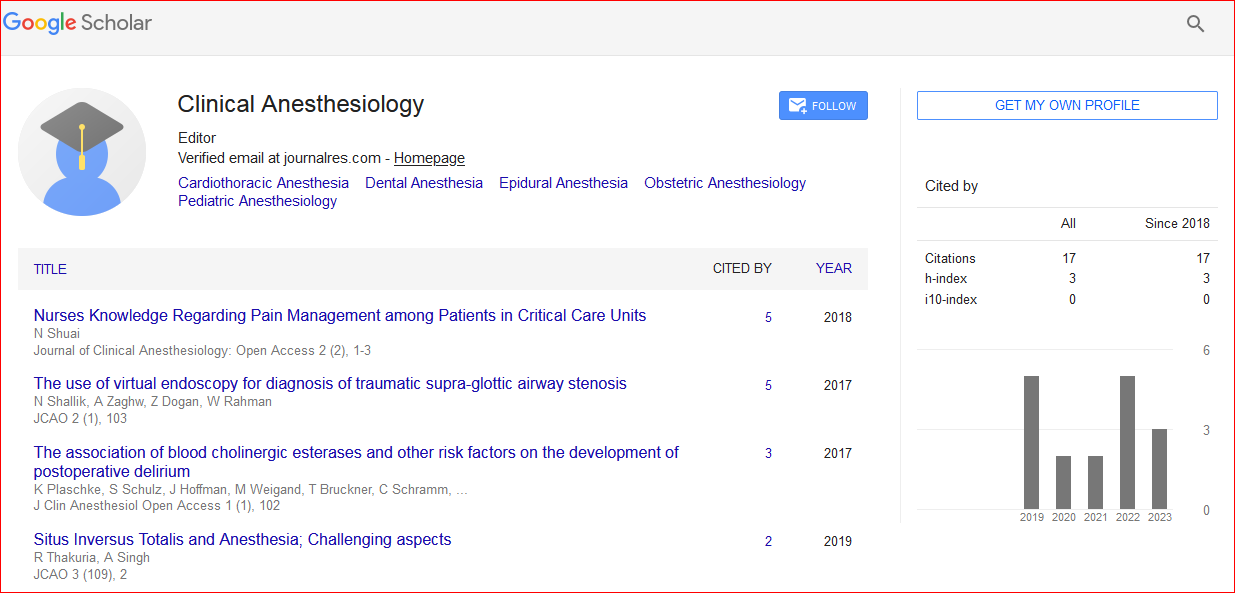
Journal of Clinical Anesthesiology: Open Access received 31 citations as per Google Scholar report