Short Communication - (2025) Volume 19, Issue 5
Received: 01-Oct-2025, Manuscript No. jmgm-26-188375;
Editor assigned: 03-Oct-2025, Pre QC No. P-188375;
Reviewed: 17-Oct-2025, QC No. Q-188375;
Revised: 22-Oct-2025, Manuscript No. R-188375;
Published:
29-Oct-2025
, DOI: 10.37421/1747-0862.2025.19.752
Citation: Rahman, Farah. ”AI Revolutionizes Genomic Medicine: Prediction and Personalization.” J Mol Genet Med 19 (2025):752.
Copyright: © 2025 Rahman F. This is an open-access article distributed under the terms of the Creative Commons Attribution License, which permits unrestricted use, distribution and reproduction in any medium, provided the original author and source are credited.
Artificial intelligence (AI) is profoundly transforming the landscape of genomic medicine, offering unprecedented capabilities in predicting disease risk and individual drug responses. Machine learning algorithms are now adept at analyzing vast and complex genomic datasets, identifying intricate patterns that are strongly correlated with susceptibility to serious conditions such as cancer and cardiovascular disorders. Furthermore, AI is significantly advancing the field of pharmacogenomics by precisely predicting how a patient's unique genetic makeup will influence their response to specific medications. This capability is instrumental in paving the way for highly personalized treatment strategies, which are crucial for minimizing the occurrence of adverse drug reactions and optimizing therapeutic outcomes. The integration of advanced AI techniques into genomic analysis provides unparalleled power in discerning an individual's predisposition to various diseases. Deep learning models, in particular, have demonstrated exceptional proficiency in identifying subtle genomic markers that are associated with multifactorial conditions, thereby offering earlier and more accurate risk assessments than traditional methodologies. This enhanced predictive capability is of paramount importance for the implementation of proactive healthcare interventions and the development of personalized preventative measures. By understanding an individual's genetic vulnerabilities, clinicians can intervene earlier and more effectively, potentially altering the course of disease development. Predicting an individual's drug response based on their specific genome is emerging as a cornerstone of modern precision medicine, and AI is making substantial and rapid advancements in this domain. AI algorithms possess the capacity to analyze extensive pharmacogenomic datasets with remarkable efficiency. These algorithms are adept at identifying specific genetic variants that critically influence both the efficacy and toxicity of various drugs. This enables clinicians to make more informed decisions, selecting the most appropriate treatments and precise dosages for each unique patient, ultimately optimizing therapeutic outcomes and enhancing patient safety. The application of machine learning techniques in the identification of novel genetic targets for disease prediction is experiencing an accelerated pace of development. By meticulously sifting through complex genomic interactions, AI systems can pinpoint specific genes or intricate combinations of genes that demonstrably contribute to disease susceptibility. This capability offers entirely new avenues for the development of diagnostic markers and the creation of targeted therapeutic interventions. Understanding these genetic underpinnings allows for more precise diagnostics and potentially more effective treatments tailored to the specific genetic profile of a patient. AI's remarkable ability to process and interpret large-scale genomic data is fundamentally transforming how we approach the diagnosis and management of rare diseases. By identifying genotype-phenotype correlations that might otherwise be overlooked by human analysis, AI can significantly accelerate the diagnostic process for rare genetic disorders. This acceleration is crucial for initiating timely and appropriate treatment plans, thereby improving the quality of life and management for individuals affected by these complex conditions. The insights gained can lead to more effective and personalized care strategies. [10]
Artificial intelligence (AI) is revolutionizing genomic medicine by enabling precise prediction of disease risk and individual drug responses. Machine learning algorithms can analyze vast genomic datasets, identifying complex patterns that correlate with susceptibility to diseases like cancer and cardiovascular disorders. Furthermore, AI facilitates pharmacogenomics by predicting how a patient's genetic makeup will influence their response to specific medications, paving the way for personalized treatment strategies and minimizing adverse drug reactions. [1] The integration of AI into genomic analysis offers unparalleled power in discerning disease predisposition. Deep learning models, in particular, excel at identifying subtle genomic markers associated with multifactorial conditions, providing earlier and more accurate risk assessments than traditional methods. This predictive capability is crucial for proactive healthcare interventions and personalized preventative measures. [2] Predicting drug response based on an individual's genome is a cornerstone of precision medicine, and AI is making significant strides. AI algorithms can analyze large pharmacogenomic datasets to identify genetic variants that influence drug efficacy and toxicity, enabling clinicians to select the most appropriate treatments and dosages for each patient, thereby optimizing therapeutic outcomes. [3] The application of machine learning in identifying novel genetic targets for disease prediction is accelerating. By sifting through complex genomic interactions, AI can pinpoint specific genes or combinations of genes that significantly contribute to disease susceptibility, offering new avenues for diagnostic marker development and therapeutic interventions. [4] AI's ability to process and interpret large-scale genomic data is transforming how we approach rare disease diagnosis and management. By identifying genotype-phenotype correlations that might be missed by human analysis, AI can accelerate the diagnosis of rare genetic disorders and inform personalized treatment plans for affected individuals. [5] The predictive power of AI extends to understanding the genomic basis of drug resistance in diseases like cancer. Machine learning models can analyze tumor genomic profiles to predict which patients are likely to respond to specific therapies, guiding treatment selection and potentially overcoming resistance mechanisms. [6] Ethical considerations are paramount in the application of AI in genomic medicine. Ensuring data privacy, algorithmic fairness, and responsible deployment are critical to building trust and realizing the full potential of AI for disease risk prediction and drug response tailoring. [7] The continuous development of AI algorithms, particularly in natural language processing and deep learning, is enhancing our ability to extract actionable insights from electronic health records and genomic databases for disease prediction. [8] Personalized drug prescribing based on genomic profiles is becoming a reality, with AI playing a crucial role in integrating complex genetic information with clinical data to predict patient response and tailor medication regimens for optimal efficacy and safety. [9] The future of genomic medicine hinges on advanced AI capabilities to analyze polygenic risk scores and predict the likelihood of developing complex diseases. AI models are instrumental in translating raw genomic data into clinically actionable insights for preventative strategies. [10]
Artificial intelligence (AI) is revolutionizing genomic medicine by enabling precise disease risk prediction and personalized drug response analysis. Machine learning and deep learning algorithms can process vast genomic datasets to identify patterns and genetic markers associated with various diseases, leading to earlier and more accurate risk assessments. AI facilitates pharmacogenomics by predicting how genetic makeup influences drug efficacy and toxicity, allowing for tailored treatment strategies and minimizing adverse reactions. This technology is also crucial for identifying novel genetic targets, accelerating rare disease diagnosis, and predicting drug resistance in conditions like cancer. While AI offers immense potential for preventative healthcare and optimized treatments, ethical considerations such as data privacy and algorithmic fairness are paramount for its responsible deployment.
None
None
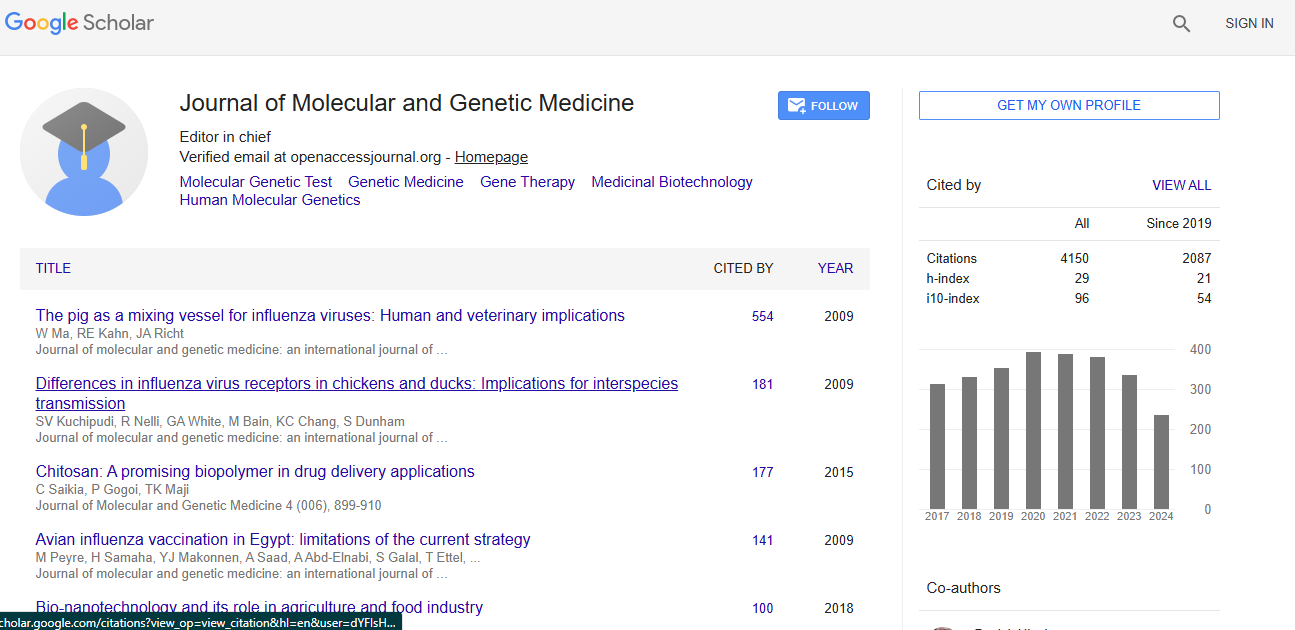
Molecular and Genetic Medicine received 3919 citations as per Google Scholar report