Commentary - (2025) Volume 17, Issue 2
Received: 01-Apr-2025, Manuscript No. jbabm-26-182322;
Editor assigned: 03-Apr-2025, Pre QC No. P-182322;
Reviewed: 17-Apr-2025, QC No. Q-182322;
Revised: 22-Apr-2025, Manuscript No. R-182322;
Published:
29-Apr-2025
, DOI: 10.37421/1948-593X.2025.17.480
Citation: Menon, Aishwarya. "Innovations Transforming Clinical Drug Monitoring." J Bioanal Biomed 17 (2025):480.
Copyright: © 2025 Menon A. This is an open-access article distributed under the terms of the Creative Commons Attribution License, which permits unrestricted use, distribution and reproduction in any medium, provided the original author and source are credited.
Recent advancements in bioanalytical techniques are profoundly reshaping the landscape of clinical drug monitoring (CDM), ushering in an era of enhanced precision and personalization in patient care. These innovations are critical for optimizing therapeutic outcomes and mitigating risks associated with drug therapy. The development of high-throughput liquid chromatography-mass spectrometry (LC-MS/MS) methods represents a significant leap forward, enabling more efficient and accurate quantification of drug levels in biological samples. This technology allows for the simultaneous analysis of multiple drugs and their metabolites, which is particularly vital for patients undergoing complex treatment regimens involving polypharmacy. Its widespread adoption in routine clinical laboratories is streamlining the drug monitoring process, leading to more rapid and informed therapeutic adjustments. The emergence of miniaturized point-of-care testing (POCT) devices, leveraging microfluidics and biosensors, is another transformative development, offering rapid, on-site analysis of drug concentrations. This capability is invaluable in critical care settings and for managing drugs with narrow therapeutic windows, where immediate clinical decision-making is paramount. The integration of artificial intelligence (AI) and machine learning (ML) into bioanalysis for drug monitoring holds immense potential to revolutionize personalized medicine. AI algorithms can analyze vast datasets to predict optimal dosing regimens, identify potential drug interactions, and flag patients at risk of toxicity, leading to truly data-driven therapeutic strategies. Matrix-assisted laser desorption/ionization time-of-flight mass spectrometry (MALDI-TOF MS) provides a rapid and sensitive method for both qualitative and quantitative drug analysis. Its ability to analyze intact molecules with minimal sample preparation makes it a valuable tool in drug screening and pharmacokinetic studies. Furthermore, antibody-based assays, such as enzyme-linked immunosorbent assays (ELISAs), continue to be a reliable and cost-effective cornerstone for therapeutic drug monitoring. Advances in antibody engineering have further improved their specificity and reduced cross-reactivity, ensuring their continued relevance in high-throughput settings. Capillary electrophoresis (CE), when coupled with various detection methods like mass spectrometry, offers exceptional separation efficiency and minimal sample consumption for drug analysis. CE is particularly adept at handling complex drug structures and chiral separations, providing a viable alternative to traditional chromatographic techniques. The utilization of dried blood spots (DBS) as a sample collection matrix is gaining traction due to its ease of collection, reduced volume requirements, and enhanced stability. Optimizing bioanalytical techniques for DBS analysis is making drug monitoring more accessible and patient-friendly, especially for vulnerable populations. Finally, nanotechnology-based biosensors are emerging as powerful tools for highly sensitive and selective drug detection. These sensors, employing nanoparticles, can significantly enhance signal transduction and lower detection limits, paving the way for precise molecular-level drug monitoring.
The field of clinical drug monitoring (CDM) is undergoing a significant transformation driven by rapid advancements in bioanalytical techniques, aimed at enhancing therapeutic efficacy and patient safety. High-throughput liquid chromatography-mass spectrometry (LC-MS/MS) methods have emerged as a cornerstone in this evolution, offering unparalleled sensitivity and selectivity for drug quantification in complex biological matrices. This technology facilitates the simultaneous analysis of multiple drugs and their metabolites, a critical requirement for effective monitoring in patients with polypharmacy, thereby streamlining therapeutic adjustments and improving patient care. Ultra-high-performance liquid chromatography-tandem mass spectrometry (UHPLC-MS/MS), a refined version of LC-MS/MS, further enhances these capabilities, allowing for more rapid and accurate drug measurements. Its application in routine clinical laboratories significantly streamlines the drug monitoring process, contributing to faster therapeutic decision-making and improved patient outcomes. Point-of-care testing (POCT) devices are also revolutionizing drug monitoring by enabling rapid, on-site analysis of drug concentrations. These devices, often integrating microfluidics and electrochemical biosensors, are particularly beneficial in critical care settings and for managing drugs with narrow therapeutic windows, allowing for immediate clinical intervention and optimized patient management. The integration of artificial intelligence (AI) and machine learning (ML) into bioanalysis represents a paradigm shift towards personalized medicine. AI algorithms can process extensive patient data, including drug levels and clinical profiles, to predict optimal dosing, identify potential drug interactions, and forecast toxicity risks, thereby enabling highly individualized therapeutic strategies. Matrix-assisted laser desorption/ionization time-of-flight mass spectrometry (MALDI-TOF MS) offers a rapid and sensitive approach for both qualitative and quantitative drug analysis in biological samples. Its minimal sample preparation requirements make it an efficient tool for drug screening and pharmacokinetic studies, particularly in toxicology and drug development. Enzyme-linked immunosorbent assays (ELISAs) continue to be a foundational technique in therapeutic drug monitoring, known for their cost-effectiveness and reliability, especially in high-throughput environments. Ongoing advancements in antibody engineering and assay design have led to improved specificity and reduced cross-reactivity, solidifying ELISAs as a valuable diagnostic tool. Capillary electrophoresis (CE), especially when coupled with mass spectrometry, provides high separation efficiency and requires minimal sample volume for drug analysis. CE is especially valuable for separating chiral drugs and monitoring compounds with intricate molecular structures, offering a distinct advantage over conventional chromatographic methods in specific applications. The use of dried blood spots (DBS) as a sample matrix for drug monitoring presents numerous advantages, including simplified collection, reduced sample volume, and enhanced sample stability. Developing advanced bioanalytical techniques suitable for DBS analysis promotes more accessible and patient-centric drug monitoring strategies, particularly for pediatric and remote patient populations. Lastly, nanotechnology-based biosensors are emerging as highly promising tools for sensitive and selective drug detection. By utilizing nanoparticles or nanomaterials, these sensors can amplify signals and lower detection limits, facilitating precise drug monitoring at the molecular level and advancing the precision of therapeutic interventions.
Clinical drug monitoring (CDM) is being transformed by innovative bioanalytical techniques. High-throughput LC-MS/MS and UHPLC-MS/MS offer enhanced sensitivity and selectivity for drug quantification, aiding in polypharmacy management. Point-of-care testing (POCT) devices with microfluidics and biosensors enable rapid, on-site analysis, crucial for critical care. Artificial intelligence (AI) and machine learning (ML) are driving personalized medicine by predicting optimal dosing and identifying risks. MALDI-TOF MS provides rapid drug analysis, while ELISAs remain cost-effective for high-throughput monitoring. Capillary electrophoresis (CE) excels in separating complex drug structures. Dried blood spots (DBS) simplify sample collection and enhance stability. Nanotechnology-based biosensors promise highly sensitive and selective drug detection at the molecular level.
None
None
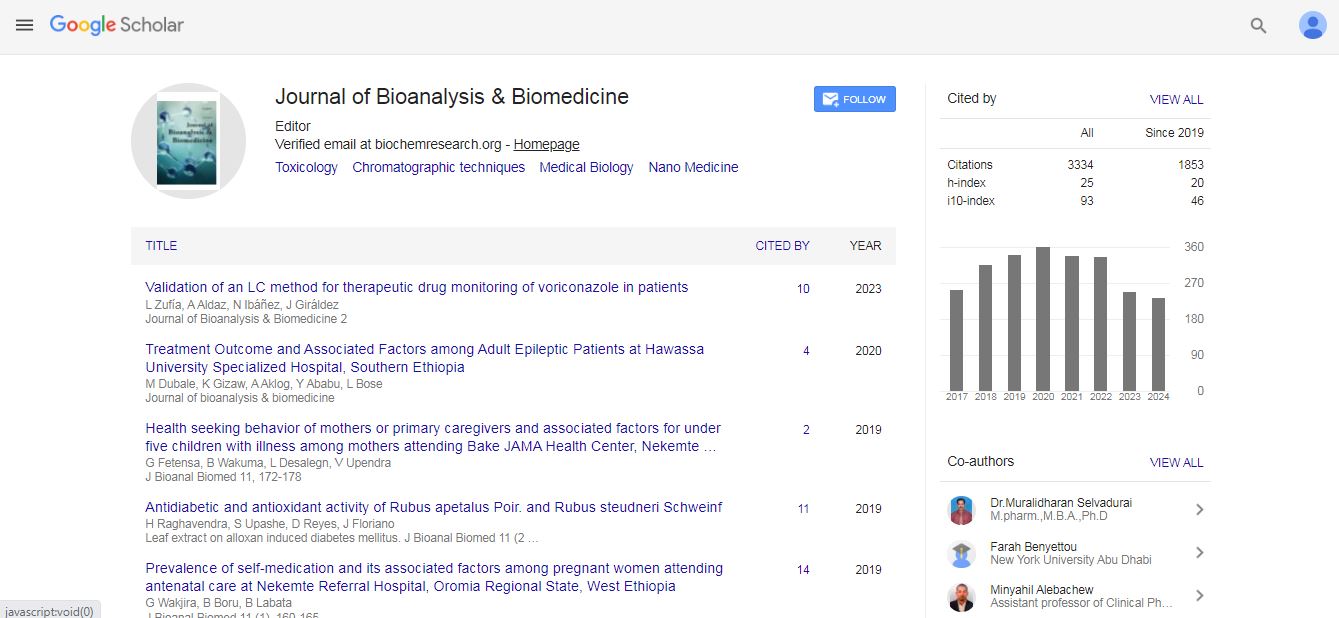
Journal of Bioanalysis & Biomedicine received 3099 citations as per Google Scholar report