Brief Report - (2025) Volume 14, Issue 6
Received: 01-Dec-2025, Manuscript No. jeom-26-188204;
Editor assigned: 03-Dec-2025, Pre QC No. P-188204;
Reviewed: 17-Dec-2025, QC No. Q-188204;
Revised: 22-Dec-2025, Manuscript No. R-188204;
Published:
29-Dec-2025
, DOI: 10.37421/2169-026X.2025.14.564
Citation: Dupont, Paul. ”Innovation: Fueling Competitive Advantage Through Transformation.” J Entrepren Organiz Manag 14 (2025):564.
Copyright: © 2025 Dupont P. This is an open-access article distributed under the terms of the Creative Commons Attribution License, which permits unrestricted use, distribution and reproduction in any medium, provided the original author and source are credited.
Organizational innovation is a pivotal driver for businesses aiming to establish and maintain a competitive advantage in today's dynamic marketplace. It encompasses the processes, strategies, and cultural elements that enable a company to introduce novel products, services, or operational improvements that differentiate it from rivals and provide sustained market leadership. [1] Firms that actively cultivate an environment where innovation thrives are significantly better equipped to identify and capitalize on emerging opportunities, while simultaneously building resilience against competitive pressures. This often necessitates strategic allocation of resources towards research and development activities and the deliberate nurturing of a culture that encourages creative thinking and the free flow of ideas. [2] The advent and widespread adoption of digital technologies have fundamentally reshaped the landscape of organizational innovation. By integrating new digital tools and platforms, businesses can achieve remarkable efficiencies in their operations, deliver superior customer experiences, and unlock entirely new avenues for revenue generation, thereby strengthening their competitive standing. [3] At the core of an organization's ability to innovate and adapt lies its dynamic capabilities. These refer to a firm's innate capacity to sense market shifts, seize emerging opportunities, and reconfigure its internal resources and structures in response, which are indispensable for navigating and succeeding in rapidly evolving industries. [4] An increasingly vital approach to innovation is open innovation, which leverages both internal and external knowledge and pathways to market. This collaborative model allows organizations to accelerate their innovation cycles and broaden the application of their innovations, making external engagement a powerful catalyst for competitive advantage. [5] Achieving a delicate balance between leveraging existing strengths and exploring new possibilities, known as organizational ambidexterity, is crucial for sustained success. This dual focus enables companies to maintain current performance levels while simultaneously positioning themselves for future growth and competitive advantage through ongoing innovation. [6] The alignment of innovation initiatives with the overarching strategic objectives of the business is of paramount importance. When innovation efforts are directly integrated with the organization's core goals, they become a more potent and sustainable engine for generating and maintaining a competitive edge. [7] Beyond product or process enhancements, innovation in business models offers a profound opportunity for companies to redefine how they create, deliver, and capture value. Such strategic shifts can lead to unique market positions and a durable competitive advantage. [8] The role of leadership in fostering a culture of innovation cannot be overstated. Leaders who actively champion experimentation, create safe spaces for learning from failures, and promote a continuous learning orientation are instrumental in cultivating an environment where groundbreaking innovations can emerge and flourish, leading to sustained competitive advantage. [9] Ultimately, the success of innovation endeavors can be quantitatively assessed through various performance metrics, including the success rates of new product introductions and the attainment of greater market share. A consistent track record of innovation directly translates into an organization's ability to build and sustain its competitive advantage, underscoring the importance of continuous improvement and novel approaches. [10]
The pursuit of a competitive edge in the modern business environment is inextricably linked to the concept of organizational innovation, which enables firms to adapt, evolve, and outmaneuver rivals through the development of novel offerings and improved operational efficiencies. This continuous process of adaptation and improvement is essential for long-term viability and market leadership. [1] Fostering a robust culture of innovation within an organization is paramount for its ability to proactively identify and exploit new market opportunities. This involves creating an environment that encourages experimentation, rewards creative thinking, and facilitates the open sharing of knowledge, all of which contribute to a firm's competitive resilience. [2] Digital transformation has emerged as a significant accelerator for organizational innovation, providing businesses with the tools and capabilities to streamline processes, enhance customer interactions, and discover new revenue streams. This technological integration is crucial for maintaining a competitive edge in an increasingly digital world. [3] Dynamic capabilities, encompassing the ability to sense changes, seize opportunities, and reconfigure resources, are fundamental to driving innovation. Organizations possessing strong dynamic capabilities are better positioned to adapt to market shifts and maintain a competitive advantage, particularly in volatile industries. [4] Open innovation, characterized by the collaborative use of internal and external ideas and market pathways, allows organizations to expedite their innovation processes and expand the reach of their innovations. This external engagement is a powerful strategy for enhancing competitive advantage. [5] Organizational ambidexterity, the capability to simultaneously manage existing operations and explore new ventures, is critical for achieving both short-term performance and long-term competitive advantage. This dual focus on exploitation and exploration fuels innovation and sustained success. [6] The strategic alignment of innovation efforts with an organization's overall business strategy is a key determinant of its effectiveness. When innovation is integrated into the core strategic framework, it becomes a more potent and sustainable driver of competitive advantage, ensuring that efforts are focused and impactful. [7] Business model innovation offers a distinct yet equally powerful pathway to competitive advantage. By re-imagining how value is created, delivered, and captured, companies can establish unique market positions and achieve sustained differentiation. [8] Effective leadership plays a crucial role in championing innovation. Leaders who foster an environment that encourages experimentation, tolerates calculated risks, and promotes a learning mindset are instrumental in driving breakthrough innovations and securing a lasting competitive advantage. [9] Innovation performance, when measured by key indicators such as new product success rates and market share growth, directly correlates with an organization's ability to build and sustain its competitive advantage. Continuous innovation is thus a vital component of competitive strategy. [10]
Organizational innovation is critical for gaining and maintaining a competitive edge by enabling adaptation to market changes, developing new offerings, and improving processes. Fostering an innovative culture encourages experimentation and knowledge sharing, leading to better exploitation of opportunities. Digital transformation is a key catalyst, streamlining operations and uncovering new revenue streams. Dynamic capabilities, such as sensing and seizing opportunities, are vital for navigating evolving industries. Open innovation, utilizing external and internal ideas, accelerates innovation and market reach. Organizational ambidexterity, balancing exploitation and exploration, drives both current performance and future advantage. Strategic alignment of innovation with business goals is paramount. Business model innovation can create unique value propositions. Leadership is crucial in championing innovation by promoting experimentation and learning. Ultimately, strong innovation performance, measured by metrics like new product success, directly correlates with sustained competitive advantage.
None
None
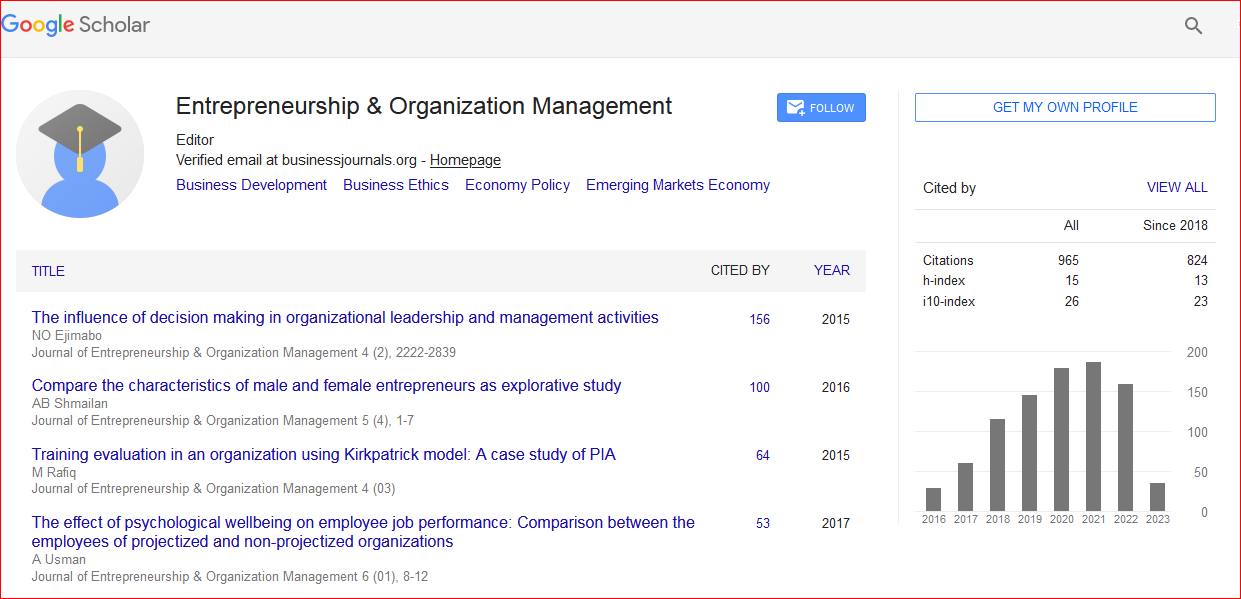
Entrepreneurship & Organization Management received 1115 citations as per Google Scholar report