Opinion - (2025) Volume 14, Issue 6
Received: 01-Dec-2025, Manuscript No. jeom-26-188203;
Editor assigned: 03-Dec-2025, Pre QC No. P-188203;
Reviewed: 17-Dec-2025, QC No. Q-188203;
Revised: 22-Dec-2025, Manuscript No. R-188203;
Published:
29-Dec-2025
, DOI: 10.37421/2169-026X.2025.14.563
Citation: Dupont, Paul. ”Innovation: Driving Competitive Advantage Through Culture and Strategy.” J Entrepren Organiz Manag 14 (2025):563.
Copyright: © 2025 Dupont P. This is an open-access article distributed under the terms of the Creative Commons Attribution License, which permits unrestricted use, distribution and reproduction in any medium, provided the original author and source are credited.
Organizational innovation stands as a significant driver for achieving a competitive edge in today's dynamic business landscape [1].
It empowers organizations to pioneer new products, services, and operational procedures, thereby setting them apart from their rivals and paving the way for sustained market leadership and superior financial outcomes. This necessitates the cultivation of an internal environment that champions creativity, welcomes change, and commits resources to research and development initiatives. The intricate relationship between an organization's structural design and its capacity for innovation is a subject of paramount importance. Structures that are characterized by flexibility and adaptability, frequently observed in entrepreneurial firms, are more conducive to the successful adoption and deployment of innovative ideas. This, in turn, serves to reinforce a company's competitive standing within its market segment [2].
True innovation transcends the mere generation of novel concepts; it critically hinges on the efficacy of their implementation. Enterprises that excel at transforming innovative ideas into tangible value are well-positioned to reap substantial competitive advantages. Achieving this level of success typically demands robust leadership and a precisely articulated strategic direction [3].
In the contemporary business era, digitalization plays an indispensable role in fostering organizational innovation. The strategic integration of digital technologies opens avenues for novel business models and enhances operational efficiencies. This strategic adoption of digital tools significantly bolsters a firm's competitive position in the marketplace [4].
A firm's absorptive capacity, defined as its inherent ability to identify, internalize, and effectively leverage new external knowledge, is fundamental. This capacity is crucial for driving continuous organizational innovation and, consequently, for maintaining a sustainable competitive advantage in the long term [5].
Open innovation, which involves the judicious utilization of external ideas and pathways to market, can substantially amplify a company's innovative endeavors. This approach not only broadens the spectrum of potential innovations but also accelerates their development cycles, leading to enhanced competitive positioning [6].
Organizational learning is deeply intertwined with the process of innovation. An organization's proficiency in learning, adapting to new circumstances, and evolving its practices is what enables it to consistently develop novel solutions. This capacity for continuous learning is essential for retaining a competitive edge [7].
An organization's chosen innovation strategy is a pivotal determinant of its ability to harness innovation for competitive advantage. A meticulously crafted strategy ensures that innovation efforts are closely aligned with overarching business objectives, maximizing their impact and effectiveness [8].
Human capital, encompassing the collective skills, creativity, and ingenuity of employees, forms the bedrock of organizational innovation. It is a primary catalyst for achieving competitive advantage, underscoring the importance of investing in employee development and nurturing an innovative ethos throughout the workforce [9].
Organizational culture exerts a profound influence on an organization's propensity to innovate. A culture that actively embraces experimentation, allows for the tolerance of calculated risks and failures, and promotes collaborative endeavors creates an optimal environment for developing and implementing innovations that confer a distinct competitive advantage [10].
Organizational innovation serves as a potent catalyst for achieving a distinct competitive advantage, enabling businesses to forge ahead by developing novel products, services, and processes that differentiate them in the market. This differentiation ultimately leads to superior performance and enduring success. The cultivation of a culture that fosters creativity, embraces change, and prioritizes investment in research and development is paramount to this process [1].
Understanding the dynamic interplay between organizational structure and innovation is critical for firms seeking to thrive. Flexible and adaptive organizational frameworks, commonly found in more entrepreneurial settings, are particularly adept at facilitating the adoption and successful implementation of innovative initiatives. This structural agility directly contributes to a strengthened competitive positioning [2].
The essence of innovation lies not solely in the conception of new ideas but, more crucially, in their effective translation into tangible outcomes. Companies that demonstrate proficiency in converting innovative concepts into measurable value are positioned to capture significant competitive advantages. This requires decisive leadership and a clearly defined strategic vision [3].
Digitalization has emerged as a cornerstone of contemporary organizational innovation, fundamentally reshaping how businesses operate and compete. By embracing digital technologies, organizations can unlock new business models and achieve substantial improvements in operational efficiency, thereby significantly enhancing their competitive edge [4].
A core capability for any organization aiming for sustained innovation and competitive advantage is its absorptive capacity. This refers to an organization's ability to effectively identify, assimilate, and capitalize on new knowledge acquired from external sources, forming a basis for continuous innovation [5].
The strategic adoption of open innovation, characterized by the proactive use of external ideas and distribution channels, can markedly improve a company's innovation capacity. This approach broadens the horizons of innovation and accelerates the pace at which new ideas are brought to fruition, contributing to a stronger competitive stance [6].
Organizational learning is inextricably linked to the capacity for innovation. The continuous ability of an organization to learn from its experiences, adapt to evolving market demands, and refine its processes is what empowers it to consistently generate groundbreaking solutions and maintain its competitive advantage [7].
The formulation and execution of a well-defined innovation strategy are critical determinants of an organization's success in leveraging innovation for competitive gain. Such a strategy ensures that innovation efforts are purposefully aligned with broader business objectives, thereby maximizing their strategic impact [8].
Human capital, represented by the diverse skills, creativity, and innovative potential of employees, is a foundational element for organizational innovation and a primary driver of competitive advantage. Strategic investments in employee development and the promotion of an innovative mindset are therefore essential [9].
Organizational culture plays a pivotal role in shaping an organization's innovation orientation. A culture that encourages experimentation, provides a safe space for learning from failures, and fosters robust collaboration creates the ideal conditions for developing and implementing innovations that confer a lasting competitive advantage [10].
Organizational innovation is a key driver of competitive advantage, enabling companies to differentiate themselves through new products, services, and processes. This requires a culture that supports creativity and R&D. Flexible organizational structures facilitate innovation adoption, strengthening competitive positioning. Effective implementation of innovative ideas is crucial for capturing value and requires strong leadership and strategic focus. Digitalization plays a pivotal role by enabling new business models and operational efficiencies. Absorptive capacity, the ability to utilize external knowledge, is fundamental for continuous innovation. Open innovation, leveraging external ideas, can accelerate development and bolster competitive advantage. Organizational learning is intrinsically linked to innovation, allowing for adaptation and the generation of novel solutions. A clear innovation strategy aligns efforts with business goals for maximum impact. Human capital, through employee skills and creativity, is a cornerstone of innovation and a competitive advantage. Finally, organizational culture, by encouraging experimentation and collaboration, fosters an environment conducive to innovation and competitive advantage.
None
None
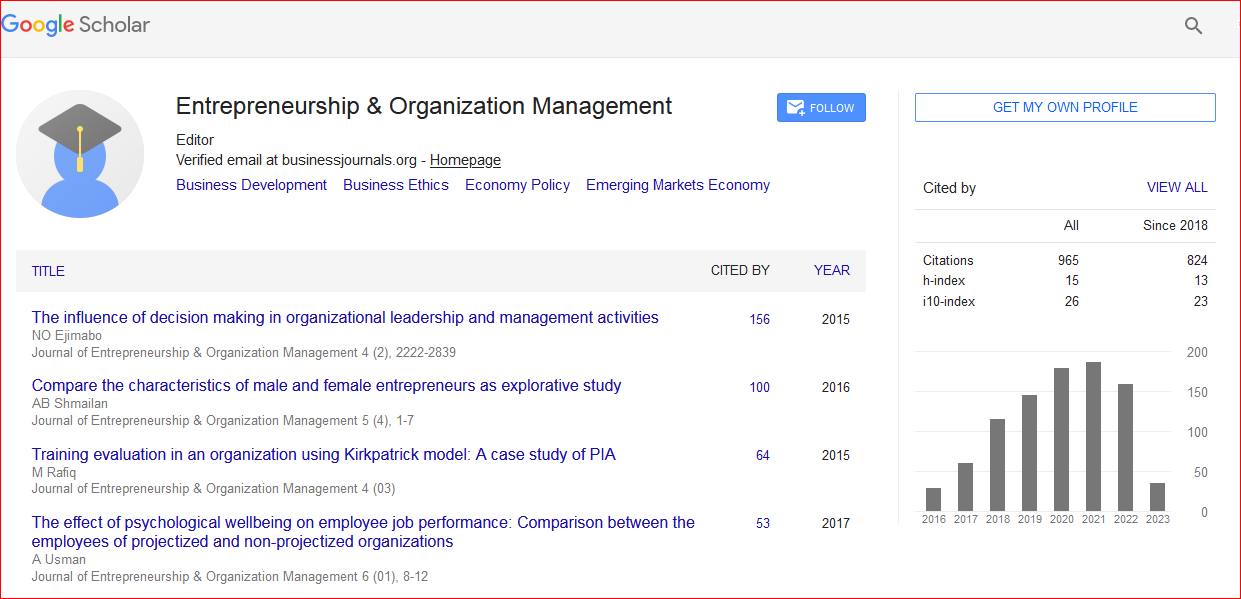
Entrepreneurship & Organization Management received 1115 citations as per Google Scholar report