Opinion - (2025) Volume 15, Issue 4
Received: 31-Jul-2025, Manuscript No. jmcj-25-176903;
Editor assigned: 04-Aug-2025, Pre QC No. P-176903;
Reviewed: 18-Aug-2025, QC No. Q-176903;
Revised: 21-Aug-2025, Manuscript No. R-176903;
Published:
28-Aug-2025
, DOI: 10.37421/2165-7912.2025.15.635
Citation: Krämer, Sophia L.. ”Information, Trust, and Polarization in Digital Politics.” J Mass Communicat Journalism 15(2025):635.
Copyright: © 2025 Krämer L. Sophia This is an open-access article distributed under the terms of the Creative Commons Attribution License, which permits unrestricted use,
distribution and reproduction in any medium, provided the original author and source are credited.
The contemporary political landscape is profoundly influenced by the dynamics of communication, information environments, and evolving media technologies. Understanding the factors that shape political trust and contribute to polarization has become paramount. One significant area of inquiry focuses on how ideological alignment and the nature of an individual's information environment—whether characterized by diverse media exposure or echo chambers—critically influence levels of political trust [1].
This suggests that both personal leanings and media consumption structures are central to citizens' confidence in political institutions and processes. Further complicating the issue of trust is the pervasive challenge of political misinformation. Research indicates that attempts to correct misinformation can paradoxically backfire, particularly when such corrections challenge an individual's group identity [2].
This highlights that debunking efforts are not merely about factual accuracy but are deeply interwoven with social identity and tribal loyalties, posing a substantial hurdle to effective counter-disinformation strategies. The role of digital platforms in shaping the public sphere and, consequently, political dynamics cannot be overstated. The emergence of these platforms as a 'public square' raises questions about their contribution to increasing political polarization observed across many democracies [3].
Investigations into online communication mechanisms, such as echo chambers and selective exposure, seek to understand how partisan divides are amplified in digital spaces. Looking ahead, the landscape of political communication is poised for further transformation with the advent of Generative Artificial Intelligence (AI). This emerging technology presents a duality of potential benefits, like personalized messaging and content creation, alongside significant challenges, including the rapid proliferation of disinformation and complex ethical concerns [4].
Critical analysis is vital to grasp AI's evolving role in shaping political discourse. In examining different media consumption patterns, studies reveal how reliance on social media versus traditional news outlets impacts political trust [5].
While traditional media use often correlates with fostering trust, heavy engagement with social media can yield varied and at times detrimental effects on citizens' confidence in political systems. This underscores the divergent impacts of different media types on public sentiment. Beyond factual information and trust, emotions play a potent role in political engagement. Research explores how various emotional expressions in political communication on social media can influence user engagement and mobilization [6].
It suggests that certain emotions are more effective in driving political participation, emphasizing the strategic deployment of affect in digital campaigns. This emotional dimension is also evident in populist communication strategies. Analyses show how such strategies contribute to affective polarization, often by appealing to emotions and constructing 'us vs. them' narratives [7].
This rhetoric exacerbates divisions, fostering greater animosity between opposing political groups, as exemplified by specific electoral contexts. The efficacy of corrective measures, like political fact-checking, on media trust is another critical area of study. Experimental research indicates that while fact-checking can indeed correct misperceptions, its overall impact on building or eroding trust in the media is contingent on various factors, including the audience's prior beliefs and the credibility of the fact-checking source [8].
This complex interaction suggests that simple fact presentation may not always translate into increased trust. Furthermore, the concept of digital citizenship has gained prominence in an era marked by widespread misinformation and declining trust [9].
This area of inquiry investigates how citizens navigate digital spaces for political participation, identifying factors that either enhance or hinder their informed engagement and civic responsibility online. The ability to engage critically and responsibly in digital environments is crucial for democratic health. Finally, cross-national analyses shed light on how news media consumption patterns influence political polarization [10].
These studies provide empirical evidence on whether exposure to specific types of media content, or media usage in general, contributes to the increasing partisan divides, thereby offering valuable insights into the media's role in societal fragmentation.
The intricate interplay between political trust, media environments, and citizen engagement forms a central theme across contemporary communication research. Several studies highlight how an individual's ideological alignment and the characteristics of their information environment—ranging from exposure to diverse perspectives to being entrenched in echo chambers—significantly shape their confidence in political institutions and processes [1]. This foundational understanding is crucial for grasping the broader dynamics of civic participation and democratic stability. Moreover, the very act of correcting political misinformation, while seemingly straightforward, presents unique challenges. Research demonstrates that such corrections can inadvertently decrease political trust, especially when the information challenges a person's deeply held group identity [2]. This suggests that effective debunking strategies must navigate not just factual inaccuracies but also the complex layers of social identity and tribal loyalties that underpin political beliefs.
The digital revolution has fundamentally reshaped the public sphere, creating new arenas for political discourse but also exacerbating existing tensions. The rise of digital platforms, often viewed as modern 'public squares,' is critically examined for its role in amplifying political polarization [3]. Mechanisms such as selective exposure and the formation of echo chambers online are frequently cited as drivers of increasing partisan divides. This digital fragmentation is further compounded by new technological advancements, notably Generative Artificial Intelligence (AI). The emerging impact of AI on political communication is a dual-edged sword, offering potential benefits like hyper-personalized messaging while simultaneously posing significant risks through the rapid spread of disinformation and complex ethical dilemmas [4]. A careful analysis of AI's integration into political discourse is therefore essential to anticipate and mitigate its societal effects.
Media consumption patterns exhibit a direct influence on political trust. Studies reveal a nuanced relationship, where reliance on traditional news outlets can foster higher levels of trust, contrasting with social media, which can have varied and sometimes detrimental effects on citizens' confidence in political systems [5]. This differentiation suggests that the source and nature of information consumed are as important as the information itself, highlighting a critical distinction in media effects.
Beyond factual content, the emotional dimension of political communication plays a critical role in online spaces. Research explores how specific emotional expressions within social media political content can effectively influence user engagement and mobilize political participation [6]. This underscores the strategic importance of affect in digital campaigns and its capacity to galvanize action. Similarly, populist communication strategies, which often leverage strong emotional appeals and construct clear 'us vs. them' narratives, are shown to actively contribute to affective polarization [7]. Such rhetoric deepens divisions and fuels animosity between opposing political groups, thereby fragmenting the societal fabric and posing a significant challenge to social cohesion.
The effectiveness of measures designed to counteract misinformation and build trust is also a key area of investigation. Political fact-checking, for instance, can correct misperceptions, but its ability to build or erode overall media trust is contingent on factors like the audience's prior beliefs and the credibility of the fact-check source [8]. This complex interaction implies that trust is not simply restored by factual corrections alone, but rather depends on a broader context of audience receptivity and source credibility. In this context of pervasive misinformation and declining trust, the concept of digital citizenship gains significant relevance. Scholars examine how citizens navigate digital environments for political engagement, exploring factors that either enhance or hinder their informed participation and civic responsibility online [9]. Fostering robust digital citizenship is seen as vital for maintaining a healthy, participatory democracy in the digital age.
Finally, comprehensive cross-national studies provide empirical evidence on how various news media consumption patterns contribute to political polarization [10]. These analyses offer critical insights into the media's overarching role in shaping societal fragmentation and the widening chasm of partisan divides. Together, these studies illuminate the multifaceted challenges and opportunities facing political communication in the digital age, underscoring the necessity for continued research and thoughtful public discourse on these critical issues.
This collection of studies examines the intricate landscape of political communication, trust, and polarization in contemporary democracies. Research highlights how ideological alignment and the structure of an individual's information environment, encompassing diverse or echo-chambered media, fundamentally shape political trust. The challenge of misinformation is also a recurring theme, with findings suggesting that attempts to correct false information can backfire, especially when it threatens group identity, leading to decreased trust. Furthermore, media consumption patterns—from reliance on social media to traditional news outlets—are shown to critically influence levels of political trust; while traditional media can foster trust, social media's impact can be varied and sometimes detrimental. The studies also delve into the pervasive issue of political polarization. The rise of digital platforms as a new public square is explored, investigating how online communication can amplify partisan divides through mechanisms like echo chambers and selective exposure. Populist communication strategies, often characterized by emotional appeals and 'us vs. them' narratives, are identified as significant contributors to affective polarization. News media consumption patterns similarly play a role, with exposure to certain content types contributing to increased partisan divides. The evolving digital landscape introduces new factors, such as the emerging impact of Generative Artificial Intelligence (AI) on political communication, presenting both opportunities for personalized messaging and challenges like the rapid proliferation of disinformation. Other research explores the strategic use of emotional expressions in social media to mobilize political engagement and examines how political fact-checking influences media trust within partisan contexts. Altogether, these papers paint a comprehensive picture of how information environments, media technologies, and communicative strategies interact to shape citizens' confidence in political systems, their engagement, and the fragmentation of the political landscape.
None
None
Marc SS, Joseph BJ, Daniel JS. "The Role of Ideology and Information Environments in Political Trust".Pol Commun 40 (2023):367-390.
Indexed at, Google Scholar, Crossref
Erik N, Jessica MF, Sara KJS. "Correction as an Identity Threat: The Effect of Group Membership and Misinformation on Political Trust".Pol Commun 39 (2022):509-529.
Indexed at, Google Scholar, Crossref
Yphtach L, Joshua AT, Nicole EDA. "The Digital Public Square and the Problem of Political Polarization".J Commun 71 (2021):799-823.
Indexed at, Google Scholar, Crossref
Philip NH, Samantha B, Alex HL. "Generative AI and the Future of Political Communication: Opportunities and Challenges".Int J Press Polit OnlineFirst (2024):N/A.
Indexed at, Google Scholar, Crossref
Hajo GB, André CS, Gijs HJD. "Political Trust and the Information Environment: The Role of Social Media and Traditional Media Use".Pol Commun 37 (2020):457-478.
Indexed at, Google Scholar, Crossref
Lena F, Svenja B, Laura BKD. "Emotional Expression and the Mobilization of Political Engagement on Social Media".Commun Res 48 (2021):1121-1147.
Indexed at, Google Scholar, Crossref
Thiago JdS, Letícia P, Mariana M. "Populist communication and affective polarization: The case of the 2018 Brazilian election".Pol Commun 39 (2022):569-588.
Indexed at, Google Scholar, Crossref
Jonathan B, Richard F, Rasmus KN. "Political Fact-Checking and Trust in the Media: An Experimental Study".J Comput-Mediated Commun 25 (2020):117-133.
Indexed at, Google Scholar, Crossref
Jessica TF, Chris W, Deen F. "Digital Citizenship and Political Engagement in the Post-Truth Era".Pol Commun 39 (2022):641-660.
Indexed at, Google Scholar, Crossref
Natalie JS, Joshua DK, Ethan P. "News Media Effects on Political Polarization: A Cross-National Analysis".Am J Polit Sci 64 (2020):631-648.
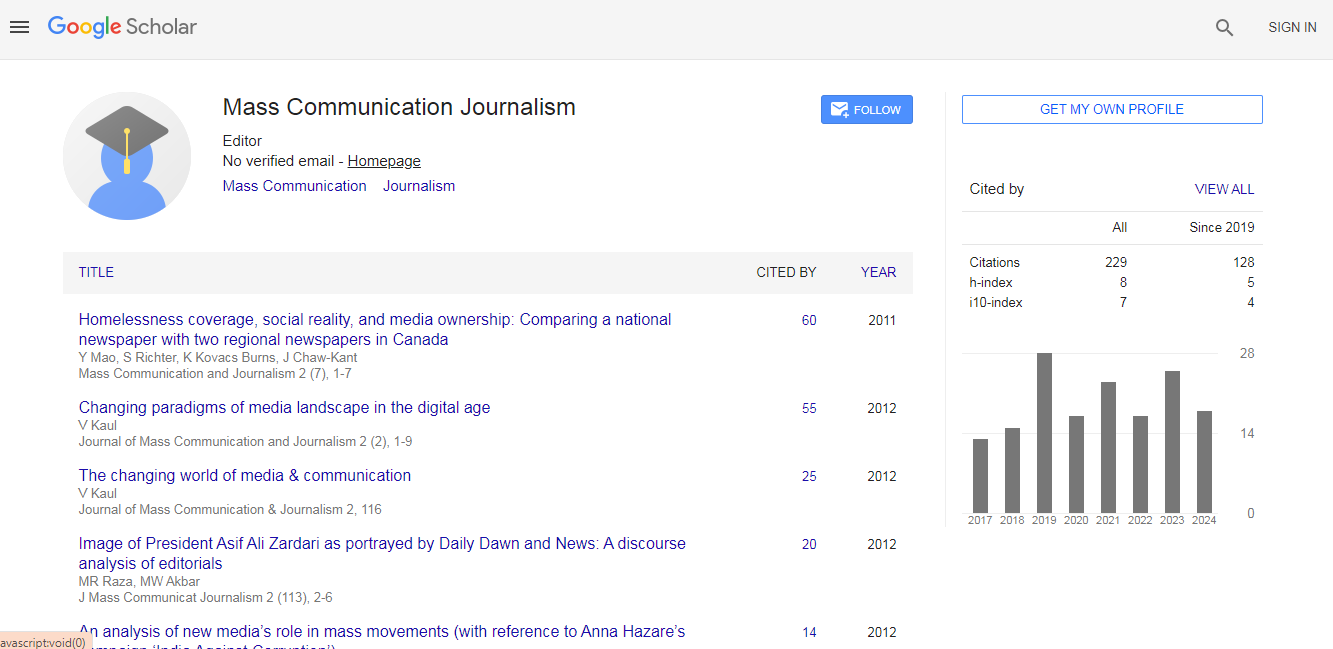
Journal of Mass Communication & Journalism received 205 citations as per Google Scholar report