Opinion - (2025) Volume 14, Issue 5
Received: 01-Oct-2025, Manuscript No. jbfa-25-176828;
Editor assigned: 03-Oct-2025, Pre QC No. P-176828;
Reviewed: 17-Oct-2025, QC No. Q-176828;
Revised: 22-Oct-2025, Manuscript No. R-176828;
Published:
29-Oct-2025
, DOI: 10.37421/2161-0673.2025.14.553
Citation: Sorensen, Amelia. ”Inflation: Drivers, Expectations, Policy, and Stability.” J Bus Fin Aff 14 (2025):553.
Copyright: © 2025 Sorensen A. This is an open-access article distributed under the terms of the Creative Commons Attribution License, which permits unrestricted use, distribution and reproduction in any medium, provided the original author and source are credited.
The dynamics of inflation remain a paramount concern for economists, policymakers, and global citizens alike. Recent academic inquiries have delved into a multifaceted understanding of what drives price changes, how expectations are formed and measured, the impact of various shocks, and the evolving role of policy instruments. This collection of research offers comprehensive insights into the complexities of inflation in contemporary economies. Central to understanding price stability is the profound influence of inflation expectations on actual inflation. This research emphasizes that people's beliefs about future prices are not merely passive reflections but active determinants, becoming even more significant when the predictability of monetary policy wanes. Essentially, accurately gauging public and market expectations is fundamental for charting the future course of inflation and informing proactive policy decisions[1].
A recent surge in global inflation has necessitated a thorough investigation into its root causes. This study meticulously disentangles the contributions of supply-side problems from stronger demand pressures, providing critical clarity for policymakers. Knowing this distinction is indispensable for deploying appropriate remedies, whether those involve alleviating production bottlenecks, enhancing supply chain resilience, or skillfully managing aggregate spending within an economy[2].
External shocks, particularly sudden increases in oil prices, have a demonstrably significant ripple effect on inflation, especially within the delicate economic structures of developing economies. This analysis underscores that comprehending the transmission mechanisms of these energy shocks is paramount for nations striving to stabilize their domestic price levels and safeguard their hard-won economic growth from external volatility[3].
The interplay between government spending and taxation, known as fiscal policy, and its relationship with inflation in the Euro Area is a continually evolving subject. Utilizing a dynamic model, this investigation reveals that this connection changes over time, offering new and vital perspectives on how carefully crafted fiscal decisions can be leveraged to effectively influence and maintain price stability across the region[4].
Measuring inflation expectations accurately is a critical endeavor, leading to comparative analyses of different methodologies. This work contrasts survey data, which directly queries public sentiment, with information gleaned from financial markets, which embed investor expectations. Such comparisons are essential because how these expectations are measured profoundly affects our understanding of actual price behavior and, consequently, the efficacy of monetary policy interventions[5].
A broader, global perspective reveals the diverse yet interconnected factors driving inflation across various countries. This research identifies both pervasive common factors that affect many nations and distinct regional differences, offering a comprehensive and nuanced understanding of the intricate forces contributing to rising prices worldwide. This holistic view is crucial for coordinated international policy responses[6].
The character of the recent inflation spike prompts a fundamental question: is it a transient anomaly or a signal of a more enduring shift in inflation dynamics? Employing a time-varying parameter model, this study equips economists and policymakers with tools to determine if the economy has entered a fundamentally new inflation environment, thereby demanding potentially different and innovative policy responses[7].
Uncertainty surrounding future inflation profoundly impacts global economic growth. This research illuminates how unpredictable price changes can act as a significant deterrent to investment and consumption decisions across economies. It thereby strongly emphasizes the intrinsic importance of achieving and maintaining price stability as a cornerstone for fostering robust and sustainable economic development globally[8].
The advent of Central Bank Digital Currencies (CBDCs) introduces new considerations for monetary policy and inflation. This paper meticulously examines the potential effects of these novel forms of money on the transmission mechanisms of monetary policy and their ultimate influence on price levels. It provides invaluable insights that are particularly relevant for central bankers worldwide who are contemplating the design and implementation of CBDCs[9].
Forecasting inflation with greater precision is a continuous challenge for economic institutions. This study introduces advanced models that leverage mixed-frequency data, combining various types of data available at different temporal granularities. By integrating these diverse data streams, these factor models demonstrate enhanced accuracy in inflation predictions, proving indispensable for central banks and businesses in their strategic economic planning[10].
Collectively, these studies highlight the critical, multi-faceted nature of inflation, underscoring that effective management requires a deep understanding of expectations, supply and demand dynamics, external shocks, fiscal responses, new financial instruments, and sophisticated forecasting techniques. The interplay of these elements paints a complex yet crucial picture for navigating global economic stability.
The role of inflation expectations stands out as a primary driver of actual inflation dynamics. Research confirms that people's beliefs about future prices significantly influence the current economic landscape, with their impact amplified when monetary policy signals are unclear [1]. Consequently, understanding these expectations is paramount for accurately predicting inflation trends. Moreover, the methods used to gauge these expectations are equally important. Comparing survey data, which captures public sentiment, with financial market data, which reflects investor outlooks, is crucial for grasping how these expectations shape actual price behavior and the overall effectiveness of monetary policy [5].
Recent studies have meticulously dissected the drivers behind global inflation surges. It's vital for policymakers to differentiate between supply-side constraints, such as production bottlenecks, and robust demand-side pressures to apply appropriate economic remedies [2]. Beyond internal market forces, external factors also play a critical role. For instance, sudden spikes in oil prices create significant inflationary ripples, particularly challenging for developing economies striving to maintain price stability and protect economic growth [3]. Additionally, government fiscal policy, through spending and taxation, has a dynamic and time-varying relationship with inflation, especially evident in the Euro Area. Recognizing this shifting connection offers fresh insights into how fiscal decisions can support or destabilize price levels [4].
Taking a global perspective, research identifies both common and regionally specific factors contributing to inflation across diverse countries. This comprehensive view illuminates the complex, worldwide forces driving price increases [6]. A key question explored is whether the current inflation surge represents a temporary deviation or a more fundamental, enduring shift in how inflation behaves. Employing sophisticated time-varying parameter models helps economists and policymakers determine if a new inflationary environment is emerging, one that might necessitate novel policy responses [7].
Beyond its immediate impact on purchasing power, inflation uncertainty also profoundly affects global economic growth. Unpredictable price changes are shown to deter investment and consumer spending, emphasizing the indispensable role of price stability for fostering sustainable economic development [8]. Furthermore, the emergence of Central Bank Digital Currencies (CBDCs) introduces new considerations for monetary policy. Research examines how these digital forms of money could alter monetary policy transmission mechanisms and influence overall price levels, offering essential insights for central banks globally as they consider implementation [9].
Finally, improving the accuracy of inflation predictions remains a critical objective for economic stability. Advanced factor models, which integrate mixed-frequency dataâ??combining various data types available at different time intervalsâ??demonstrate superior forecasting capabilities. These enhanced prediction tools are indispensable for central banks and businesses in formulating robust economic strategies and navigating future challenges [10]. Collectively, these findings reinforce that a holistic understanding of inflationâ??s causes, measurements, impacts, and future trends is essential for effective macroeconomic management.
Understanding inflation is central to economic stability, as evidenced by a range of recent research. One key area of focus involves how people's expectations about future prices actively shape actual inflation dynamics, with a notable increase in influence when monetary policy becomes less predictable. This implies that gauging public belief is crucial for predicting inflation's trajectory. Recent global inflation surges have prompted economists to dissect their origins, distinguishing between supply-side constraints and demand-side pressures. This distinction is vital for policymakers to implement effective solutions, whether addressing production bottlenecks or managing overall spending. Furthermore, specific external shocks, such as sudden spikes in oil prices, are shown to significantly impact inflation, particularly within developing economies. A clear understanding of these energy shocks helps countries maintain price stability and foster economic growth. Fiscal policy, encompassing government spending and taxation, also plays a changing role in inflation, particularly in regions like the Euro Area. Its dynamic relationship with price stability requires fresh perspectives. Moreover, accurately measuring inflation expectations is critical; comparing survey data with financial market indicators helps clarify how these expectations drive actual prices and influence the effectiveness of monetary policy. Beyond these factors, the global inflation landscape is driven by a complex interplay of common and regional factors. Researchers are also examining if the current inflation surge represents a temporary anomaly or a deeper shift, employing time-varying parameter models to guide policy responses. The link between inflation uncertainty and global economic growth is also explored, highlighting how unpredictable prices can deter investment and consumption, underscoring the need for stability. Innovations like Central Bank Digital Currencies (CBDCs) are being analyzed for their potential effects on inflation and monetary policy transmission. Finally, advanced forecasting models, leveraging mixed-frequency data, are proving essential for more accurate inflation predictions, providing central banks and businesses with better tools for strategic economic planning.
None
None
Indexed at, Google Scholar, Crossref
Indexed at, Google Scholar, Crossref
Indexed at, Google Scholar, Crossref
Indexed at, Google Scholar, Crossref
Indexed at, Google Scholar, Crossref
Indexed at, Google Scholar, Crossref
Indexed at, Google Scholar, Crossref
Indexed at, Google Scholar, Crossref
Indexed at, Google Scholar, Crossref
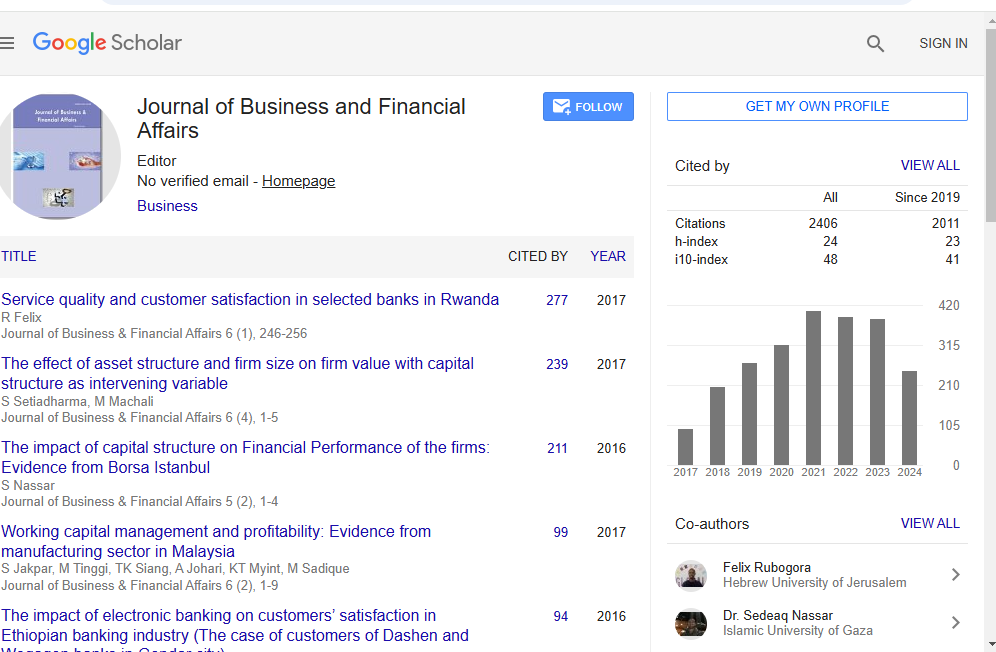
Journal of Business & Financial Affairs received 1726 citations as per Google Scholar report