Brief Report - (2025) Volume 16, Issue 2
Received: 01-Apr-2025, Manuscript No. .jmbd-26-179365;
Editor assigned: 03-Apr-2025, Pre QC No. P-179365;
Reviewed: 14-Apr-2025, QC No. Q-179365;
Revised: 22-Apr-2025, Manuscript No. R-179365;
Published:
29-Apr-2025
, DOI: 10.37421/2155-9929.2025.16.690
Citation: Nguyen, Clara. ”Biomarkers Revolutionize Disease Diagnosis: A Multi-Omics Future.” J Mol Biomark Diagn 16 (2025): 690.
Copyright: © 2025 Nguyen C. This is an open-access article distributed under the terms of the Creative Commons Attribution License, which permits unrestricted use, distribution and reproduction in any medium, provided the original author and source are credited.
Molecular biomarkers are fundamentally reshaping the landscape of disease diagnosis, offering objective, sensitive, and highly specific indicators crucial for early detection, accurate prognosis, and effective monitoring of treatment response [1].
Current research trends are increasingly emphasizing the strategic integration of multi-omics data, recognizing its power to provide a holistic view of biological systems and disease states. Among these advanced approaches, circulating nucleic acids such as cell-free DNA (ctDNA) and microRNAs (miRNAs), along with extracellular vesicles like exosomes, are gaining significant traction for their potential in non-invasive diagnostic applications [1].
The ability to obtain diagnostic information from readily accessible biofluids represents a major leap forward in patient care and disease management. Substantial advancements in high-throughput technologies, coupled with sophisticated bioinformatics tools, are considerably accelerating the pace of biomarker discovery and validation [1].
This synergistic progress is vital for translating novel findings from the laboratory into clinically actionable insights. The implications of these developments are profound, paving the way for the broader implementation of personalized medicine, where treatments are tailored to the individual's unique biological profile [1].
This paradigm shift promises to enhance therapeutic efficacy and minimize adverse effects. Future directions in this dynamic field are focused on the development of more sophisticated predictive and prognostic biomarkers, particularly for complex and challenging diseases [1].
These biomarkers will be instrumental in anticipating disease trajectory and guiding therapeutic decisions. Furthermore, the integration of artificial intelligence (AI) and machine learning (ML) algorithms is poised to revolutionize the analysis of complex biological datasets [1].
AI/ML's capacity to identify subtle patterns and correlations will be essential for unlocking the full potential of biomarker data. Equally important is the establishment of standardized protocols for biomarker validation and clinical translation [1].
Such standardization is paramount for ensuring the reliability, reproducibility, and widespread adoption of new diagnostic tools. The evolution of cancer diagnostics is being dramatically impacted by the emergence of liquid biopsies, a testament to the power of non-invasive biomarker approaches [2].
These techniques are transforming how we detect, monitor, and manage cancer. Exosomes, as small yet potent carriers of biological information, are rapidly emerging as valuable diagnostic and prognostic tools [3].
Their ability to encapsulate and deliver a diverse range of biomolecules makes them highly informative for disease assessment. MicroRNAs, due to their critical roles in gene regulation and their remarkable stability in biofluids, are increasingly recognized as ideal candidates for non-invasive diagnostic applications across a spectrum of diseases [4].
Their specific expression patterns offer a unique window into cellular states.
Molecular biomarkers are revolutionizing disease diagnosis by providing objective, sensitive, and specific indicators essential for early detection, prognosis, and treatment response assessment [1].
The current trajectory of research prominently features the integration of multi-omics data, alongside circulating nucleic acids like ctDNA and miRNAs, and exosomes, for the development of non-invasive diagnostic strategies [1].
The synergy between high-throughput technologies and advanced bioinformatics is significantly accelerating the discovery and validation of these crucial biomarkers, thereby facilitating the advancement of personalized medicine [1].
Looking ahead, the field is actively pursuing the development of predictive and prognostic biomarkers for intricate diseases, alongside the integration of artificial intelligence for sophisticated data analysis and the implementation of standardized protocols for seamless clinical translation [1].
The field of cancer diagnostics is undergoing a profound transformation driven by the advent of liquid biopsies, which enable non-invasive detection of genetic alterations, monitoring of treatment efficacy, and early identification of disease relapse through the analysis of circulating tumor DNA (ctDNA) [2].
Current research endeavors are keenly focused on enhancing the sensitivity and specificity of ctDNA detection methods and expanding their application across a wider range of cancer types [2].
Exosomes, recognized as minute extracellular vesicles, are rapidly emerging as potent carriers of diagnostic and prognostic biomarkers, reflecting the physiological state of their parent cells through their encapsulated cargo of proteins, lipids, and nucleic acids [3].
Significant progress in isolation and characterization techniques is broadening their applicability in diagnosing and monitoring various diseases, including neurodegenerative and cardiovascular conditions [3].
MicroRNAs (miRNAs) play indispensable roles in gene regulation and are increasingly being recognized for their value as biomarkers in diverse disease contexts [4].
Their inherent stability in biological fluids and distinct expression patterns render them exceptionally suitable for non-invasive diagnostic purposes, with recent advancements highlighting their potential in diagnosing infectious diseases, autoimmune disorders, and various cancers [4].
The comprehensive integration of multi-omics data, encompassing genomics, transcriptomics, proteomics, and metabolomics, offers an unparalleled holistic perspective on disease pathogenesis and serves as a rich reservoir for novel biomarker identification [5].
The intricate nature and inherent heterogeneity of these complex datasets necessitate advanced computational approaches for the identification of robust diagnostic and prognostic signatures [5].
Proteomics-based biomarker discovery plays a pivotal role in identifying proteins exhibiting differential expression in disease states, with key technologies like mass spectrometry and antibody-based arrays being instrumental in the identification and validation of protein biomarkers for early disease detection and the formulation of personalized treatment strategies [6].
The application of artificial intelligence (AI) and machine learning (ML) is ushering in a new era for biomarker discovery and disease diagnostics [7].
These algorithms possess the remarkable ability to process vast datasets, discern intricate patterns, and predict disease risk or outcomes with exceptional accuracy, thereby accelerating the translation of research findings into practical clinical applications [7].
Crucially, the development and implementation of standardized protocols for biomarker validation and clinical integration are paramount for guaranteeing the reliability and reproducibility of molecular diagnostics [8].
Robust regulatory frameworks and stringent quality control measures are indispensable for the successful translation of promising biomarkers from the laboratory bench to the patient bedside [8].
Personalized medicine's success is intrinsically linked to the identification of patient-specific biomarkers that can predict an individual's response to targeted therapies [9].
Pharmacogenomic biomarkers, for instance, are critical in tailoring drug selection and dosage regimens to optimize therapeutic efficacy while minimizing the risk of adverse drug reactions [9].
Glycomics presents a unique and valuable perspective on disease diagnostics, as deviations in glycosylation patterns are characteristic features of numerous pathologies [10].
Glycan-based biomarkers, which can be detected in readily accessible biofluids, hold considerable promise for the early detection and ongoing monitoring of diseases such as cancer and various inflammatory conditions [10].
Molecular biomarkers are transforming disease diagnosis through objective, sensitive, and specific indicators for early detection, prognosis, and treatment response. Current trends involve integrating multi-omics data, circulating nucleic acids (ctDNA, miRNA), and exosomes for non-invasive diagnostics. Advances in high-throughput technologies and bioinformatics are accelerating biomarker discovery and validation, enabling personalized medicine. Future efforts focus on predictive and prognostic biomarkers for complex diseases, AI integration for data analysis, and standardized protocols for clinical translation. Liquid biopsies are revolutionizing cancer diagnostics, while exosomes and microRNAs show promise for detecting various diseases. Multi-omics data integration and proteomics are providing comprehensive insights and identifying key proteins. AI/ML enhances biomarker discovery and prediction. Standardization of protocols is crucial for clinical implementation, and pharmacogenomics guides personalized medicine. Glycomics offers a unique approach through glycan-based biomarkers for early detection and monitoring.
None
None
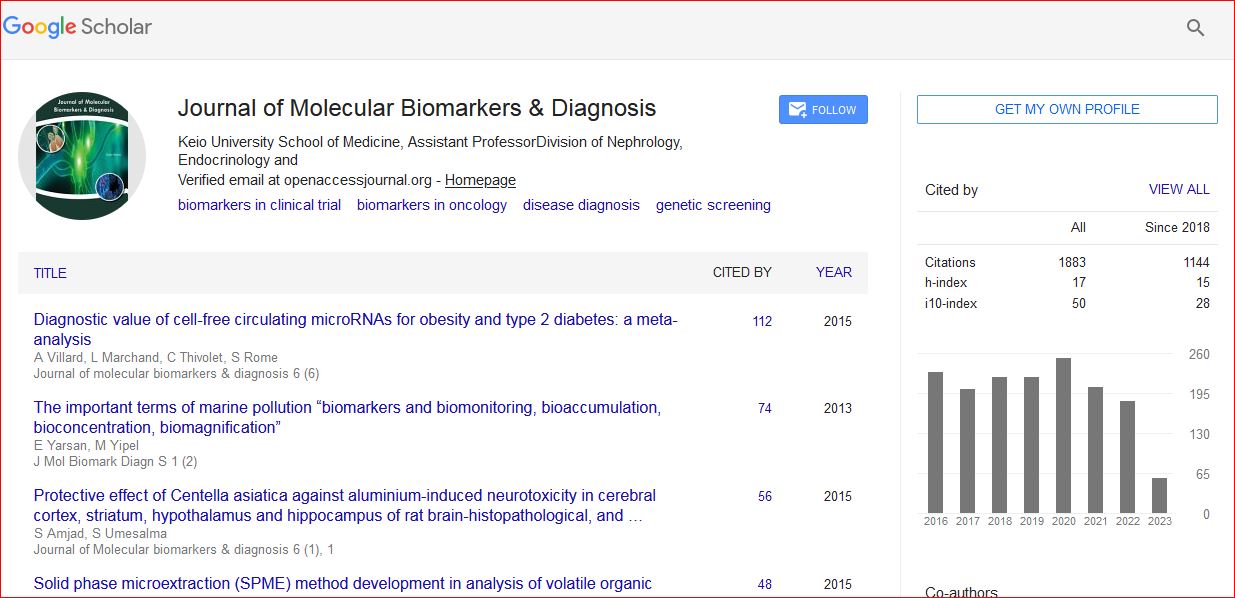
Journal of Molecular Biomarkers & Diagnosis received 2054 citations as per Google Scholar report