Short Communication - (2025) Volume 10, Issue 2
Received: 01-Apr-2025, Manuscript No. arwm-26-182709;
Editor assigned: 03-Apr-2025, Pre QC No. P-182709;
Reviewed: 17-Apr-2025, QC No. Q-182709;
Revised: 22-Apr-2025, Manuscript No. R-182709;
Published:
29-Apr-2025
Citation: Petrova, Elena. ”Life Cycle Assessment of Waste Management Environmental Impacts.” Advances in Recycling & Waste Management 10 (2025):399.
Copyright: © 2025 Petrova E. This is an open-access article distributed under the terms of the Creative Commons Attribution License, which permits unrestricted use, distribution and reproduction in any medium, provided the original author and source are credited.
The field of waste management is undergoing a significant transformation, driven by a growing understanding of its environmental implications and the imperative to transition towards more sustainable practices. Life Cycle Assessment (LCA) has emerged as a crucial tool for evaluating the environmental burdens associated with various waste management strategies. This methodology allows for a comprehensive analysis, considering impacts from raw material extraction through production, use, and end-of-life disposal or recovery. Recycling and waste treatment processes, in particular, are subject to intense scrutiny through LCA. Research highlights that the environmental footprint of these operations is not uniform; it is significantly influenced by localized factors such as the availability and efficiency of recycling infrastructure, as well as the specific composition of the waste materials being processed. This emphasizes the need for context-specific assessments and policy development [1].
Furthermore, the embodied energy and greenhouse gas emissions associated with different municipal solid waste management strategies are critical metrics for environmental performance. Studies have indicated that the effectiveness of recycling is intrinsically linked to the energy recovery achieved during treatment processes and, importantly, the avoided impacts associated with the production of virgin materials that recycling helps to supplant [2].
Advanced recycling technologies, such as chemical recycling for plastics, are also being evaluated using LCA. While these innovations promise to reduce dependence on fossil fuel-based virgin resources, their own energy demands and the potential for generating unintended emissions necessitate careful and thorough life cycle evaluations to ensure net environmental benefits [3].
Organic waste management presents another area where LCA provides valuable insights. The environmental performance of different composting methods, for instance, reveals that on-site composting often has lower environmental burdens compared to centralized facilities. This is primarily due to the reduction in transportation emissions, although localized environmental impacts must also be considered [4].
Energy recovery from waste through incineration with energy capture is another prominent waste management strategy assessed by LCA. While this approach reduces landfill volume and generates energy, its overall environmental benefits are highly dependent on the efficiency of the combustion process and the effectiveness of emission control technologies employed [5].
Specific waste streams, such as electronic waste (e-waste), pose unique challenges and opportunities. LCAs comparing landfilling with specialized recycling processes for e-waste demonstrate that the recovery of valuable materials can significantly offset the environmental burdens associated with the extraction of primary raw materials [6].
Anaerobic digestion for biogas production from organic waste, particularly food waste, is another area where LCA is instrumental. This technology offers potential for greenhouse gas mitigation and renewable energy generation, but its environmental viability is also influenced by challenges in digestate management and the energy consumed during the process itself [7].
The initial stages of the waste management hierarchy, namely collection and sorting, also have considerable environmental implications. LCAs of these systems highlight the critical role of efficient source separation and advanced sorting technologies in determining the overall environmental performance and economic feasibility of recycling programs [8].
Finally, even traditional waste management methods like landfilling are subjected to LCA to understand their impacts and potential mitigation strategies. While modern landfills with methane capture can reduce certain environmental issues, long-term impacts and resource depletion remain significant concerns when compared to circular economy principles [10].
The environmental impacts of recycling and waste treatment processes are comprehensively examined through Life Cycle Assessment (LCA), offering insights that inform policy and technological advancements. A key finding is the significant variability in environmental impacts, which is strongly correlated with local infrastructure conditions and the specific material composition of the waste streams. Consequently, a holistic approach considering the entire life cycle, from initial collection to final disposal or reuse, is paramount for effective environmental management [1].
Research into municipal solid waste management strategies has focused on quantifying embodied energy and greenhouse gas emissions. This analysis reveals that the environmental advantage of recycling is not absolute but is contingent upon the efficiency of energy recovery during treatment and, crucially, the environmental benefits derived from reducing the demand for virgin material production. The comparative LCA approach is essential for understanding these trade-offs [2].
For plastic waste, advanced recycling technologies such as chemical recycling are being rigorously assessed via LCA. While these methods hold promise for diverting plastics from landfills and reducing reliance on petrochemical feedstocks, their environmental footprint is still under scrutiny. The energy requirements and potential for generating unintended emissions necessitate careful consideration and further optimization to ensure their sustainability [3].
Investigating different composting methods for organic waste using LCA highlights the importance of logistical factors. On-site composting typically exhibits lower environmental burdens than centralized composting facilities, largely due to minimized transportation emissions. However, potential localized impacts must also be evaluated to provide a complete picture of the environmental performance [4].
The LCA of waste-to-energy incineration processes, particularly those involving energy capture, underscores the importance of technological sophistication. While incineration can effectively reduce landfill volume and produce energy, its environmental benefits are intrinsically tied to the efficiency of combustion and the implementation of robust emission control systems to mitigate air pollution [5].
When comparing waste management options for specific streams like e-waste, LCA reveals significant environmental trade-offs. Specialized recycling processes for e-waste can lead to substantial environmental benefits by recovering valuable materials, thereby offsetting the considerable environmental burdens associated with the mining and processing of virgin resources required for their production [6].
Anaerobic digestion, a biological treatment process for organic waste, is evaluated through LCA for its potential in biogas production. This technology offers the dual benefits of greenhouse gas mitigation and renewable energy generation. However, its overall environmental performance is influenced by challenges related to digestate management and the energy intensity of the process itself [7].
The foundational aspects of waste management, including collection and sorting systems, are critical determinants of overall environmental performance. LCAs in this domain emphasize that the effectiveness of source separation by residents and the technological sophistication of sorting facilities play a pivotal role in the environmental efficiency and economic viability of recycling operations [8].
Construction and demolition (C&D) waste treatment is another sector benefiting from LCA analysis. Studies comparing mechanical recycling with alternative disposal methods for C&D waste indicate that mechanical recycling can lead to significant reductions in embodied energy and a decrease in the demand for landfill space, contributing to more sustainable construction practices [9].
Even traditional landfilling practices are subject to LCA, focusing on mitigation strategies like methane capture and utilization. While modern landfills have improved their environmental performance, LCAs reveal that long-term environmental impacts and the continued depletion of finite resources remain considerable concerns when contrasted with the principles of a circular economy [10].
This collection of studies utilizes Life Cycle Assessment (LCA) to evaluate the environmental impacts of various waste management strategies. Research covers recycling and waste treatment processes, highlighting the influence of local infrastructure and material composition. Embodied energy and greenhouse gas emissions in municipal solid waste management are analyzed, emphasizing the role of energy recovery and avoided virgin material production. Advanced recycling technologies like chemical recycling for plastics show promise but require careful evaluation of energy demands and emissions. Organic waste composting and anaerobic digestion are assessed for their environmental benefits and challenges. E-waste recycling is compared to landfilling, showing significant material recovery advantages. Waste-to-energy incineration and construction and demolition waste recycling are also examined for their environmental performance. Finally, landfilling is assessed with mitigation strategies, noting its long-term impacts compared to circular economy approaches. Collection and sorting systems are identified as crucial for overall recycling efficiency.
None
None
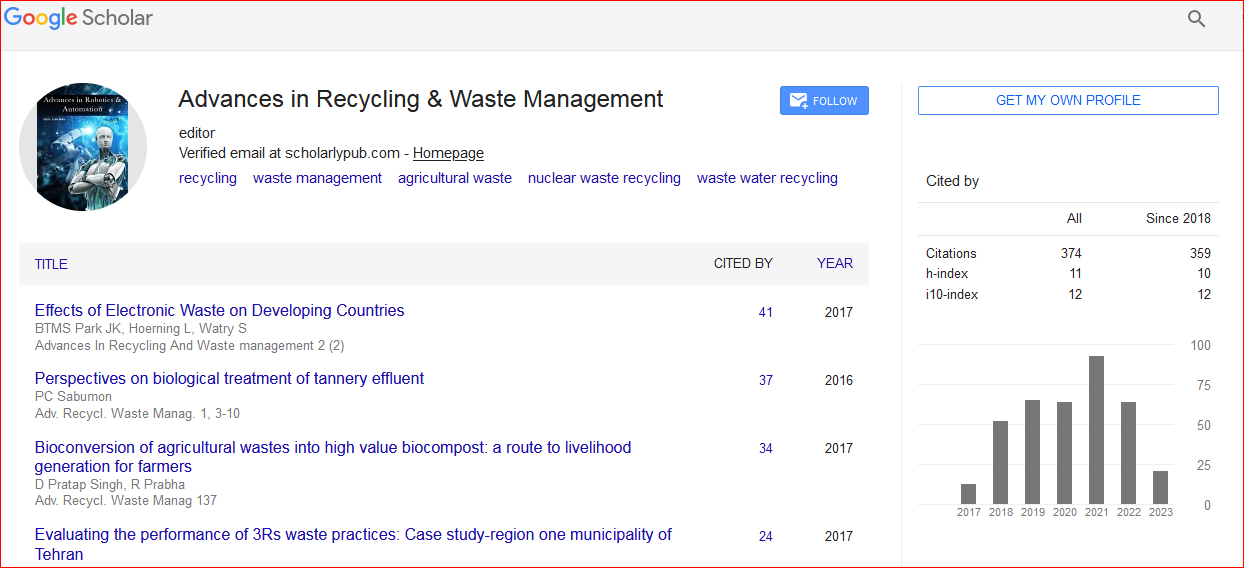
Advances in Recycling & Waste Management received 438 citations as per Google Scholar report