Opinion - (2025) Volume 11, Issue 5
Received: 01-Oct-2025, Manuscript No. JOV-26-186440;
Editor assigned: 03-Oct-2025, Pre QC No. P-186440;
Reviewed: 17-Oct-2025, QC No. Q-186440;
Revised: 23-Oct-2025, Manuscript No. R-186440;
Published:
29-Oct-2025
, DOI: 10.37421/2471-9544.2025.11.325
Citation: Zhao, Ming. ”Immune System Roles in Vasculitis: Mechanisms and Therapies.” J Vasc 11 (2025):325.
Copyright: © 2025 Zhao M. This is an open-access article distributed under the terms of the Creative Commons Attribution License, which permits unrestricted use, distribution and reproduction in any medium, provided the original author and source are credited.
The intricate relationship between the immune system and the vascular network is a cornerstone in understanding inflammatory diseases, particularly vasculitis. This complex interplay is characterized by immune cells navigating and interacting within the vasculature, driving inflammatory processes that define vascular pathologies. The endothelium, the single layer of cells lining blood vessels, emerges as a pivotal player in modulating these immune responses and maintaining vascular integrity, controlling the dynamic exchange between blood and tissue [1].
Understanding these 'threads of immunity' woven within the vascular net is crucial for the development of precise and effective targeted therapies for vasculitis. Immune cell trafficking within the bloodstream is a sophisticated process governed by adhesion molecules and chemical gradients. Research has explored how these fundamental mechanisms become dysregulated in vasculitis, leading to aberrant leukocyte infiltration and subsequent tissue damage. Elucidating the specific molecular pathways responsible for immune cell recruitment to inflamed vessel walls offers promising avenues for therapeutic intervention [2].
The complement system, a critical component of innate immunity, plays a significant role in the pathogenesis of small vessel vasculitis. Its activation contributes to endothelial cell activation and the recruitment of neutrophils, thereby fueling inflammation and causing microvascular injury. The exploration of current and emerging strategies for complement inhibition presents a substantial opportunity for treating these debilitating conditions [3].
In large vessel vasculitis, such as giant cell arteritis, T lymphocytes are implicated as key drivers of immunopathology. Investigations into specific T cell subsets and their associated cytokine profiles reveal their capacity to promote vascular inflammation and remodeling. Gaining insights into T cell-endothelial cell interactions forms a strong basis for designing targeted immunotherapies for these conditions [4].
The involvement of B cells and autoantibodies is prominent in ANCA-associated vasculitis. B cell activation triggers the production of autoantibodies that target neutrophil components, initiating a cascade of vasculitic damage. The efficacy of B cell depletion therapies in managing this disease is a subject of ongoing clinical interest and investigation [5].
The endothelium's responsiveness to immune stimuli is a critical determinant of vascular inflammation in vasculitis. Studies examine how cytokines and other inflammatory mediators can alter the endothelial cell phenotype, thereby promoting immune cell adhesion and their migration into tissues. This underscores the endothelium's active and multifaceted role in the inflammatory cascade of vasculitis [6].
Neutrophils are recognized for their significant contribution to both the initiation and perpetuation of vasculitis. Activated neutrophils release destructive enzymes and inflammatory mediators that directly damage blood vessel walls, contributing to the characteristic pathological lesions observed in vasculitis. Their multifaceted role in tissue damage is a key area of research [7].
The vascular microenvironment itself plays a substantial role in shaping immune responses within the context of vasculitis. Factors present within the blood vessel wall, including pericytes and vascular smooth muscle cells, engage in intricate interactions with immune cells, contributing to the overall inflammatory milieu that defines vasculitis [8].
Innate lymphoid cells (ILCs) are increasingly being recognized as important regulators of inflammation in a variety of diseases, including vasculitis. Research is exploring the specific roles of different ILC subsets in vascular inflammation, highlighting their potential to modulate adaptive immune responses and influence disease severity [9].
Histopathological examination of vasculitis provides crucial insights into the underlying immune processes occurring within the vascular wall. Correlating specific immune cell infiltrates and tissue damage patterns with distinct types of vasculitis establishes a foundational understanding for both diagnosis and prognosis, bridging the gap between cellular events and clinical presentation [10].
The endothelium serves as a central player in vasculitis pathogenesis, orchestrating the complex interactions between the immune system and the vascular network. It facilitates the passage of immune cells and modulates inflammatory responses, making its integrity and function critical to preventing or exacerbating vascular damage [1].
Understanding these intricate 'threads of immunity' within the vascular net is paramount for developing sophisticated targeted therapies that address the root causes of vasculitis. Immune cell trafficking within the vasculature is a tightly regulated process involving specific adhesion molecules and chemokine gradients. Dysregulation of these mechanisms in vasculitis leads to uncontrolled leukocyte infiltration and subsequent tissue destruction. Detailed exploration of these molecular pathways offers potential targets for therapeutic intervention aimed at controlling immune cell recruitment to inflamed vessels [2].
The complement system's activation is a key pathogenic mechanism in small vessel vasculitis, contributing to endothelial cell dysfunction and neutrophil recruitment. This cascade of events results in significant inflammation and microvascular injury. Consequently, strategies focused on inhibiting complement pathways represent a promising therapeutic avenue for managing these conditions [3].
In large vessel vasculitis, particularly giant cell arteritis, T lymphocytes play a critical role in driving vascular inflammation and remodeling. The study of specific T cell subsets and their cytokine production provides valuable insights into the immunopathology, forming a basis for developing targeted immunotherapies based on T cell-endothelial cell interactions [4].
B cells and the autoantibodies they produce are central to the pathogenesis of ANCA-associated vasculitis. Their activation leads to autoantibodies targeting neutrophil components, initiating inflammatory cascades and vasculitic damage. The effectiveness of B cell depletion therapies in managing this specific form of vasculitis is an area of significant clinical interest [5].
Endothelial cell activation in response to immune stimuli is a critical step in the development of vascular inflammation characteristic of vasculitis. Inflammatory mediators alter endothelial cell phenotypes, promoting immune cell adhesion and their transmigration into vessel walls, thereby highlighting the endothelium's active role in orchestrating these inflammatory processes [6].
Neutrophils are instrumental in both initiating and perpetuating vasculitis. Activated neutrophils release enzymes and inflammatory mediators that directly damage vessel walls, contributing to the hallmark histological features of vasculitis. Understanding their destructive mechanisms is crucial for therapeutic development [7].
The vascular microenvironment, including cellular components like pericytes and smooth muscle cells, significantly influences immune responses in vasculitis. These non-endothelial vascular cells interact with immune cells, contributing to and shaping the inflammatory milieu that drives vasculitis [8].
Innate lymphoid cells (ILCs) are emerging as significant regulators of vascular inflammation in vasculitis. Research is uncovering the roles of different ILC subsets in modulating immune responses and influencing disease severity, suggesting their potential as therapeutic targets [9].
Histopathological examination of vasculitic lesions offers a direct window into the underlying immune processes within the vascular wall. By correlating specific immune cell infiltrates and tissue damage patterns with different vasculitis types, a deeper understanding of their pathogenesis is achieved, aiding in diagnosis and prognosis [10].
This collection of research explores the multifaceted roles of the immune system in vasculitis, a group of inflammatory diseases affecting blood vessels. Key areas of focus include the endothelium's central role in immune cell trafficking and inflammation, the mechanisms of leukocyte recruitment, and the involvement of specific immune cells like T cells, B cells, neutrophils, and innate lymphoid cells. The complement system and autoantibodies are highlighted as crucial contributors to pathogenesis. Furthermore, the vascular microenvironment and the histopathological features of vasculitis are examined to provide a comprehensive understanding of disease mechanisms. The research collectively underscores the importance of these interconnected pathways for developing targeted therapies aimed at mitigating vascular damage and improving patient outcomes.
None
None
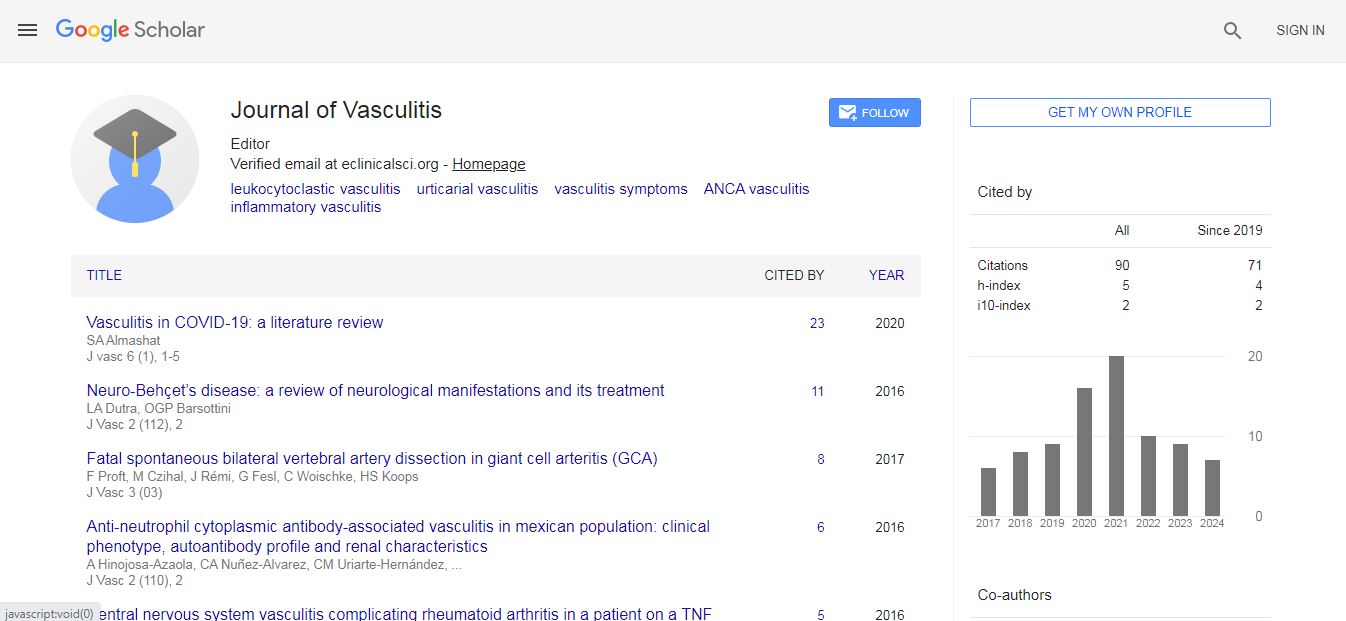
Journal of Vasculitis received 83 citations as per Google Scholar report